

Kent Coast Road Trip – White Cliffs, Castles & Cinque Ports
Historic Coastlines, Chalk Cliffs & One of England’s Most Varied Short Journeys
Kent’s coastline is more varied than its proximity to London might suggest — where cathedral cities give way to oyster harbours, chalk cliffs rise above sandy bays, and medieval ports meet wide, open skies.
This route links those contrasts into a single, coherent journey — not defined by one road, but by a sequence of places that naturally unfold along England’s south-east edge.
How the Journey Works
This route is best understood as three distinct but connected sections, each revealing a different side of Kent:
Canterbury & the Oyster Coast – Beginning inland before reaching the sea, this section combines cathedral city history with relaxed coastal life and working harbours.
Thanet Cliffs & Classic Seaside – The coastline curves around the Isle of Thanet, where sandy bays, chalk stacks and revitalised seaside towns define the landscape.
White Cliffs, Castles & Cinque Ports – The journey becomes more elemental, with defensive coastlines, historic ports and the dramatic rise of the White Cliffs above the Channel.
Practical Starting Point
Many travellers begin in Canterbury or Whitstable, but the route works equally well from any section depending on where you base yourself.

1. Canterbury & The Oyster Coast

2. Thanet Cliffs & Seaside Towns
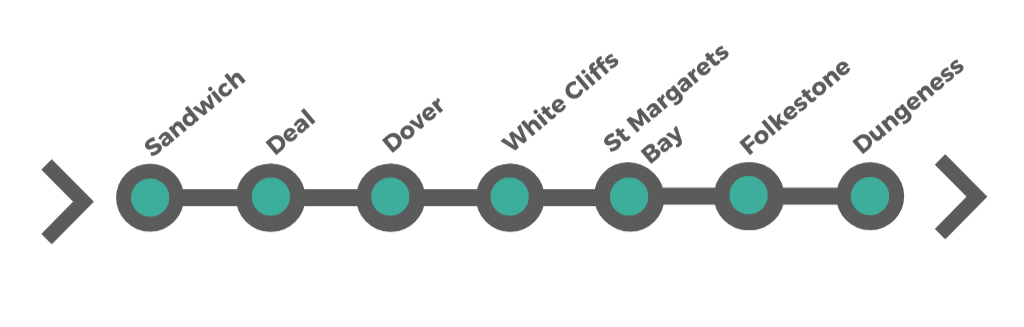
3. White Cliffs & Cinque Ports
How to Get There
This Kent coast road trip begins in Canterbury, one of England’s best-known cathedral cities and an excellent gateway into the southeast coast. Positioned close to London, Dover and the Channel crossings, Kent is one of the easiest regions in Britain to reach from both the UK and mainland Europe.
The route combines historic towns, castles, white cliff coastline, seaside resorts and countryside landscapes, with many travellers naturally combining Canterbury, Dover, Whitstable, Margate and the Kent Downs into a wider touring route.
Excellent road, rail and ferry connections make Kent particularly convenient for shorter UK breaks, self-drive holidays and first-time visitors arriving into southern England.
By Road
London (~1.5–2 hrs)
M2 or A2 directly to Canterbury (approx. 60 miles)
Southampton (~2.5–3 hrs)
M3 → M25 → M2
Birmingham (~3.5 hrs)
M40 → M25 → M2
Manchester (~4.5–5 hrs)
M6 → M1 → M20 or M2
Parking:
Park & Ride at Wincheap, New Dover Road and Sturry Road, plus central options including Whitefriars and Castle Street.
Dover, Folkestone and the Kent coast are all within relatively short driving distances once you reach Canterbury.
By Train
London St Pancras → Canterbury West (~50 mins)
High-speed Southeastern services.
London Victoria → Canterbury East (~90 mins)
Slower direct services through Kent.
From other UK cities
Usually via London with onward high-speed connections into Kent.
Ashford International also acts as a useful gateway station for wider Kent touring routes.
Search UK train tickets and fares: Search train tickets
Travelling longer distances around Britain? Compare: UK rail passes
Save up to 1/3 on UK rail travel with a Railcard .
By Coach & Bus
National Express , Megabus and FlixBus services connect Canterbury with London and regional cities.
London connections
Victoria Coach Station → Canterbury (~2–3 hrs)
Regional bus services
Stagecoach routes connect Canterbury with Dover, Whitstable, Margate, Ramsgate and Folkestone.
Save on longer coach journeys with National Express Coachcards .
Coach travel provides a lower-cost alternative to rail, though journeys are generally slower.
From Europe
Southern UK Arrivals
Le Shuttle
Vehicle crossings through the Channel Tunnel between Calais and Folkestone.
Vehicle crossings via Channel Tunnel
Eurostar
High-speed passenger rail connecting London with Paris, Brussels and Amsterdam.
Find lowest fares
DFDS Ferries
Dover–Calais, Dover–Dunkirk and Newhaven–Dieppe crossings.
Explore DFDS crossings
P&O Ferries
Dover to Calais crossings for southern UK arrivals.
P&O ferry routes
Dover, Folkestone and Ashford are all around 30 minutes from Canterbury by road or rail.
Northern England Arrivals
DFDS Ferries – Amsterdam to Newcastle
Useful for visitors touring Britain north-to-south before reaching Kent and the Channel coast.
Explore DFDS crossings
P&O Ferries – Rotterdam to Hull
Useful for longer England touring routes.
P&O ferry routes
•
Vehicle travel information
By Air – Best Airports
Gatwick and Heathrow provide the strongest international connections for Kent, while London City Airport works particularly well for shorter European routes and quick rail access into London.
London Gatwick
Usually the easiest overall airport for Kent coast routes.
Direct rail connections via Ashford International and Canterbury.
Around 1.5–2 hours overall journey time.
London Heathrow
Best overall airport for long-haul international arrivals.
Rail transfer via central London and St Pancras.
London City Airport
Particularly convenient for European city connections.
Quick access into London for high-speed rail services into Kent.
Vehicle Hire Options
Having your own vehicle gives the greatest flexibility for exploring Kent’s coastline, countryside villages, castles and scenic rural routes.




Uncover More — Hidden Histories, Coastal Paths & Curious Tales
Beyond cathedral towers and coastal highlights, Kent reveals a deeper layer of stories — shaped by invasion, defence, trade and time. This is a coastline where Roman frontiers, wartime strategy and centuries-old folklore all overlap.
From long-distance coastal paths to underground tunnels and windswept legends, these are the details that turn a journey into something far more immersive.
The Saxon Shore Way — Walking the Edge of Roman Britain
The Saxon Shore Way traces Kent’s historic coastline from Gravesend to Hastings, following the line of Roman defensive forts that once protected Britain’s south-east edge.
Today, it passes through marshes, estuaries, chalk cliffs and coastal towns — offering one of the most complete ways to experience the shifting landscapes of the Kent coast.
World War II Coastline
• Dover Castle Tunnels — Command centres and underground hospitals carved into the cliffs
• Ramsgate Tunnels — Vast air raid shelters protecting thousands during bombing raids
• RAF Manston — A key Battle of Britain airfield on the edge of the coast
• Battle of Britain Memorial — A clifftop tribute overlooking the Channel
• Dungeness Sound Mirrors — Early-warning structures from the dawn of aerial defence
Kent’s coastline formed the frontline of Britain’s defence. From radar experiments to evacuation routes and fortified cliffs, these landscapes still carry the imprint of wartime strategy.
Folklore, Myths & Legends
• The Drummer Boy of Dover Castle — A ghostly figure said to wander the tunnels, with distant drumming echoing through the castle’s underground passages.
• The Devil’s Jumps — Prehistoric burial mounds tied to a legend of the devil leaping across the landscape, scattering earth as he travelled.
• St Eanswythe of Folkestone — A 7th-century princess believed to have performed miracles, drawing pilgrims to the Kent coast for centuries.
These stories bring a different dimension to the Kent coast — where history blends with myth, and familiar places carry echoes of something older and less easily explained.
Kent Coast Last updated: 10 April 2026
Some links may earn Uncover Britain a small commission at no extra cost to you. This helps support the ongoing creation, review and presentation of our road trip guides.
Route information and listings are provided for general guidance only. Always use your preferred navigation system and check official websites to confirm suitability, opening times and the latest details before travelling.
Our guides are reviewed regularly and supported by a mix of editorial research and digital tools to help keep content clear and up to date. If you spot anything that needs updating, we’re always glad to hear from you.