


Thanet Cliffs, Viking Bay & Botany Bay
Heading east, the coastline becomes more open and more expressive. The Isle of Thanet feels distinct — a sweep of sandy bays, chalk stacks and clifftop paths that catch wide Channel light. Margate introduces contemporary energy and art-led revival, while Broadstairs centres around the curved sands of Viking Bay, one of the county’s most recognisable beaches.
Beyond the towns, the cliffs assert themselves. Botany Bay and Kingsgate Bay offer exposed chalk formations and coastal walking with uninterrupted views across the sea. Ramsgate’s Royal Harbour then completes the arc with Georgian facades and maritime heritage.
This section captures Kent’s seaside evolution — from Victorian resort to creative renewal — framed by dramatic coastal geology.
How to Spend Your Time — Thanet Cliffs, Viking Bay & Botany Bay
This section marks a clear shift in mood — from estuary calm to chalk cliffs, sandy bays and lively seaside towns. Beginning in Margate, the route moves through exposed coastal landscapes to Ramsgate, passing some of Kent’s most distinctive coastal scenery along the way.
Distances are short, but this is a section to slow down — walking between bays, exploring towns and letting the coastline set the pace.
Half Day
Clifftop Highlights
- Start in Margate
- Drive to Botany Bay
- Explore chalk stacks and coastal views
- Continue to Broadstairs
- Beach walk at Viking Bay
1 Day
Cliffs & Seaside Towns
- Morning in Margate
- Turner Contemporary & Old Town
- Walk between Botany Bay and Kingsgate Bay
- Lunch in Broadstairs
- Finish in Ramsgate
2 Days
Slow Coastal Exploration
- Day 1: Margate & Broadstairs
- Day 2: Chalk bays → Ramsgate
- Walk sections of the Thanet Coastal Path
- More time for beaches and harbour life
Days Out
Experiences
- Galleries and Old Town in Margate
- Clifftop walking at Botany Bay
- Beach time at Viking Bay
- Harbour exploring in Ramsgate
Scenic Drive
Clifftop Route
- Margate → Botany Bay → Kingsgate Bay → Broadstairs → Ramsgate
- Approx 1 hr 10 driving
- Best with stops: 3–5 hours
Planning Tip
Let It Breathe
- Short distances — don’t rush
- Best experienced on foot between bays
- Time Botany Bay for low tide
- Evenings are best in Ramsgate
A lively and visually striking stretch of coast — where chalk cliffs, sandy bays and characterful seaside towns create one of Kent’s most distinctive and memorable sections.
Margate - Creative Seaside Revival & Turner’s Coastal Light
Margate sits at the meeting point of heritage seaside tradition and contemporary cultural renewal. Once a classic Victorian resort, it has re-emerged in recent years as one of the most distinctive coastal towns in the southeast — where wide sandy bays, open skies and historic architecture now sit alongside galleries, studios and independent cafés.
The town’s identity is closely tied to light. J.M.W. Turner was drawn here repeatedly, inspired by the expansive horizon and shifting coastal atmosphere that continues to define Margate today. That same quality of light now frames the town’s revival, with the Turner Contemporary anchoring a growing creative scene centred around the Old Town.
Beyond the galleries, Margate retains its traditional character. Dreamland’s retro amusement park, the broad sands of Margate Main Sands and the lively seafront all reflect its enduring role as a seaside destination, while quieter streets reveal independent shops, restored buildings and evolving cultural spaces.
As a starting point for this section of the coast, Margate introduces a more expressive, energetic tone — where heritage meets reinvention, and where the coastline begins to open into the bays and cliffs of Thanet.
Things to See and Do in Margate
Margate is one of England’s classic seaside towns, reimagined as a lively cultural and creative hub. It blends sandy beaches and traditional seaside fun with world-class contemporary art, historic streets, underground curiosities, and a thriving independent scene.
Beaches, Seafront & Harbour
Margate Beach is one of the finest sandy beaches in Kent, stretching along the town’s seafront and perfect for swimming, sunbathing, paddling, and classic bucket-and-spade days. The promenade is ideal for a gentle stroll with wide sea views.
At the heart of the seafront, Margate Harbour Arm is a lively pier-like walkway lined with cafés, bars, and small shops. It’s a great place for a drink or meal overlooking the harbour, and for watching boats coming and going from the nearby marina.
Art, Culture & Creative Margate
The town’s cultural revival is centred on Turner Contemporary, a striking seafront gallery that hosts a constantly changing programme of exhibitions by leading UK and international artists. Even if you’re not visiting an exhibition, the building itself and the sea views from inside are worth the stop.
Nearby, Margate’s Old Town is a maze of historic streets filled with independent shops, galleries, cafés, antique stores, and small creative businesses. It’s the best place to soak up the town’s bohemian, slightly retro atmosphere and do some interesting browsing.
Classic Seaside Fun & Family Attractions
No visit to Margate is complete without Dreamland, the town’s famous vintage amusement park. Dating back to the 19th century, it combines beautifully restored historic rides with modern attractions, live music events, and old-school seaside charm.
For something more unusual, step into the mysterious Shell Grotto, a chamber decorated with intricate mosaics made entirely from seashells. Its origins are still unknown, making it one of Margate’s most intriguing and unique sights.
History, Museums & Hidden Margate
Learn about the town’s story at Margate Museum, where exhibits explore its Victorian heyday as a major seaside resort, its maritime history, and its connections to artists such as J.M.W. Turner.
Railway enthusiasts and families will enjoy The WonderWorks by Hornby Hobbies, home to impressive model railway layouts, historic Hornby collections, and interactive displays.
Beneath the surface of the town lies another hidden world: Margate Caves, a network of chalk tunnels and chambers. Guided tours explore their strange history, legends, and geological features (covered in more detail above in your caves section).
Events, Festivals & Live Culture
Margate has one of the liveliest cultural calendars on the Kent coast, with regular live music, exhibitions, markets, and seasonal events. Highlights include the Margate Bookie Literary Festival and the Margate Soul Festival, alongside many smaller arts and community events throughout the year.
Margate Caves – Secrets Beneath the Surface
Step away from the sandy beaches and bustling promenades and descend into the hidden underground world of the Margate Caves — a network of mysterious chalk-carved tunnels and chambers steeped in local legend and layered history.
Originally dug in the 18th century as part of a private well for a grand villa, the caves were later expanded and opened to the public in the 1860s, quickly becoming one of Margate’s most curious attractions. After decades of closure, they were carefully restored and reopened in 2019, now offering a modern visitor experience with a strong sense of discovery.
Inside, you’ll find hand-dug passages, wall carvings and colourful murals, some dating back centuries. The caves have served many roles over time — from smugglers’ hideouts and air raid shelters to Victorian tourist curiosity — blending geological features with human history.
Guided tours reveal stories of hidden priests, local myths and wartime use, while the visitor centre adds context through exhibitions, a café and community-led projects. It’s a quieter, more unexpected side of Margate that contrasts with the coastline above.
-
Margate is a compact and easy-to-navigate seaside town, centred around the beach, Old Town and seafront. Most key areas — including Turner Contemporary, Dreamland and the harbour — are within walking distance of each other, making it straightforward to explore on foot once you arrive.
The town has a lively, creative atmosphere, especially around the Old Town, where galleries, independent shops and cafés cluster together. The main sands sit directly in front of the town centre, giving Margate a strong sense of openness and connection to the sea.
Orientation
Main Sands & Seafront – the focal point, with wide sandy beach and classic seaside feel
Old Town – just behind the seafront, home to galleries, shops and cafés
Turner Contemporary – on the harbour edge, linking culture and coastline
Dreamland – slightly to the west, adding retro seaside character
Everything connects easily on foot, with short distances between stops.
Best Time to Visit
Early morning or late afternoon – quieter, softer light, easier parking
Weekdays outside school holidays – best for a relaxed visit
Summer weekends – lively and energetic, but can be busy
Evenings – particularly good for seafront walks, sunset and dining
Margate works in most weather, but its full character comes through on bright, open days when the coastal light is at its best.
Getting Around
The town is best explored on foot once parked
Coastal walks link Margate with Botany Bay and Broadstairs
Train connections are strong, with direct services from London
Parking in Margate
Margate has a mix of pay-and-display car parks, on-street parking, and a few free short-stay options. During holidays and weekends, arriving early is the easiest way to secure a space close to the beach or Old Town.
Central Car Parks (Beach, Turner Contemporary & Old Town)
College Square Car Park (CT9 1QA)
Large and central, ideal for the beach and Old Town
Pay-and-display, close to shops and cafésDreamland Car Park (CT9 1XJ)
Best for Dreamland and the western seafront
Large open-air car parkTrinity Square Car Park (CT9 1QB)
Smaller but convenient for Old Town galleries and restaurants
On-Street Parking
Limited along the seafront and around the Old Town (mostly paid)
Some residential streets further back offer free parking
Always check signage carefully for restrictions and permit zones
Disabled Parking
Blue Badge spaces are available in all council car parks
Additional bays are located near the seafront and Turner Contemporary
Practical Tip
If central car parks are full, it’s often quicker to park slightly further out and walk in — distances are short, and this avoids congestion around the harbour and beach areas.
Nearby
The Powell-Cotton Museum in Birchington-on-Sea was founded in 1896 by Major Percy Horace Gordon Powell-Cotton, a British explorer, hunter and conservationist. His travels across Africa and Asia led to the creation of a remarkable collection of artefacts, natural history specimens and ethnographic displays, many of which remain arranged in immersive, diorama-style galleries.
The Spitfire and Hurricane Memorial Museum, located in Manston, focuses on two of Britain’s most iconic World War II aircraft. Set on the former RAF Manston airfield — a key base during the Battle of Britain — the museum presents restored aircraft, engines, uniforms and archival material, telling the story of the Spitfire, Hurricane and the pilots who defended British airspace.
Thanet Coastal Path – Clifftop Walking Between Margate, Broadstairs & Ramsgate
The Thanet Coastal Path links Margate, Broadstairs and Ramsgate in one continuous shoreline route, following chalk cliffs, sandy bays and historic promenades around the Isle of Thanet.
This is one of the most rewarding and accessible coastal walks in south-east England — combining constant sea views with regular places to stop, explore and experience the changing character of the coast on foot.
Overview
- Full route: 19 miles (31 km) – Reculver to Pegwell Bay
- Popular section: Margate → Ramsgate
- Distance: 6–7 miles (10–11 km)
- Flat to gently undulating terrain
- Mix of promenades, clifftop paths and beach sections
What Makes It Special
- Continuous sea views along chalk cliffs
- Access to Botany Bay’s iconic chalk stacks
- Connects three distinct seaside towns
- Flexible — walk part or all of the route
- Best experienced slowly on foot
Practical Info
- Time needed: 3–4 hours with stops
- Best on clear days with light wind
- Check tide times for Botany Bay
- Wear comfortable walking shoes
- Regular cafés, toilets and shops en route
How to Walk It
- Start in Margate (Main Sands or Turner Contemporary)
- Climb gently onto the cliffs
- Walk through Botany Bay and Kingsgate Bay
- Stop in Broadstairs (Viking Bay)
- Finish at Ramsgate Royal Harbour
Flexible Options
- Walk one way, return by train
- Break into shorter sections
- Focus on Botany Bay and clifftop paths
- Combine with town visits along the route
Highlights
- Margate seafront and Turner Contemporary
- Botany Bay chalk stacks (best at low tide)
- Kingsgate Bay’s quieter setting
- Broadstairs and Viking Bay
- Ramsgate Royal Harbour
From Margate to Botany Bay
Leaving Margate, the tone shifts quickly from art-led seafront to open coastline. The promenade narrows, houses begin to thin out, and the land rises gently onto exposed chalk cliffs. The sea feels closer here — wider, brighter and less framed by buildings.
Within just a few miles, the atmosphere moves from lively resort to sculpted shoreline. The route tracks south along the Isle of Thanet, revealing one of the most visually striking stretches of coast in Kent.
Botany Bay marks the first dramatic break in the cliff line — a natural amphitheatre of white chalk, shaped by wind and tide into distinctive stacks and formations.
Botany Bay - Chalk Stacks, Wide Horizons & Thanet’s Most Dramatic Shoreline
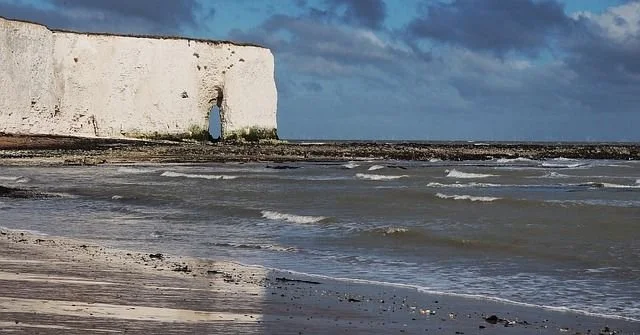
Botany Bay is one of the defining landscapes of the Thanet coast. Tall white chalk stacks rise from the sand, separated from the main cliffs by centuries of erosion. At low tide, the beach opens wide, revealing rock pools and textured chalk platforms; at high tide, the stacks stand isolated against the sea.
The setting feels more elemental than neighbouring towns. There are no arcades or harbour walls — just chalk, sky and shifting light. Early morning and late afternoon are particularly striking, when the cliffs take on softer tones and the coastline feels quieter.
Iconic chalk sea stacks and cliff formations
Expansive sandy beach at low tide
Panoramic views along the Thanet cliffs
What to See & Do
Walk along the cliff-top section of the Thanet Coastal Path (see above) for elevated views across the bay before descending to the beach. At low tide, explore the base of the chalk stacks and the rock pools that appear along the shoreline.
Continue south on foot towards Kingsgate Bay for a longer coastal walk, or return north along the cliffs for views back towards Margate.
Botany Bay is also a strong photography location — especially when the tide is retreating and the chalk stacks cast long shadows across the sand.
-
Location: Eastern edge of Broadstairs, Isle of Thanet
Parking:
Botany Bay car park (Cliff Promenade) – limited spaces
Additional on-street parking in nearby residential areas (check restrictions)
Parking can fill quickly in summer and on sunny weekends.
Access:
Steps from the cliff-top down to the beach
Cliff-top path suitable for most walkers
Beach access may be limited at high tide
Facilities:
Seasonal café and toilets near the clifftop
No extensive facilities directly on the beach
Best Time to Visit:
Low tide for beach exploration
Early morning or late afternoon for softer light and fewer visitors
Botany Bay works best as a slower stop between Margate and Broadstairs — a place to pause, walk and absorb the scale of the Thanet cliffs before continuing south.
Kingsgate Bay - Sheltered Cove Beneath Chalk Cliffs & Castle Views
Kingsgate Bay sits immediately south of Botany Bay, separated by a short stretch of cliff-top path that takes just 5–10 minutes to walk along the Thanet Coastal Path. While Botany Bay is known for its sea stacks, Kingsgate feels slightly more enclosed and intimate — a sandy cove framed by tall white cliffs and overlooked by the striking silhouette of Kingsgate Castle above.
The atmosphere here is quieter and more contained. At low tide, the beach opens wide with rock pools and chalk ledges exposed; at higher tide, the bay feels compact and sheltered beneath the cliffs. The castle above adds a distinctive landmark presence that sets it apart from neighbouring coves.
Sheltered sandy cove with chalk cliff backdrop
Views up to Kingsgate Castle above the bay
Easy coastal walk connection to Botany Bay
What to See & Do
Descend from the clifftop path to explore the sandy shoreline and rock pools at low tide. The chalk cliffs create a dramatic backdrop, especially when the light catches their white surface.
Look up towards Kingsgate Castle — a private residence today but an unmistakable feature of the skyline. From the cliff-top path above the bay, you’ll gain elevated views south towards Broadstairs and north back towards Botany Bay.
Kingsgate Bay works well as a quieter alternative to Botany Bay if the latter feels busy, or as a natural continuation of a longer coastal walk between Margate and Broadstairs.
-
Location: Between Botany Bay and Broadstairs, Isle of Thanet
Parking:
Limited roadside parking along Kingsgate Avenue (check restrictions carefully)
Additional parking available at Botany Bay car park (5–10 minute walk along the clifftop)
Access:
Steps lead down from the cliff-top path to the beach
Access may be restricted at high tide
Facilities:
No major facilities directly on the beach
Nearest cafés and toilets in Broadstairs or near Botany Bay
Best Time to Visit:
Low tide for maximum beach access
Clear days for strong contrast between chalk cliffs and sea
Kingsgate Bay offers a slightly calmer, more tucked-away coastal experience — close to Botany Bay, but with its own distinct sense of enclosure and perspective.
From Kingsgate Bay to Broadstairs
Leaving Kingsgate Bay, the coastline begins to soften. The cliffs remain, but the shoreline curves more gently, and the path gradually descends towards a more defined seaside setting. The Thanet Coastal Path continues south, revealing glimpses of sandy crescent beaches and ordered terraces ahead.
Where Botany Bay and Kingsgate feel shaped primarily by geology, Broadstairs introduces a more human scale. Gardens appear along the clifftops, houses draw closer to the shore, and the atmosphere shifts from exposed coastline to classic seaside town.
As you approach Viking Bay, the curve of sand comes into view beneath the promenade — a sheltered arc framed by white cliffs and Georgian façades. The mood changes from raw chalk formations to nostalgic seaside charm.
Broadstairs marks the point where dramatic coastline transitions into one of Kent’s most recognisable and traditionally appealing bays.
Broadstairs & Viking Bay - Classic Crescent Sands & Dickensian Seaside Charm

-
Broadstairs is one of the most compact and easily explored towns on the Thanet coast, centred around Viking Bay and the harbour. Most key areas — including the beach, promenade, cafés and town centre — sit within a short walking distance, making it ideal for a slower, more relaxed visit.
The town has a distinctly traditional seaside feel, with Georgian and Victorian architecture, curved sandy bays and a clear sense of place. Viking Bay forms the focal point, with its sheltered sands framed by cliffs, harbour walls and promenade.
Orientation
Viking Bay – the main beach, sheltered and gently curved
Harbour & Promenade – central access point with cafés and views
Town Centre – just above the bay, with shops, restaurants and galleries
Clifftop Paths – linking north towards Kingsgate and south towards Ramsgate
Everything is closely connected, with short walks between each area.
Best Time to Visit
Early morning or late afternoon – quieter and easier for parking
Weekdays outside peak season – more relaxed atmosphere
Summer weekends – lively and busy, especially around Viking Bay
Low tide – best for beach walks and exploring the full extent of the bay
Broadstairs works well in most conditions, but the bay is at its best on clear days when the light and colour of the water are most visible.
Getting Around
Best explored on foot once parked
Coastal paths link directly to Botany Bay and Ramsgate
Train station sits just inland, with direct services to London
Parking in Broadstairs
Broadstairs has a mix of car parks and limited on-street options. During summer and on sunny weekends, arriving early is recommended if you want to park close to the beach.
Town Centre & Beach Parking
Albion Street Car Park (CT10 1NE)
Closest to Viking Bay, Dickens House Museum and the town centre
Medium-sized, pay-and-displayBroadstairs Harbour Car Park (CT10 1NB)
Small and very scenic, positioned above Viking Bay
Limited spaces — best for short visits or early arrivalsSt Peter’s Park Road Car Park (CT10 2TR)
Around a 5–10 minute walk from the seafront
Typically easier to find space and often less busy
On-Street & Free Parking
Some free on-street parking is available further back from the beach
(e.g. Dumpton Park Drive or Vicarage Street)Always check signage for time limits and permit restrictions
Disabled Parking
Blue Badge bays are available in all main car parks
Additional spaces are located near the harbour and seafront
Practical Tip
If central car parks are full, it’s often quicker to park slightly outside the centre and walk in. Distances are short, and this avoids congestion around Viking Bay during busy periods.
-
Half-Day Idea: Dickensian Charm & Coastal Calm
Perfect for a morning or afternoon visit
Start at Viking Bay, Broadstairs’ main sandy beach—ideal for a stroll along the promenade or a paddle in the sea.
Visit the Dickens House Museum, where the author spent many holidays, and explore rooms filled with original artefacts and Victorian charm.
Wander the quaint streets of the Old Town, browsing independent bookshops, ice cream parlours, and galleries.
Finish with a treat from Morelli’s Gelato, a Broadstairs institution since 1932, or a cup of tea with sea views.
Full-Day Idea: Beaches, Literature & Cliff-Top Walks
Morning:
Enjoy a relaxed breakfast or brunch at a seaside café like The Pavillion or Bessie's Tea Parlour.
Take your time exploring Viking Bay, then head to the Dickens House Museum to learn how Broadstairs inspired David Copperfield.
Afternoon:
Walk along the coast path to Botany Bay or Kingsgate Bay—both offer dramatic chalk cliffs and quiet coves (check tide times!).
Alternatively, visit Bleak House (formerly Fort House), perched above the cliffs where Dickens once stayed and wrote.
Evening:
Enjoy fresh seafood or pub classics at Wyatt & Jones, The Tartar Frigate, or The Charles Dickens Pub.
If you’re staying late, take in the golden light at Louisa Bay or catch a summer event at the Bandstand.
-
Broadstairs sits almost at the centre of the Thanet peninsula, making it an ideal starting point for coastal walking in either direction.
North from Broadstairs (towards Kingsgate Bay & Botany Bay)
Distance to Botany Bay: approx. 1.5–2 miles (2.5–3 km)
Time: 30–45 minutes one wayThis section climbs gently onto the clifftop and delivers some of the most dramatic views on the Isle of Thanet. You’ll pass Stone Bay before reaching Kingsgate Bay and then Botany Bay’s chalk stacks.
Best for:
Open clifftop scenery
Photography
A half-day coastal walk
This is the more exposed and scenic direction.
South from Broadstairs (towards Ramsgate)
Distance to Ramsgate Harbour: approx. 2 miles (3 km)
Time: 35–45 minutes one wayThe path undulates gently above the sea, eventually descending into Ramsgate’s Royal Harbour. This walk feels more settled and architectural, with strong views across the marina as you approach.
Best for:
Linking two towns on foot
Finishing with lunch or coffee in Ramsgate
Walking one way and returning by train
This direction feels more town-connected and less rugged than the northern stretch.
Practical Tip for Visitors
Broadstairs works well as a walk-out-and-back base:
Walk north in the morning, return for lunch.
Or walk south to Ramsgate and return by train (stations in both towns).
Because Broadstairs has strong facilities and easy parking, it’s one of the most practical starting points for exploring the Thanet Coastal Path without committing to the full 6–7 mile stretch in one go.
Broadstairs centres around Viking Bay — a sweeping crescent of golden sand framed by white cliffs and colourful beach huts. More compact and traditional in feel than Margate, the town retains a classic seaside character, with clifftop gardens, independent cafés and a strong literary connection to Charles Dickens.
Viking Bay is the focal point. Sheltered and south-facing, it has long been one of Kent’s most popular sandy beaches, offering a safe bathing area, historic harbour arm and an easy promenade above the shore. Beyond the main bay, smaller coves and cliff-top paths extend in both directions, making Broadstairs feel intimate but varied.
Curved sandy beach with sheltered swimming area
Cliff-top gardens and harbour views
Strong Victorian and Dickens-era seaside character
What to See & Do
Spend time on Viking Bay itself — walk the harbour arm for views back across the sand, or climb the steps to the promenade for elevated perspectives over the curve of the beach.
Wander through the town centre’s compact streets for independent shops, cafés and traditional ice cream parlours. The Dickens House Museum reflects the town’s literary heritage, while clifftop paths north and south offer easy coastal walking links. Bleak House is a historic building overlooking Viking Bay that inspired Dickens' novel "Bleak House." The house is now a hotel and restaurant, but visitors can still admire its distinctive architecture. Experience the annual Dickens Festival, held in June, which brings the streets of Broadstairs to life with costumed characters, parades, and theatrical performances inspired by Dickens' novels.
For a quieter moment, explore nearby Louisa Bay or Stone Bay, both within walking distance and typically less busy than Viking Bay.
Broadstairs works well as a relaxed lunch stop or half-day pause within the Thanet section, balancing beach time with gentle town exploration.
From Broadstairs to Ramsgate
Leaving the curve of Viking Bay, the coastline turns south and the character begins to shift once more. The sandy crescent gives way to longer stretches of clifftop path, where the Thanet Coastal Path rises and falls gently above the sea. The atmosphere becomes quieter and more open again, with fewer beach huts and more uninterrupted views across the Channel.
As you walk or drive onwards, the land begins to settle into a broader sweep. The approach to Ramsgate feels gradual — the cliffs soften, rooftops appear ahead, and masts begin to rise into view above the harbour.
Where Broadstairs feels compact and nostalgic, Ramsgate introduces scale. The descent into the Royal Harbour brings Georgian façades, curved terraces and a distinctly maritime presence. Fishing boats and yachts replace sandy bays as the focal point, and the mood shifts from seaside charm to harbour town heritage.
Ramsgate marks the southern arc of the Thanet peninsula — the point where beach culture gives way to naval history and open Channel horizons before the journey continues towards Sandwich and the Cinque Ports.
Ramsgate - Royal Harbour, Maritime History & Open Channel Horizons
Ramsgate sits at the southern edge of the Isle of Thanet, where sandy bays give way to one of the most distinctive harbours in Britain. Its Royal Harbour — the only one in the UK granted royal status — forms the heart of the town, framed by Georgian terraces and lined with yachts, fishing boats and harbourfront cafés.
Compared with Broadstairs’ intimate crescent beach, Ramsgate feels broader and more maritime. The town’s seafront curves around the marina, while the cliffs above hold grand Regency buildings and sweeping Channel views. Beneath the surface, Ramsgate also carries a deeper wartime story, with an extensive network of World War II tunnels running below the streets.
Britain’s only Royal Harbour
Elegant Regency architecture along the seafront
Strong maritime and wartime heritage
What to See & Do
Walk around Ramsgate's Royal Harbour to take in the curved marina, historic harbour walls and views out towards the open sea. The lower harbour area is ideal for a relaxed lunch stop, especially in good weather. Choose from a variety of excursions, including sightseeing tours, seal-watching trips, and fishing expeditions, and enjoy panoramic views of the coastline from the water.
Relax and unwind on Ramsgate Main Sands, a beautiful sandy beach that stretches along the seafront. Ideal for families and sun-seekers, the beach offers opportunities for swimming, sunbathing, and building sandcastles, with facilities including lifeguard services and beachside amenities.
Explore the Ramsgate Tunnels, which offer guided tours through the underground air-raid shelters used during World War II. For elevated views, climb the steps to the clifftop promenade, where the architecture and sea horizon combine for classic coastal panoramas.
Continue along the seafront towards Pegwell Bay for a quieter shoreline walk, or simply enjoy the harbour atmosphere before continuing south towards Sandwich and the Cinque Ports.
Discover Ramsgate's maritime history at the Ramsgate Maritime Museum, housed in the historic Clock House building overlooking the harbour. Explore exhibits on the town's fishing heritage, maritime trade, and lifeboat services, and learn about famous figures such as the pioneering lifeboatman Coxswain Henry Williams.
Admire the stunning architecture of St. Augustine's Church, designed by the renowned Victorian architect Augustus Pugin. Marvel at the church's Gothic Revival features, including its ornate interior decorations and stained glass windows, and learn about Pugin's contributions to British architecture. Visit The Grange, Augustus Pugin’s gothic masterpiece, built for his family home.
-
Half-Day Idea: Royal Harbour & Creative Quarter
Perfect for a relaxed morning or afternoon
Start with a stroll around the Royal Harbour, the only one in the UK with a royal designation. Admire the yachts, colourful boats, and historic buildings.
Visit the Ramsgate Maritime Museum to uncover stories of smuggling, shipwrecks, and naval heroics.
Walk up to Addington Street, a creative hub of galleries, vintage shops, and independent cafés.
Enjoy coffee, brunch, or a light lunch at The Falstaff, Archive, or one of the marina’s waterside cafés.
If time allows, walk part of the Ramsgate to Broadstairs clifftop path for sea views.
Full-Day Idea: Architecture, History & Coastal Walks
Morning:
Begin with a visit to The Grange, Augustus Pugin’s gothic masterpiece, tucked above the cliffs (pre-booking often required).
Walk the West Cliff Promenade for sweeping sea views and quiet contemplation.
Explore Ramsgate Tunnels, a fascinating WWII air-raid shelter system under the town.
Afternoon:
Head down to the Royal Harbour, browse the shops at the Arches, and take in the lively marina atmosphere.
Visit the Sailors’ Church and Smack Boys Home, poignant reminders of the town’s seafaring past.
Enjoy a seafood lunch by the harbour or dine at Vinyl Head, The Empire Room, or Flavours by Kumar for something unique.
Evening (optional):
Stay for a drink at a harbour-view bar or walk to Pegwell Bay for a quiet sunset spot with wildlife-rich coastal views.
-
Location: Southern end of the Isle of Thanet
Parking:
Royal Harbour car park (close to marina and harbourfront)
Leopold Street car park
West Cliff car park
On-street parking available (check local restrictions)
Parking is generally easier here than in Broadstairs during peak season, though harbour-front spaces can fill quickly on sunny weekends.
Access:
Harbour and lower promenade are mostly flat
Steep slopes and steps connect the harbour to the upper town
Facilities:
Public toilets near the harbour
Wide range of cafés, restaurants and pubs
Shops and convenience stores in the town centre
Best Time to Visit:
Late afternoon for softer harbour light
Clear days for open Channel views
Ramsgate closes the Thanet section with scale and maritime presence — a fitting transition point before the journey continues towards Sandwich, the Cinque Ports and the White Cliffs.
End of Chapter Summary – Thanet Cliffs, Viking Bay & Botany Bay
This section of the journey has been shaped by light, cliffs and classic seaside rhythm. From Margate’s creative revival to the chalk stacks of Botany Bay, the sheltered sands of Viking Bay and the harbour curve of Ramsgate, the Isle of Thanet reveals a coastline that is compact but varied.
The distances are short, yet the atmospheres shift noticeably. Margate feels expressive and contemporary. Botany Bay is elemental and sculpted by erosion. Broadstairs centres around nostalgic seaside charm. Ramsgate introduces maritime scale and Regency architecture.
Walking the Thanet Coastal Path ties these places together — a continuous thread of cliff, bay and sea horizon. It is a chapter defined by openness, photography, beach time and coastal perspective.
From here, the character of the Kent coast changes again.
Next Chapter – "White Cliffs, Castles & the Cinque Ports"
Beyond Ramsgate, the shoreline turns south and begins to carry more weight. Medieval Sandwich and Deal reflect maritime defence and Cinque Ports alliances. Tudor artillery forts stand directly on the seafront, before the land rises sharply at Dover, where the White Cliffs and Dover Castle dominate both skyline and national imagination.
This final section shifts the tone from seaside leisure to strategic frontier. Beaches narrow, cliffs rise higher, and history becomes more concentrated. From royal fortresses to the stark shingle of Dungeness, the coast becomes both symbolic and elemental.
The journey moves from bays and promenades to battlements and big horizons — the closing arc of the Kent Coast Road Trip.
Kent Coast Last updated: 30 April 2026
Some links may earn Uncover Britain a small commission at no extra cost to you. This helps support the ongoing creation, review and presentation of our road trip guides.
Route information and listings are provided for general guidance only. Always use your preferred navigation system and check official websites to confirm suitability, opening times and the latest details before travelling.
Our guides are reviewed regularly and supported by a mix of editorial research and digital tools to help keep content clear and up to date. If you spot anything that needs updating, we’re always glad to hear from you.