

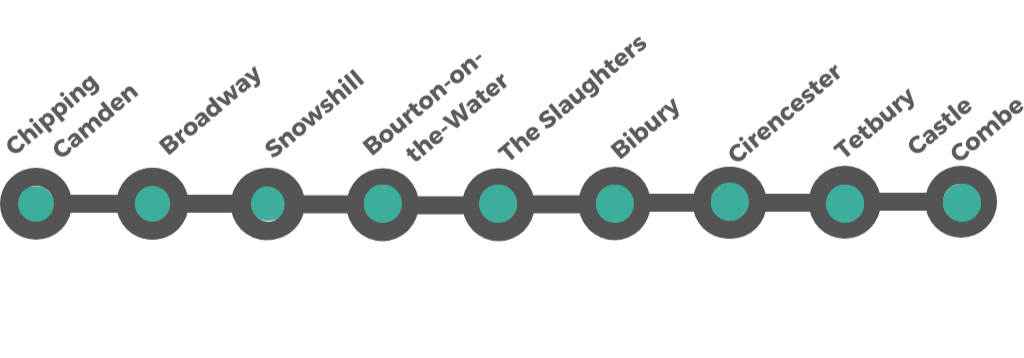
 Chipping Campden
Broadway
Snowshill
Bourton-on-the-Water
The Slaughters
Bibury
Cirencester
Tetbury
Castle Combe
Chipping Campden
Broadway
Snowshill
Bourton-on-the-Water
The Slaughters
Bibury
Cirencester
Tetbury
Castle Combe
Grand North–South spine (68 miles / 109 km, 2 hours and 20 minutes’ drive time)
Chipping Campden > Broadway > Snowshill > Bourton-on-the-Water > The Slaughters > Bibury > Cirencester > Tetbury > Castle Combe
Chipping Campden

Explore Chipping Campden with its wonderful High Street in the heart of this vibrant market town. The streets are lined with medieval buildings of golden stone aged between 200 and 500 years old.
Learn more about the Arts and Crafts movement with a visit to Court Barn Museum, a museum of Craft and Design from 1902. On Silk Street, the Gallery at the Guild is a cooperative of artists and craftspeople exhibiting their work in the historic Guild of Handicrafts. Climb the old stairs to step back in time at Harts Silversmiths, a Guild of Handicrafts since 1888, specialising in the best traditions of hand-made silver.
Depending on how you look at it, Chipping Campden is the start or even the finish of the Cotswold Way, with over 100 miles of bridleway to/from Bath.
There are several events throughout the year, including Chipping Campden Open Gardens, Chipping Campden Literature Festival, and Chipping Campden Music Festival.
Image copyright: Staycotswold.com
A Half Day in Chipping Campden
Start in the town centre
Begin with a stroll around the High Street and Market Place. Visit the Market Hall, built in 1627, which is one of the town’s most recognisable landmarks and a reminder of Chipping Campden’s wool-trading past. Browse the independent shops, delicatessens, and galleries that give the town its lively but traditional character.
Explore Arts & Crafts heritage
Head to the Court Barn Museum to learn about the Arts and Crafts movement that flourished here in the early 20th century, led by figures such as C.R. Ashbee. It’s a compact but fascinating museum and adds real cultural depth to a visit.
Lunch in a classic Cotswolds town
Choose from one of the many pubs, tearooms, or cafés in the town centre for lunch. Chipping Campden is especially good for traditional pubs and cosy tearooms.
Finish with a short countryside walk
In the afternoon, take a gentle walk along the start of the Cotswold Way towards Dover’s Hill. Even a short section gives you lovely views over the surrounding countryside and a real sense of the landscape that makes this area special.
Alternatively, take a short drive to Hidcote Manor Garden or Kiftsgate Court Gardens, both just outside town, for one of the finest garden visits in the Cotswolds.
-
Walkers can enjoy a walk from Chipping Campden that stretches approximately 2.7 miles up to Dover’s Hill and across the fields to Campden Tunnel, here.
-
Enjoy an unforgettable experience at the famous Pudding Club at the Three Ways House Hotel, Mickleton. An evening starts with an introduction by The Pudding Master, a light main followed by the Parade of Seven Traditional Puddings!
-
To experience traditional cream teas in traditional a Cotswold building try the 18th-century honey-coloured stone The Kings Hotel, which offers a variety of cream and afternoon teas.
-
Park at Market Square (GL55 6AW) with 30 spaces and restricted to 2 hours between 07:00-19:00 and no height restrictions. The National Trust's Dover's Hill (GL55 6UW) with 30 spaces - is free for 2 hours with no height restrictions.
Broadway

Broadway is often described as the gateway to the Cotswolds and is a near-perfect example of a classic Cotswold village, with its wide, elegant high street, honey-coloured stone buildings, and independent shops.
Take time to browse the boutiques and gift shops — it’s one of the best places in the Cotswolds for relaxed shopping. Hamiltons Chocolates in Cotswolds Court is a must for handmade treats and gifts (if you can resist eating them), while Little Soap Companyis ideal for locally made toiletries and small souvenirs. The Ashmolean Broadway Shop near the Broadway Museum, offers a curated selection of art, books, and gifts, perfect for culture lovers.
For culture and history, start at the Broadway Tourist Information Centre, next to the Gordon Russell Museum, which showcases the work of one of Britain’s most important Arts & Crafts furniture designers. Nearby, the Broadway Museum and Art Gallery, housed in a Tudor building, displays local artefacts from the Keil family collection in partnership with the Ashmolean Museum in Oxford.
History lovers should also pop into The Lygon Arms Hotel, where Oliver Cromwell stayed the night before the Battle of Worcester, and where King Charles I had earlier gathered his Royalist supporters — making this one of the most historically significant buildings in the village.
If you’re visiting at the right time of year, look out for seasonal and pop-up markets along the High Street, often featuring local crafts, food, and produce.
Just outside the village, Broadway Golf Club offers not only a scenic round of golf but also some of the finest views in the northern Cotswolds — even non-golfers often visit for the panorama.
Art lovers can visit Haynes Fine Art Gallery, one of the UK’s largest privately owned galleries, showcasing an impressive collection of 19th- and 20th-century British and European paintings.
For something a little different, enjoy a nostalgic journey on the Gloucestershire Warwickshirre Railway. From Broadway Station, you can take a steam train to Cheltenham Racecourse and back — a wonderful half-day experience and a memorable way to see the countryside.
Broadway works perfectly as a half-day or full-day stop, combining shopping, culture, history, scenery, and great places to eat in one very walkable village.
A Perfect Half Day in Broadway
Broadway is ideal for a relaxed half-day stop on a Cotswolds road trip, combining village charm, culture, shopping, and countryside views.
Start with coffee and the High Street
Begin by strolling along Broadway’s wide, elegant High Street and browsing the independent shops. Pop into Hamilton’s Chocolates for handmade treats and The Little Soap Company for gifts and local produce. This is one of the nicest places in the Cotswolds for unhurried shopping and people-watching.
Discover Broadway’s museums and history
Head to the Gordon Russell Museum to explore the legacy of the Arts & Crafts movement, then continue to the Broadway Museum & Art Gallery in its Tudor building. Take a quick look inside The Lygon Arms Hotel, where both Charles I and Oliver Cromwell once stayed — a small but fascinating slice of English history.
Lunch in the village
Choose one of Broadway’s many cafés or traditional pubs for lunch — there are plenty of good options along the High Street and around the village green.
Finish with views or steam
If the weather is good, take a short drive or taxi up to Broadway Tower for panoramic views across the Cotswolds and, on clear days, as far as Wales.
Alternatively, head to Broadway Station and enjoy a short steam train journey on the Gloucestershire Warwickshire Railway towards Cheltenham and back for a classic Cotswolds experience.
This plan gives you a relaxed, varied half-day in Broadway without rushing — perfect to combine with nearby villages or a drive through the northern Cotswolds.
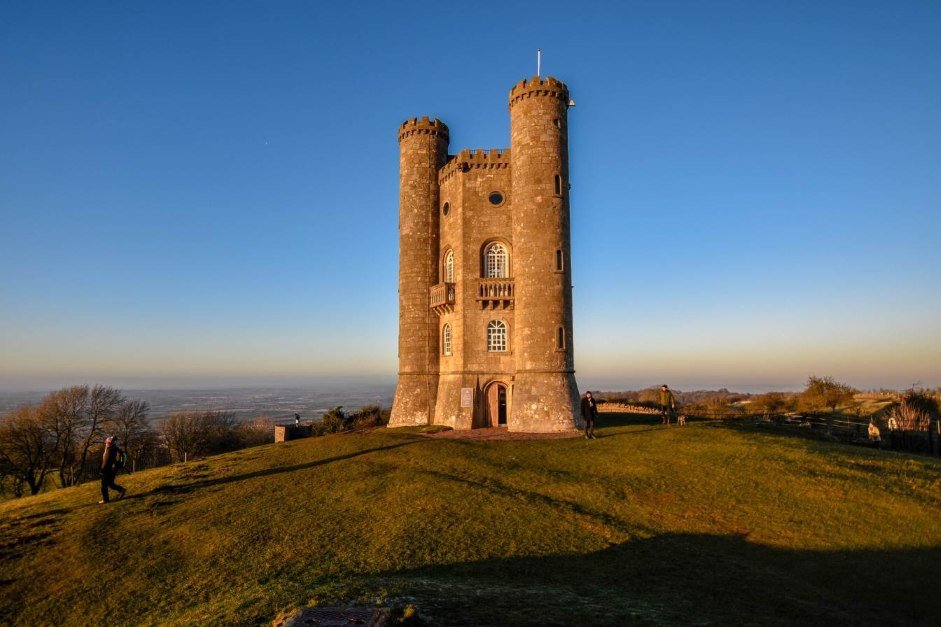
Broadway Tower
The Broadway Tower folly (pictured), designed by 'Capability' Brown, is nestled on 50 acres. Enjoy the Tower Museum with roof platform, Deer Park, and Morris and Brown Café. Spectacular Severn Vale views.
Located just a short drive from Broadway, Snowshill Manor and Garden is a charming manor filled with an eccentric collection of artefacts amassed by Charles Paget Wade. The gardens are equally enchanting and worth exploring.
-
The Cotswold Way Circular Walk Broadway and the Tower leads you from the high street, along historic towpaths and up to the Broadway Tower with its scenic views across the Severn Vale.
-
The Broadway overlooks the village green and offers the choice of a casual bite or fine dining. Dine with a historic backdrop at The Lygon Arms Hotel for afternoon tea or Grill and Cocktail Bar. For a light lunch stop, the Market Pantry is found on the High Street. Russell's Fish and Chips is listed in The Times' top 100 places to eat in UK! Broadway Deli is great for light bites and picnics.
-
The following have no height restrictions: High Street (WR12 7AH), 156 spaces and Milestone Ground (WR12 7HA), 108 spaces. Shear House (WR12 7ET) has 73 spaces and a height restriction of 2.44m
-
Broadway Christmas Market: The village comes alive during the festive season with charming market stalls, twinkling lights, and a magical atmosphere.
Open Garden Events: Check local schedules, as many private gardens around Broadway open to the public for charity during certain times of the year.
Visit Cotswold Lavender – Just Minutes from Broadway
Just a 10-minute drive from the heart of Broadway, the rolling purple fields of Cotswold Lavender offer a spectacular sensory experience during the summer bloom. Set high on the Cotswold hills near Snowshill, this family-run farm bursts into colour from late June through early August, when over 40 varieties of lavender bloom across the landscape.
Visitors can stroll through the vibrant fields, take in sweeping views across the Vale of Evesham, and learn about how lavender is harvested and distilled for essential oils. The on-site shop sells beautifully packaged products made from the farm’s own crop — from oils and soaps to lavender-infused treats — and there’s a charming tearoom with homemade cakes and light refreshments.
Cotswold Lavender is typically open daily from late June to early August, but dates vary slightly each year depending on the bloom, so be sure to check before visiting.
Snowshill – Hilltop Views, Quiet Lanes & One of the Cotswolds’ Hidden Gems
Snowshill is a small, elevated village tucked between Broadway and the wider Cotswolds countryside, offering a quieter and more secluded feel than many of the region’s better-known spots. With its honey-coloured cottages, narrow lanes and sweeping views, it captures the essence of the Cotswolds without the crowds.
It’s also a natural turning point on the route — a place where the landscape opens out and where you can either continue south or branch off to explore the surrounding villages and countryside.
A peaceful, less-visited alternative to nearby Broadway
Elevated views across the surrounding Cotswolds landscape
A gateway to one of the most scenic village loops in the region
What to See & Do
Snowshill Village – A small cluster of traditional stone cottages, quiet lanes and classic Cotswolds charm
Snowshill Manor & Garden – A unique National Trust property filled with an eclectic collection and surrounded by beautifully designed gardens
Countryside Walks – Rolling hills and footpaths offering panoramic views across the Vale of Evesham
Nearby Lavender Fields (seasonal) – Cotswold Lavender, just outside the village, blooms in summer with striking purple landscapes
Scenic Drives – One of the most picturesque stretches of road linking Broadway, Snowshill and the surrounding villages
Practical Information for Visiting
Snowshill is located just a short drive from Broadway and is easily accessed by car, though the narrow lanes require slow and careful driving.
Parking is limited within the village, with additional parking available near Snowshill Manor. The area is best explored on foot once you arrive, with short walks leading to viewpoints and nearby attractions.
Facilities are limited within the village itself, so it’s best combined with nearby stops such as Broadway or Bourton-on-the-Water.
Snowshill works particularly well as a starting point for the North Cotswolds Villages Loop, offering a quieter introduction before exploring some of the region’s more well-known destinations.
Bourton-on-the-Water
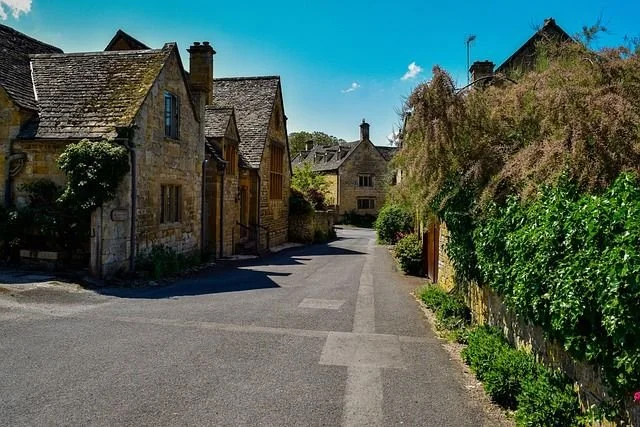
Bourton-on-the-Water is a charming village, known as the "Venice of the Cotswolds" due to its picturesque setting along the River Windrush and its low stone bridges spanning the water. The arched stone bridges create a picturesque scene reminiscent of a fairy tale. The most iconic of these bridges is the historic Packhorse Bridge, dating back to the 14th century.
Bourton-on-the-Water is renowned for its idyllic setting amidst the rolling hills and limestone buildings characteristic of the Cotswolds. The tranquil River Windrush runs through the village, flanked by lush greenery and weeping willows.
With a great variety of shops, tea rooms, and cafés to stop at, Bourton-on-the-Water is possibly one of the most famous Cotswolds villages. There are several attractions to visit, such as Bourton Model Railway Exhibition with some of the finest operating indoor model railway layouts in the country. There is also the Model Village – a one-ninth-scale replica of the heart of Bourton-on-the-Water, and the Cotswolds Motor Museum and Toy Collection. The Dragonfly Maze is a classic maze and puzzle featuring 14 hidden clues and a dragonfly in its centre. Set over nine acres, Birdland & Jurassic Journey has over 50 aviaries and more than 500 birds, plus their Jurassic ancestors to discover.
If you're looking to shop or enjoy a browse, head to the Cotswolds Perfumery where world-renowned perfumes have been created for over 50 years. Have a go with a one-day course. Bourton-on-the-Water Farmers & Producers Market is held on the 4th Sunday of every month.
Hawkstone Brewery is based just outside Bourton-on-the-Water on the lane toward Lower Slaughter. Hawkstone runs brewery tours, a shop selling bottles and branded merchandise, and The Hawkstone Arms on-site. The bar is open daily for tastings or a pint of Hawkstone lager or cider; check the brewery site for tour times and seasonal events.
Other Clarkson enterprises in the Cotswolds include: Diddly Squat Farm Shop — located just outside Chipping Norton, and The Farmer’s Dog pub, by Asthall Barrow near Burford. Further details and booking links are available on each operator’s website and in the related sections of this guide.
-
Take a walk around the nature reserve at Greystones Farm. Gloucestershire Wildlife Trust carefully manages the land to ensure that wildflowers thrive and support a stunning range of wildlife and wildflowers.
-
Explore Gloucestershire Wildlife Trust's Salmonsbury Camp which is a Scheduled Ancient Monument; an extraordinary historic site combining an Iron Age fort and town, a nature reserve and a Site of Special Scientific Interest.
-
For a Cotswold tearoom experience, pay a visit to Smiths Kitchen. The Bakery on the Water is ideal for those with a sweet tooth looking for a treat. The Old Prison, formerly the Northleach House of Correction with police station and petty sessional court, offers a great menu in interesting surroundings and is situated on the A429, near Northleach.
-
Parking in Bourton-on-the-Water is very limited. Try Bourton Vale Car & Coach (GL54 2EP), 284 spaces, which has no height restrictions.
The Slaughters
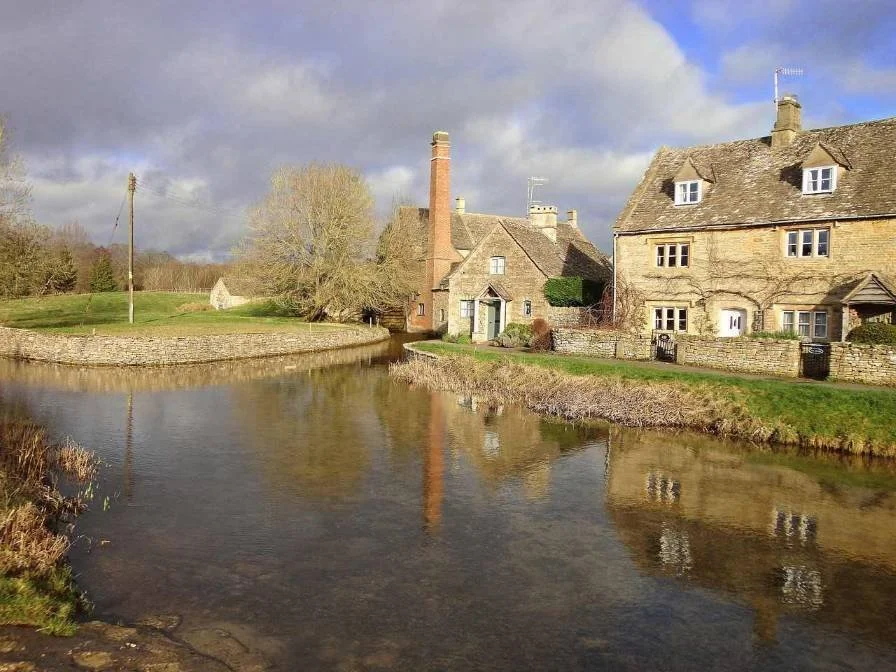
The twin villages of Upper and Lower Slaughters are around a mile from Bourton on the Water. They are small villages and parking may be difficult so you could consider walking the circular 3-mile route from Bourton on the Water. Find the route details here. Parking is limited as there are no designated parking spaces - therefore we suggest walking and making a day of it.
The names for the villages have always sparked discussion but did not arise from killing – as in ‘slaughtering' but from the old English word 'Sclostre', which means 'muddy place'.
Straddling the banks of the River Eye, which is a tributary of the River Windrush, the two villages have remained largely unchanged since 1906 making them picture-perfect villages.
The main attraction, apart from enjoying the ambience and a stroll of course, is to admire the view of the Old Mill in Lower Slaughter, which is a museum with an award-winning gift and craft shop, plus riverside tea rooms. Step back in time and be guided through the history of breadmaking and learn how a corn mill works. The pretty church of St. Mary is found at Lower Slaughter with an impressive spire.
Upper Slaughter is connected by the river and is located one mile away from Lower Slaughter. The Manor dates back to 1649 as a much smaller house – and The Slaughter family purchased the Manor from Henry VIII. Read more on the history here. It is now a hotel.
The cottages around the square were reconstructed in 1906, by the architect Sir Edward Lutyens.
Upper Slaughter is a 'sainted village' meaning that it lost nobody in World War I. It is also a 'Double Thankful Village' as they had no fatalities in World War II.
Once the village was dominated by a Norman castle but all that can be seen of it today are the remains of the motte and bailey.
-
Walking between the villages is about 1 mile each way with details here and includes information on the Warden's Way walk which runs along the River Eye.
-
You may have timed your visit to coincide with the National Open Garden Scheme and be able to visit Eyford House, named the nation’s favourite house by Country Life (2011). Poet John Milton stayed and was said to have inspired Paradise Lost.
-
For a treat, all food lovers should experience dining at Lords of the Manor at Upper Slaughter – the Afternoon Tea has an extensive loose-leaf tea selection.
-
Warning! Extremely limited. Consider parking at Bourton-on-the-Water and make the 3.5-mile round walk part of your day.
Bibury
-
From Cirencester (Approx. 7 miles):
By Car: A 15-minute drive via the B4425.
By Bus: The Pulhams Coaches 855 bus runs between Cirencester and Bibury. Check local timetables for exact times.
From Bourton-on-the-Water (Approx. 12 miles):
By Car: A 20-minute drive via the A429 and B4425.
By Bus: Take a bus to Cirencester and connect to the 855 service to Bibury.
From Burford (Approx. 9 miles):
By Car: A 15-minute drive via the A40 and B4425.
By Bus: Take the 853 bus to Cirencester and connect with the 855 bus to Bibury.
From Stow-on-the-Wold (Approx. 15 miles):
By Car: A 25-minute drive via the A429 and B4425.
By Bus: Travel to Cirencester and then take the 855 bus to Bibury.
-
From London (Approx. 85 miles):
By Car: A 2-hour drive via the M4 to Swindon and then the A419 to Cirencester, continuing on the B4425.
By Train: Take a direct train from London Paddington to Kemble (approximately 1 hour 15 minutes) and then a taxi or bus to Bibury.
From Oxford (Approx. 30 miles):
By Car: A 45-minute drive via the A40 and B4425.
By Train: Take a train to Kemble or Swindon and continue by taxi or bus.
By Bus: Take the Stagecoach S2 bus to Witney and connect to Cirencester, then take the 855 bus to Bibury.
From Cheltenham (Approx. 25 miles):
By Car: A 40-minute drive via the A40 and B4425.
By Train: Take a train to Kemble or Swindon and continue by taxi or bus.
By Bus: Travel to Cirencester and connect with the 855 bus.
-
Kemble (Approx. 13 miles): Direct services from London Paddington, Swindon, and Cheltenham.
Swindon (Approx. 20 miles): A major station with services from London Paddington, Bristol, and the South West.
-
Cirencester: The main bus hub for the area, with connections to Bibury via the Pulhams Coaches 855 service.
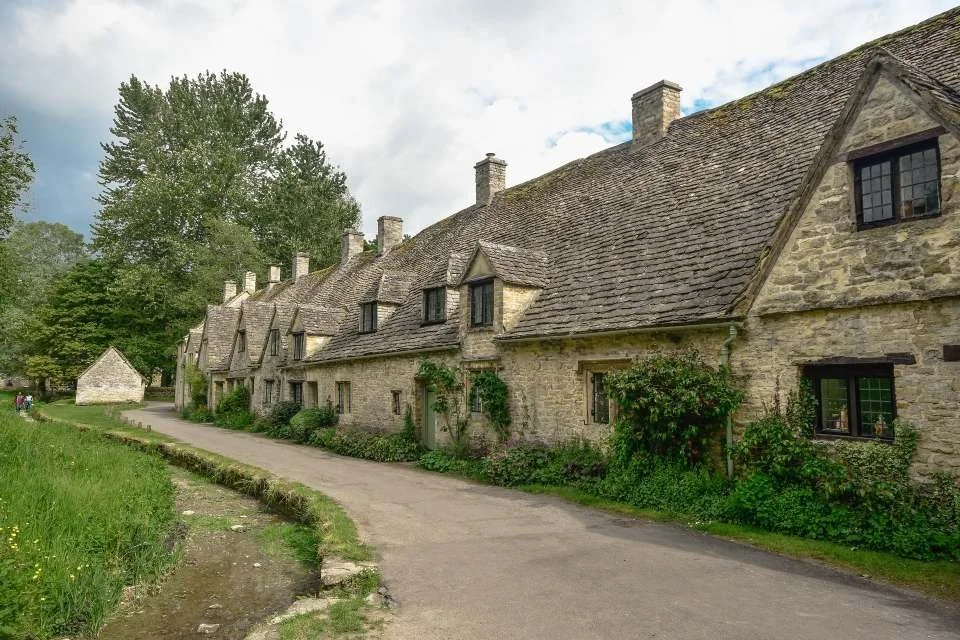
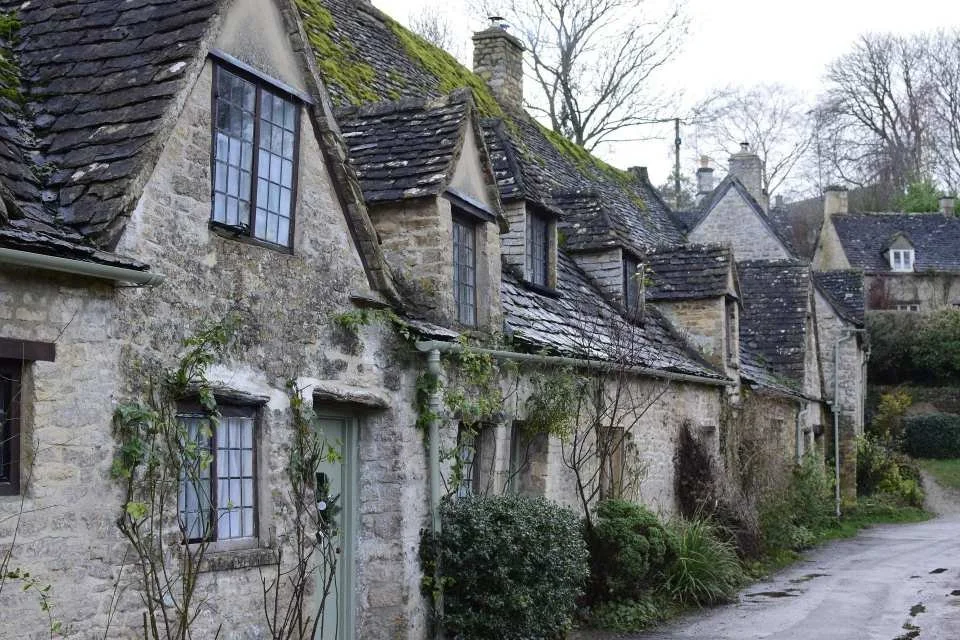
Bibury, often described by William Morris (1834-96) as "the most beautiful village in England", is a quintessential Cotswolds gem located on the banks of the River Coln. Its idyllic charm draws visitors year-round, and its timeless beauty is best explored on foot.
Arlington Row (pictured) is a must-visit. This iconic row of 17th-century weavers' cottages is one of the most photographed spots in the country. Now cared for by the National Trust, it’s a stunning example of traditional Cotswold architecture.
Bibury Trout Farm, established in 1902, this working farm offers visitors the chance to learn about trout farming and even catch their own fish. There’s a lovely gift shop and café on-site for refreshments.
The beautiful Saxon St. Mary's Church features impressive stained-glass windows and provides a peaceful retreat.
Stroll along the riverbanks of the Coln to take in the tranquil scenery and perhaps spot swans and other wildlife.
Although Bibury Mill is privately owned, this historic site adds to the village's charm and can be admired from the surrounding area.
Best Time to Visit: Early mornings or late afternoons are quieter and perfect for capturing the beauty of Arlington Row without large crowds. Spring and summer bring blooming flowers, while winter offers a magical, quieter atmosphere.
Depending on when you visit, events include Bibury Village Open Gardens Day and Bibury Duck Races.
Bibury’s timeless appeal makes it a perfect day trip or a stop on a Cotswolds itinerary, offering an authentic glimpse into England's rural past.
-
This 3.5-mile circular walk from Bibury takes in honey-coloured buildings and dry-stone walls, green hillsides and country pubs. Start at St. Mary's Church.
-
The Swan offers a delightful spot for lunch, afternoon tea, or a relaxed drink. Nearby cafés also serve local delicacies.
-
A public car park is available near the Trout Farm, and some limited street parking can be found, but spaces fill up quickly during peak times.
Cirencester
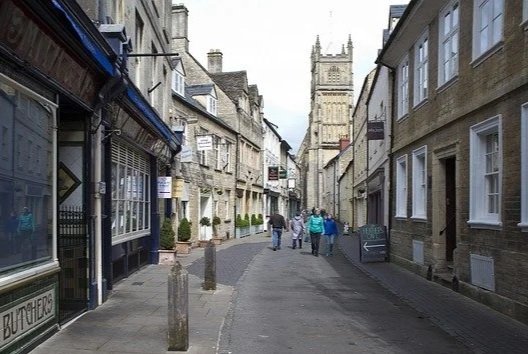
Cirencester is known for its connection to the Romans and it’s interesting Riman sites to visit. However, make time to visit the market town of Cirencester itself with its fabulous mix of shops, arts and crafts to browse. Visit the New Brewery Arts Centre to see artisan craft makers in their studios. For gifts, visit Octavia’s Bookshop, a previous Independent Bookseller of the Year, and the m.a.d.e Gallery. Check out what's on at the award-winning Barn Theatre with a cinema, theatre, and events. Cirencester's Charter Market is held in the Market Place on Monday and Friday each week. At the Abbey Home Farm, Shop & Café you can enjoy the 100% organic café, browse the shop, go for a woodland walk, discover the farm trail, and even camping too!
On a good day, climb the tower of St. John the Baptist Church, located in the beautiful market square, for panoramic views over the town. It's a Grade I celebrated 'wool' church. Cirencester Lock Up is a two-cell lock-up found in the car park of Cotswold District Council offices. Built in 1804, it includes displays of social history and architectural conservation.
Stroll around Cirencester Park in the Bathurst Estate and enjoy one of the routes around the park if you have time to meander. Nearby Rodmarton Manor is an Arts and Crafts designed home where the furniture is in keeping.
If you're a water lover, the Open Air Pool, built in 1869, is a great way to cool down in the summer and the Cotswold Water Park is a stone's throw away, which offers lots of ways to enjoy the water.
Poulton Hill Estate is a small family-run vineyard, with tours and tastings in the cellar. The relaxed tour will take you through the history of grape growing.
-
Follow the Whereat Trail from the Corinium Museum to Cirencester’s Roman Amphitheatre.
-
The Fleece Inn is a traditional coaching inn, dating from 1651, that serves traditional meals. King Charles II hid from Cromwell’s troops in the building.
-
The Abbey Grounds (GL7 2DA), has 97 spaces, Waterloo parking (GL7 2PY), has 233 spaces, and Forum parking (GL7 1LJ), has 191 spaces are Pay & Display with no height restrictions.
-
Cirencester was once one of the most important places in Roman Britain. Roman Cirencester, known as Corinium Dobunnorum during Roman times, was one of the most significant Roman settlements in Britain. Corinium was the second-largest town in Roman Britain, after Londinium (London), and served as a major administrative, economic, and cultural centre. It was strategically located near the intersection of several important Roman roads, including the Fosse Way, which connected Exeter in the southwest to Lincoln in the northeast.
The layout of Roman Cirencester followed a typical Roman town plan, with a gridiron street layout centred around a forum or market square. Excavations have revealed the remains of public buildings, houses, shops, and workshops, providing insights into daily life in Roman Britain. Corinium boasted several impressive public buildings, including a basilica (a public building used for administrative and judicial purposes), a forum (market square), and public baths. The remains of these buildings can still be seen today at the Cirencester Roman Amphitheatre and the Corinium Museum.
The economy of Corinium was based on agriculture, industry, and trade. The town was surrounded by fertile agricultural land, and its proximity to the River Thames facilitated trade and commerce. Corinium was known for its pottery production, and locally made pottery has been found at archaeological sites throughout Roman Britain.
-
Begin with a walk around the English Heritage's Amphitheatre. Located just outside the town centre, the Cirencester Roman Amphitheatre is one of the largest Roman amphitheatres in Britain. It was used for entertainment, including gladiatorial contests and public spectacles, and could accommodate up to 8,000 spectators. The massive earthwork remains of one of the largest Roman amphitheatres in Britain.
The Corinium Museum's principal collection consists of highly significant finds from the Roman town of Corinium and exhibits Roman mosaics, including the famous Hare, prehistoric tools, Anglo-Saxon grave goods, and Medieval sculpture. The museum's collections include mosaics, sculptures, pottery, and household items, providing a fascinating glimpse into the town's past. Experience a journey through time from Cotswold’s prehistoric landscape to the modern day, plus galleries that offer an exceptional interactive experience.
Nearby, Roman Villas
To extend your discovery of Roman history, visit the nearby National Trust's Chedworth Roman Villa and English Heritage's Great Witcombe Roman Villa, which is about half an hour's drive away.
Tetbury
Tetbury stands on the River Avon and is known as the southern gateway to the Cotswolds. A historic wool town with many wool merchants' houses from the 16th & 17th centuries. The town's prosperity from the wool trade is evident from these architectural gems, including the iconic 17th-century Grade I listed Market House. Markets are held here on Wednesdays & Sundays.
The Church of St. Mary the Virgin is a landmark with a difference. Concerts are held here as well as Tetbury Music Festival due to its great acoustics. For a fabulous view of the town and a good photo opportunity, take the cobbled Chipping Steps lined by the weavers' cottages and walk up to the Chipping. The Tetbury Town Trail is a 1.7-mile walk around the town past the many buildings and places of interest. Also, there is a leaflet listing Walks around Tetbury from the Tetbury & District Footpath Group.
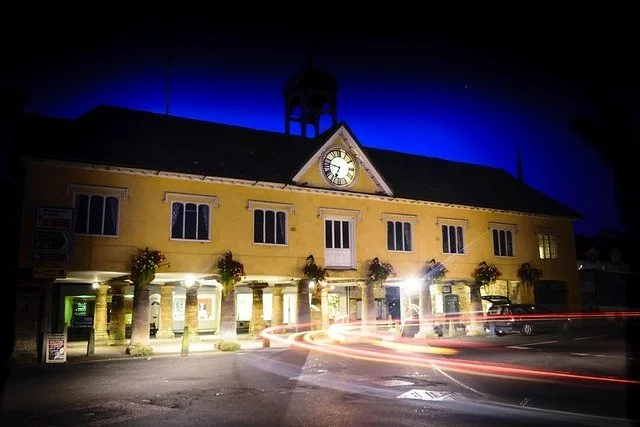
Tetbury is a shopper's paradise with a number of antique shops and independent boutiques. Tetbury Goods Shed is a restored shed at Rail Lands with events and there is also the Whistle Stop Café.
The Police Museum & Courtroom housed in the former Victorian police station and courthouse depicts the history of the Gloucestershire Constabulary.
Nearby, wander through the trees at Westonbirt Arboretum, one of the most beautiful and important plant collections in the world, with 15,000 specimens and 2,500 species of tree from all over the world. For calm and tranquillity visit the beautiful gardens at The Matara Centre, which is a 10-minute drive away.
Enjoy the peaceful surroundings at the nearby, Elizabethan Chavenage House, which has been virtually unchanged for 400 years. It's also known as 'Trenwith', in TV's Poldark!
Highgrove House & Gardens, Tetbury
A visit to Tetbury isn't complete without a stroll around Highgrove Gardens. Highgrove is one of the private residences of King Charles III and the Queen Consort, near Tetbury in Gloucestershire.
Following the marriage of the then, Prince of Wales and Diana, Princess of Wales in 1981, Highgrove became a weekend residence. The two princes, Prince William and Prince Harry spent a lot of time in their childhood here.
King Charles III, then the Prince of Wales first arrived at Highgrove in 1980 and has transformed the gardens, which are open from April until October for guided tours that need to be booked in advance. Tours include the vibrant and quintessentially English Cottage Garden and the magnificence of the Thyme Walk, with insights into family life on the Estate and tales of how HRH has shaped each garden from inception.
Highgrove Shop
King Charles opened the Highgrove Shop in Tetbury in 2008. Duchy Home Farm, which runs itself like the garden on organic principles, also lies very close to Highgrove.
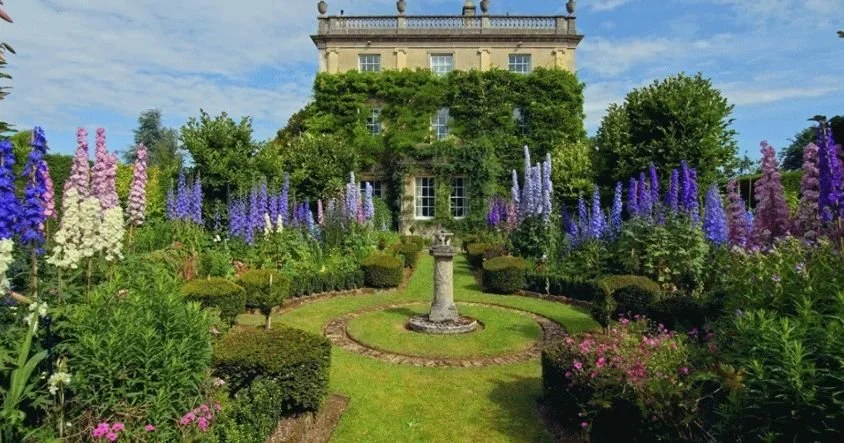
Image copyright: Highgrove Gardens
Castle Combe – One of England’s Most Beautiful Villages
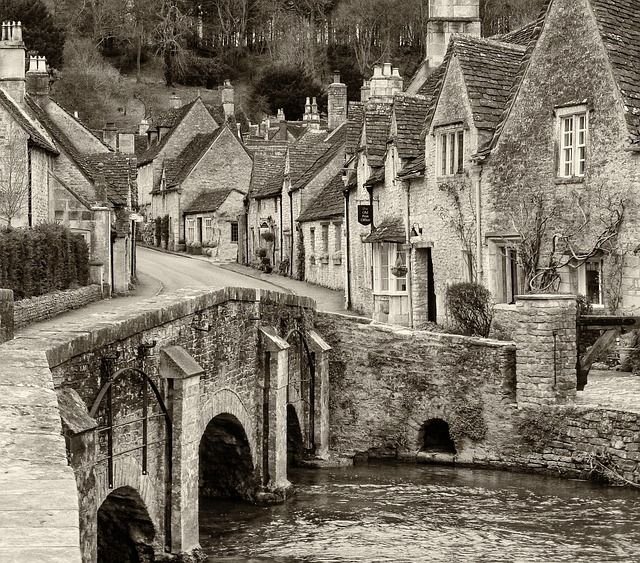
Castle Combe is often described as one of the most picturesque villages in England. Nestled in a wooded valley along the Bybrook River, the village is famous for its honey-coloured stone cottages, historic market cross and timeless rural setting.
Castle Combe developed during the medieval period as a centre for the wool trade, when the surrounding valley supported cloth production and milling. Much of the village you see today dates from this prosperous era, and remarkably little has changed over the centuries. The absence of modern street lighting and large developments has helped preserve its historic character, making it feel almost like stepping back in time.
Today Castle Combe attracts visitors from around the world who come to wander its narrow lanes, photograph the iconic bridge and cottages, and enjoy the peaceful atmosphere of one of Wiltshire’s most charming villages.
One of the most photographed and picturesque villages in England
Beautiful medieval cottages, bridge and historic market cross
Popular film location and gateway to scenic countryside walks
What to See and Do
• Market Cross and Village Square – the historic centre of Castle Combe, surrounded by traditional cottages and often considered the most photographed view in the village.
• St Andrew’s Church – a 13th-century church featuring a medieval clock believed to be one of the oldest working clocks in England.
• The Bybrook River Bridge – the iconic stone bridge offering classic views of the village’s cottages along the river.
• Village walks – explore the narrow lanes and footpaths that wind through the village and surrounding countryside.
• Castle Combe Circuit – a nearby motor racing circuit hosting events and track days throughout the year.
• The Manor House Hotel and Golf Club – a historic country house hotel with landscaped gardens and an 18-hole championship golf course.
-
How long to visit
Allow 45 minutes to 1 hour to explore the village and take photographs. Visitors staying for walks or a meal may wish to allow longer.Getting there / finding it
Castle Combe lies about 5 miles (8 km) north of Corsham and 12 miles (19 km) east of Bath, reached via small country lanes from the A420 or A4.Parking
• Castle Combe Car Park (SN14 7HU) – the main visitor car park located just outside the village
• Limited roadside parking is available near the entrance to the village, but the main car park is recommended during busy periods.The village centre itself is small and best explored on foot from the car park.
Uncover More Map
The Uncover More map highlights key points of interest, scenic viewpoints, hidden gems, and much more along the recommended route. To make the most of it, use the map in conjunction with the destination information, and explore additional options in the area you’re visiting to discover even more experiences.
If your iPhone doesn’t load via the Google Map App via the button, check out the Help page for how to update your phone or copy and paste the link into your browser: https://bit.ly/cotswold-uncover
Classic Cotswolds Last updated: 20 March 2026
Some links may earn Uncover Britain a small commission at no extra cost to you. This helps support the ongoing creation, review and presentation of our road trip guides.
Route information and listings are provided for general guidance only. Always use your preferred navigation system and check official websites to confirm suitability, opening times and the latest details before travelling.
Our guides are reviewed regularly and supported by a mix of editorial research and digital tools to help keep content clear and up to date. If you spot anything that needs updating, we’re always glad to hear from you.