

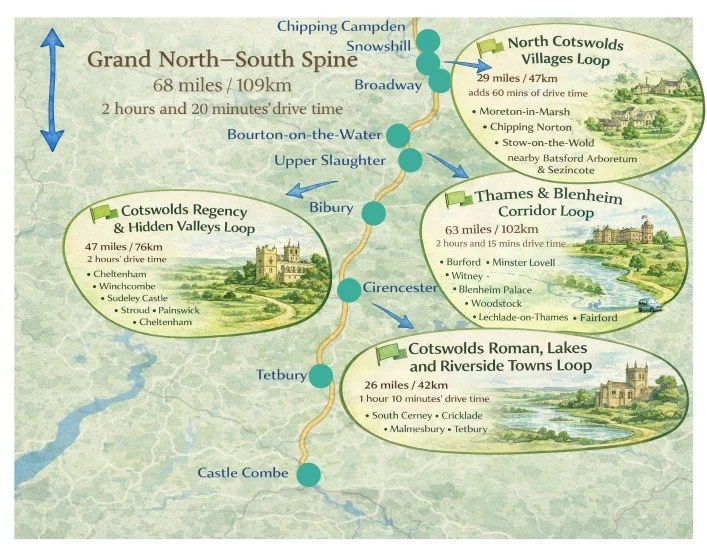
The Cotswolds road trip follows a beautifully structured journey through one of England’s most iconic landscapes, built around a central north–south spine from Chipping Campden to Castle Combe.
Along the way, honey-coloured villages, rolling hills, rivers and historic market towns unfold at an easy pace. The route is designed to be flexible, with optional loops branching off to explore grand estates like Blenheim Palace, hidden valleys, lakes and quieter corners.
Distances are short but rich in experience, making it ideal for anything from a one-day highlights drive to a slower, multi-day escape filled with culture, scenery and character.
The Cotswolds Grand Spine & Discovery Loops
Classic Villages, Hidden Valleys & Flexible Touring Routes
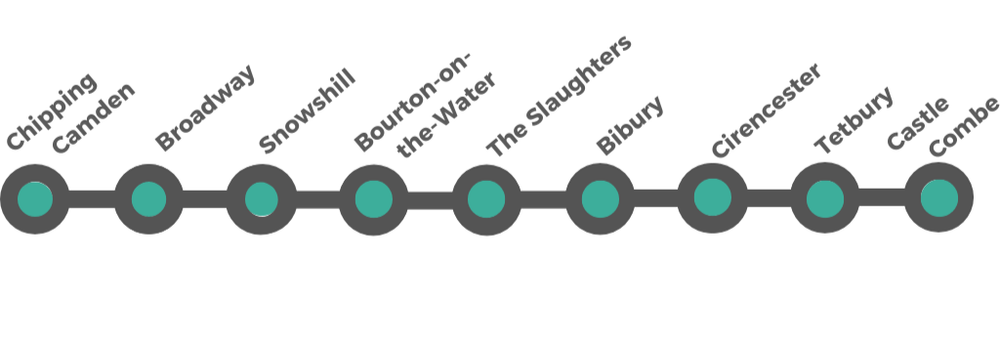
The Cotswolds Grand Spine is a flexible north–south route linking the region’s most iconic villages, countryside and historic towns.
Running from Chipping Campden to Castle Combe, it forms a clear backbone, with loop routes branching out to explore different landscapes and themes.
How the Journey Works
Grand Spine: A simple north–south route linking the most iconic villages.
Discovery Loops: Branch off to explore different landscapes.
Flexible Planning: Travel either direction or base yourself.
Time Guide
1–2 days → Spine
2–3 days → Add a loop
3–5 days+ → Combine loops
1. The Grand Spine


3. Thames & Blenheim Corridor


Practical Starting Points
The Grand Spine can be driven in either direction, starting in the north at Chipping Campden or in the south at Castle Combe. You can follow the full route or base yourself centrally and explore the loops.
Start in the North – Chipping Campden
Best for:
Broadway, Snowshill and classic villages
Nearest station:
Moreton-in-Marsh
Access:
M40 via Oxford or Stratford-upon-Avon
A classic starting point, easing into the Cotswolds’ most iconic scenery.
Start in the South – Castle Combe
Best for:
Tetbury, Cirencester and quieter landscapes
Nearest station:
Chippenham or Kemble
Access:
M4 via Bath or Bristol
A quieter start, building towards the busier northern villages.
Start in the Centre – Bourton or Cirencester
Best for:
Flexible trips and shorter stays
Access:
Easy reach of both north and south sections
Loops:
Thames & Blenheim, Hidden Valleys and Roman routes
Ideal if you prefer a single base with day trips.
How to Choose Your Start
1–2 days
Base centrally and explore one loop
2–3 days
Follow the full Grand Spine
3–5 days+
Combine the spine with multiple loops
Mix and match routes depending on your time and interests.
Choose Your Loop
Follow the Grand Spine from Chipping Campden to Castle Combe, then add one or more loops depending on your interests. These optional extensions let you shape the journey around classic villages, riverside towns, grand houses, hidden valleys or quieter southern landscapes.
North Cotswolds Villages Loop
Add this from Snowshill for more classic Cotswolds villages, garden landscapes and elegant country-house scenery.
Includes: Moreton-in-Marsh, Chipping Norton, Stow-on-the-Wold, Batsford Arboretum and Sezincote
Thames & Blenheim Corridor Loop
Add this from Bourton-on-the-Water as an eastern extension for riverside towns, historic villages and the grandeur of Blenheim Palace.
Includes: Burford, Minster Lovell, Witney, Blenheim Palace, Woodstock, Lechlade-on-Thames and Fairford
Cotswolds Regency & Hidden Valleys Loop
Add this from Bourton-on-the-Water as a western extension for Regency architecture, historic houses and the quieter western valleys.
Includes: Cheltenham, Winchcombe, Sudeley Castle, Stroud and Painswick
Cotswolds Roman, Lakes & Riverside Towns Loop
Add this from Cirencester for Roman heritage, lakeside scenery and quieter southern Cotswolds towns.
Includes: South Cerney, Cricklade, Malmesbury and Tetbury
Uncover Cotswolds
The name "Cotswolds" is believed to have originated from two Old English words: "cots," meaning "sheep enclosures," and "wold," meaning "hills" or "rolling hills." Therefore, "Cotswolds" roughly translates to "sheep enclosures on rolling hills." This name reflects the region's landscape of gentle, undulating hills and its historical association with sheep farming and wool production.
Discover more about the Cotswolds:
-
The Cotswolds region is primarily famous for its distinctive architecture and landscapes from several historical eras. Here are some of the key periods that contributed to the Cotswolds' reputation and draw:
Roman Cotswolds
Roman history is an integral part of the Cotswolds' rich heritage. While the Cotswolds region is best known for its picturesque villages, charming market towns, and rolling hills, it also has a fascinating Roman history. The Romans occupied Britain from AD 43 to the early 5th century. During their occupation, they established several settlements in the Cotswolds region. One of the most significant Roman settlements in the area was at Cirencester, known as Corinium Dobunnorum. Corinium was the second-largest town in Roman Britain and served as an important administrative and commercial centre.
The Cotswolds is home to several Roman villas, which were luxurious rural residences owned by wealthy Roman families. Notable examples include Chedworth Roman Villa and Great Witcombe Roman Villa. These villas offer insights into Roman life, architecture, and culture in the region.
The Romans built an extensive network of roads across Britain, including the Cotswolds region, to facilitate travel, trade, and communication. Some of these Roman roads still exist today as modern highways or footpaths. The Fosse Way, a major Roman road that ran from Exeter in the southwest to Lincoln in the northeast, passes through the Cotswolds, and its route can still be traced in parts of the region.
Medieval Period
The Medieval Period spans the 5th to 15th century. Many towns and villages in the Cotswolds region feature medieval architecture, including charming cottages, churches, and manor houses. The use of local honey-coloured limestone gives these buildings a warm and picturesque appearance. Notable examples of medieval architecture in the Cotswolds include the medieval wool churches, such as St. John the Baptist in Cirencester and St. James' Church in Chipping Campden.
The "Wool Period"
The Wool Period of the Cotswolds refers to a significant historical era in the region's history when the wool trade was booming and played a central role in shaping the local economy and society. This period primarily spanned from the late Middle Ages through the Tudor era, roughly from the 14th to the 17th centuries, although its influence persisted into later centuries as well.
During the Wool Period, the Cotswolds region, known for its fertile valleys and abundant pastures, became a hub for sheep farming and wool production. The Cotswold breed of sheep, with its long, coarse wool, was particularly prized for its quality and played a crucial role in the success of the wool trade. The rolling hills and lush grasslands of the Cotswolds provided ideal conditions for sheep farming. The region became known for its flocks of Cotswold sheep, which were raised primarily for their wool.
The wool trade was the backbone of the Cotswolds economy during this period. Wool was a highly valuable commodity, both domestically and internationally, and the Cotswolds became one of England's leading wool-producing regions. The wool produced in the Cotswolds was processed and woven into cloth in local towns and villages. The region became home to numerous textile mills and weaving workshops, where skilled artisans produced a wide range of woollen goods.
The wealth generated by the wool trade fueled the construction and renovation of many churches in the Cotswolds. These "Wool Churches" feature elaborate architectural details and decorative elements financed by wealthy wool merchants and landowners.
The success of the wool trade brought economic prosperity to the Cotswolds region, leading to the growth of market towns and the development of local industries and crafts. The Wool Period of the Cotswolds was a time of great prosperity and growth, and its legacy can still be seen today in the region's historic buildings, landscapes, and cultural heritage.
Tudor Period
The Tudor period began with the accession of Henry VII in 1485 and ended with the death of Elizabeth I in 1603. The Cotswolds also boast several fine examples of Tudor architecture, characterised by timber-framed buildings with distinctive black and white facades. These buildings often feature intricate carvings and decorative elements.
The picturesque town of Chipping Campden is renowned for its well-preserved Tudor architecture. The High Street in Chipping Campden is lined with beautiful half-timbered buildings, including the historic Market Hall, built in 1627, which is one of the town's most iconic landmarks. The town of Burford boasts a number of Tudor-era buildings along its historic High Street. The Tolsey Museum, housed in a 16th-century building, offers insights into the town's history and showcases Tudor artefacts. Stow-on-the-Wold is known for its historic market square and numerous Tudor buildings. The Royalist Hotel, a former coaching inn dating back to the 17th century, features classic Tudor architecture and is a notable landmark in the town. Broadway is famous for its picturesque streets lined with historic buildings, including several fine examples of Tudor architecture. The Lygon Arms, a historic coaching inn dating back to the 16th century, is a prominent Tudor building in the village. his charming town of Winchcombe is home to Sudeley Castle, a historic Tudor castle with connections to Queen Katherine Parr, the last wife of King Henry VIII. The castle boasts impressive Tudor architecture, including the Great Hall and the medieval ruins within its grounds.
These are just a few examples of Tudor buildings in the Cotswolds, but there are many more scattered throughout the region. The distinctive charm and character of Tudor architecture contribute to the timeless appeal of the Cotswolds as a destination for history enthusiasts and visitors seeking to experience quintessential English countryside charm.
Georgian Period
The term "Georgian" is commonly associated with the reigns of George I through George III, particularly the first half of the 18th century. During the Georgian era, the Cotswolds experienced prosperity from the wool trade, leading to the construction of elegant Georgian townhouses and manor houses. These buildings are typically characterised by symmetrical facades, sash windows, and classical detailing. The town of Cheltenham is known for its Georgian architecture and spa heritage. It’s known for its Regency architecture, a subset of Georgian architecture that emerged during the Regency era (1811–1820) when the future George IV served as Prince Regent. Prominent examples include the Grade I listed Pittville Pump Room, the Montpellier Rotunda, and various Regency terraces and crescents.
While not within the traditional boundaries of the Cotswolds, Bath is close by and famous for its Georgian architecture, particularly its elegant terraces of honey-coloured Bath stone. Key examples include the Royal Crescent, the Circus, and Pulteney Bridge.
The historic market town of Cirencester features a mix of Georgian buildings alongside earlier medieval and Tudor structures. Notable examples include the Corn Hall, the George Hotel, and various townhouses along the Market Place. Tetbury boasts several fine examples of Georgian architecture, including the Market House, a striking 17th-century building with Georgian additions, and various townhouses along Church Street and Long Street. Stow-on-the-Wold features Georgian buildings interspersed among its older medieval and Tudor structures. Examples include the Unicorn Hotel and various townhouses along the historic Market Square. The historic town of Tewkesbury has several Georgian buildings, including the Tewkesbury Museum, housed in a Georgian townhouse on Barton Street, and various townhouses along High Street and Church Street.
These are just a few examples of Georgian buildings scattered throughout the Cotswolds. Georgian architecture's symmetrical design, elegant proportions, and use of local materials like Cotswold stone contribute to the region's architectural diversity and charm.
Victorian Period:
This era of British history spans the reign of Queen Victoria, who ruled from 1837 to 1901. However, the term "Victorian" is often used more broadly to describe the social, cultural, and economic characteristics of the entire 19th century, not just the years of Queen Victoria's reign. The Victorian era saw further development in the Cotswolds, with the construction of grand Victorian villas, terraces, and civic buildings. The Victorian era saw the construction of many grand villas and country houses in the Cotswolds, often featuring elaborate architectural details such as decorative brickwork, bay windows, and intricate ironwork. These villas were typically built for affluent families and can be found throughout the region, particularly in towns like Cheltenham and Bath. Victorian terraced houses are a common sight in towns and villages across the Cotswolds. These rows of attached houses were built to accommodate the growing urban population during the Victorian period. They often feature ornate facades with decorative brickwork, sash windows, and slate roofs. The Victorian era saw the expansion of the railway network in England, including the construction of many railway stations in the Cotswolds. These stations were built in a variety of architectural styles, ranging from grand Victorian Gothic designs to more modest brick structures. Victorian public buildings such as town halls, libraries, and schools can also be found in the Cotswolds. These buildings often feature imposing facades with classical or Gothic architectural elements, reflecting the Victorian emphasis on civic pride and public architecture. Many churches in the Cotswolds were renovated or rebuilt during the Victorian era, often in a Gothic Revival style. These churches feature pointed arches, stained glass windows, and decorative stonework, reflecting the Victorian fascination with medieval architecture and religious revivalism.
Some villages, like Bourton-on-the-Water, feature Victorian-era structures alongside older buildings, contributing to the area's diverse architectural heritage.
Arts and Crafts Movement:
The Arts and Crafts Movement was primarily in the late 19th and early 20th centuries, spanning roughly from the 1880s to the early 1900s. The Cotswolds played a significant role in the Arts and Crafts movement of the late 19th and early 20th centuries. Influential figures such as William Morris and Ernest Gimson were associated with the region, promoting traditional craftsmanship and rural living. The Arts and Crafts Movement in the Cotswolds is closely associated with the Guild of Handicraft, an organisation founded by Charles Robert Ashbee in 1888 in the Cotswold village of Chipping Campden. The Guild of Handicrafts aimed to revive traditional craftsmanship and promote the ideals of the Arts and Crafts Movement.
Notable Arts and Crafts buildings in the Cotswolds include Rodmarton Manor and Hidcote Manor Garden. Although not located in the Cotswolds proper, Kelmscott Manor is within easy reach and is closely associated with the Arts and Crafts Movement. It was the country home of William Morris, one of the key figures of the movement, and is preserved as a museum showcasing Morris's life and work. The Gordon Russell Museum, Broadway exhibits works by the well-known 'Arts and Crafts furniture' designer. Court Barn Museum in Chipping Campden focuses on the Arts and Crafts Movement in the Cotswolds, particularly the work of the Guild of Handicraft and its impact on the local area. The museum displays a collection of Arts and Crafts objects, including furniture, metalwork, ceramics, and textiles.
Overall, the Cotswolds' fame stems from its rich architectural heritage spanning multiple historical eras, making it a captivating destination for history enthusiasts, architecture lovers, and tourists seeking to experience quintessential English countryside charm.
-
The Cotswolds Area of Outstanding Natural Beauty (AONB) is a designated protected landscape located in south-central England, covering an area of approximately 790 square miles (2,038 square kilometres). The Cotswolds AONB is characterised by its rolling hills, gentle valleys, meandering rivers, and picturesque villages built from the region's distinctive golden limestone. The landscape is dotted with historic market towns, ancient woodlands, and expansive grasslands, creating a quintessential English countryside setting. Designated as an Area of Outstanding Natural Beauty in 1966, the Cotswolds AONB is recognised and protected for its exceptional scenic beauty, cultural heritage, and biodiversity. It is one of 46 AONBs in England, Wales, and Northern Ireland designated to conserve and enhance natural landscapes of national importance.
The Cotswolds AONB supports a diverse range of habitats, including limestone grasslands, ancient woodlands, and wetlands, which are home to a variety of wildlife species. The area is known for its rich biodiversity, including rare butterflies, wildflowers, and bird species such as red kites and barn owls.
The Cotswolds AONB is steeped in history and cultural heritage, with evidence of human settlement dating back thousands of years. The area is dotted with historic landmarks, ancient monuments, and traditional villages built from locally quarried limestone. Notable cultural sites include historic churches, manor houses, and medieval market towns.
Look up which gateway town you will be present in and see what trails are available from that start point here.
The Cotswolds AONB offers a wide range of recreational opportunities for visitors, including walking, such as a range of self-guided walks, warden-led multistage monthly walks, and guided walks. For those interested in cycling - there are road routes and off-road routes. There are opportunities for horse riding too. The area is crisscrossed by numerous footpaths, bridleways, and long-distance trails, such as the Cotswold Way, providing access to the stunning countryside and panoramic views.
-
The Cotswold Way National Trail is a renowned long-distance footpath in England, stretching for approximately 102 miles (164 kilometres) through the Cotswolds Area of Outstanding Natural Beauty (AONB). Here are some key points about the Cotswold Way:
The Cotswold Way follows a picturesque route that traverses rolling hills, ancient woodlands, charming villages, and historic sites. The trail begins in the market town of Chipping Campden in Gloucestershire and ends in the city of Bath in Somerset, passing through scenic landscapes and offering panoramic views along the way.
The trail showcases the diverse beauty of the Cotswolds, with its quintessential English countryside scenery, including golden limestone villages, lush meadows, tranquil valleys, and expansive vistas. Hikers can expect to encounter a variety of landscapes and habitats, each with its own unique charm. Along the Cotswold Way, hikers can explore numerous historic sites and landmarks, including Iron Age hillforts, Roman remains, medieval churches, and stately homes. Notable points of interest include Broadway Tower, Sudeley Castle, and the Roman heritage of Bath.
While the Cotswold Way is generally well-marked and accessible, it does involve some challenging terrain, including steep climbs, descents, and uneven paths. Hikers should be prepared for varying levels of difficulty, especially in sections that traverse hilly terrain. The Cotswold Way is marked by distinctive acorn signs, making it easy for hikers to follow the trail. Additionally, there are information boards and facilities such as picnic areas, restrooms, and visitor centres at certain points along the route.
About the Trail and the Sections to Walk
Throughout the majority of its route, the trail runs along the Cotswold escarpment, offering stunning panoramic vistas of the surrounding landscape. The route can be broken down into 15 sections to walk, found here.
Chipping Campden to Broadway – 6 miles (9.6 Km)
Broadway to Wood Stanway – 6.5 miles (10.5 Km)
Wood Stanway to Winchcombe – 5.4 miles (8.8 Km)
Winchcombe to Cleeve Hill – 5.6 miles (9 Km)
Cleeve Hill to Dowdeswell – 5.5 miles (8.9 Km)
Dowdeswell to Leckhampton Hill – 4.7 miles (7.6 Km)
Leckhampton Hill to Birdlip – 5.6 miles (9 Km)
Birdlip to Painswick – 8.6 miles (13.9 Km)
Painswick to King’s Stanley – 7.8 miles (12.6 Km)
King’s Stanley to Dursley – 7.2 miles (11.6 Km)
Dursley to Wotton-Under-Edge – 7.3 miles (11.8 Km); shortcut 4.8 miles (7.8 Km)
Wotton-Under-Edge to Hawkesbury Upton – 7.4 miles (11.9 Km)
Hawkesbury Upton to Tormarton – 7.7 miles (12.4 Km)
Tormarton to Cold Ashton – 6.6 miles (10.6 Km)
Cold Ashton to Bath – 10.2 miles (16.5 Km)
-
The Cotswolds region in England offers a multitude of scenic walks, each showcasing the area's charming villages, picturesque landscapes, and historic landmarks. Here are five top walks in the Cotswolds:
Cotswold Way: Stretching for approximately 102 miles (164 kilometres) from Chipping Campden to Bath, the Cotswold Way is one of England's most renowned long-distance footpaths. This trail traverses rolling hills, lush valleys, and charming villages, offering breathtaking views of the Cotswolds countryside. Highlights include Broadway Tower, Sudeley Castle, and the historic city of Bath. See more in the separate listing.
2. Broadway Circular Walk (opens as PDF): This circular walk starting from the village of Broadway offers stunning views of the Cotswolds escarpment and surrounding countryside. The route takes you through peaceful woodlands, open fields, and picturesque villages, including the iconic Broadway High Street with its honey-coloured cottages.
3. Bourton-on-the-Water to Lower Slaughter Walk: This leisurely walk follows the Windrush Valley from the picturesque village of Bourton-on-the-Water to the equally charming Lower Slaughter. The route meanders along the tranquil River Windrush, passing through lush meadows, quaint stone bridges, and idyllic countryside scenery.
4. Cleeve Hill Circular Walk: Cleeve Hill is the highest point in the Cotswolds and offers panoramic views stretching as far as the Malvern Hills and the Welsh Mountains on a clear day. This circular walk explores the undulating terrain of Cleeve Hill, passing through grassy meadows, ancient beech woods, and patches of wildflowers.
5. Minchinhampton Common Circular Walk: This circular walk explores the beautiful Minchinhampton Common, a vast expanse of open grassland and heathland located near Stroud. The route offers sweeping views of the surrounding countryside and allows visitors to discover the rich biodiversity of the common, including wildflowers, butterflies, and grazing cattle.
These are just a few examples of the top walks in the Cotswolds, each offering a unique perspective on the region's natural beauty, cultural heritage, and scenic landscapes. Whether you're seeking a challenging hike or a stroll, the Cotswolds has something to offer for walkers of all abilities and interests.
Classic Cotswolds Last updated: 20 March 2026
Some links may earn Uncover Britain a small commission at no extra cost to you. This helps support the ongoing creation, review and presentation of our road trip guides.
Route information and listings are provided for general guidance only. Always use your preferred navigation system and check official websites to confirm suitability, opening times and the latest details before travelling.
Our guides are reviewed regularly and supported by a mix of editorial research and digital tools to help keep content clear and up to date. If you spot anything that needs updating, we’re always glad to hear from you.