


Cotswolds Roman, Lakes and Riverside Towns Loop
26 miles / 42km 1 hour 10 minutes’ drive time
South Cerney – Lakes, Open Landscapes & A Different Side of the Cotswolds
South Cerney sits within the Cotswold Water Park, a vast network of lakes, waterways and nature reserves that offers a completely different feel to the traditional honey-stone villages. Instead of narrow streets and cottages, you’ll find open skies, flat landscapes and peaceful waterside settings.
It works best as a change of pace in your route — a place to slow down, stretch your legs and enjoy the scenery before returning to the more classic Cotswolds towns nearby.
A quieter, less tourist-heavy part of the Cotswolds
Easy, flat walking routes around lakes and nature areas
A refreshing contrast to villages like Bourton-on-the-Water or Bibury
What to See & Do
Cotswold Water Park Lakes – A network of over 150 lakes, with a mix of public access areas, walking routes and waterside viewpoints
Lakeside Walks – Flat, easy trails linking lakes, ideal for short strolls or longer loops with plenty of wildlife
Water Sports & Activities – Paddleboarding, kayaking and sailing available on selected lakes
Wildlife & Birdwatching – Look out for water birds, dragonflies and seasonal nature across reed beds and open water
Village Centre – A small, traditional village core with pubs and local amenities
Practical Information for Visiting
South Cerney is located just outside Cirencester and is easily reached by car, making it a convenient stop along the southern section of the route.
Parking is available at various lakes and activity centres, though some areas are private or restricted to guests — look for designated public access points and signed walking routes.
The area is best explored on foot once parked, with flat terrain and well-connected paths between lakes. Facilities vary depending on location, with cafés and amenities available at larger lakes or nearby in Cirencester.
South Cerney works best when combined with nearby destinations such as Cricklade, Malmesbury or Tetbury, forming part of a relaxed scenic loop through this quieter side of the Cotswolds.
Cricklade – Riverside Walks, Saxon Roots & A Quiet Gateway Town
Cricklade is a small, historic town on the northern edge of Wiltshire, sitting where the River Thames begins to widen and the Cotswolds start to open out into flatter landscapes. Often overlooked, it offers a quieter, more authentic feel compared to the busier Cotswolds villages.
With its wide High Street, Saxon origins and easy riverside walks, Cricklade works well as a gentle stop — a place to pause, explore on foot and enjoy a slower pace before continuing your route.
A peaceful alternative to busier Cotswolds destinations
Riverside walks along one of the earliest stretches of the Thames
A historic market town with Saxon origins and open green spaces
What to See & Do
High Street & Historic Centre – A wide, characterful street lined with independent shops, cafés and traditional buildings
River Thames Walks – Easy, scenic walks along one of the river’s earliest navigable sections
North Meadow National Nature Reserve – A large open meadow known for seasonal wildflowers and expansive views
St Sampson’s Church – A prominent medieval church reflecting the town’s long history
Thames Path Access – Join or explore part of the long-distance trail following the river
Practical Information for Visiting
Cricklade is located just north of South Cerney and is easily accessed by car, making it a natural stop on the Cotswolds Roman, Lakes & Riverside loop.
Parking is available in the town centre, with most of the highlights within easy walking distance. The terrain is flat, making it ideal for relaxed strolls, particularly along the river and through the surrounding meadows.
Facilities include cafés, pubs and small independent shops, making it a good place for a break or light lunch.
Cricklade pairs well with nearby South Cerney, Malmesbury and Tetbury, forming part of a quieter, more spacious section of the wider Cotswolds route.
Malmesbury
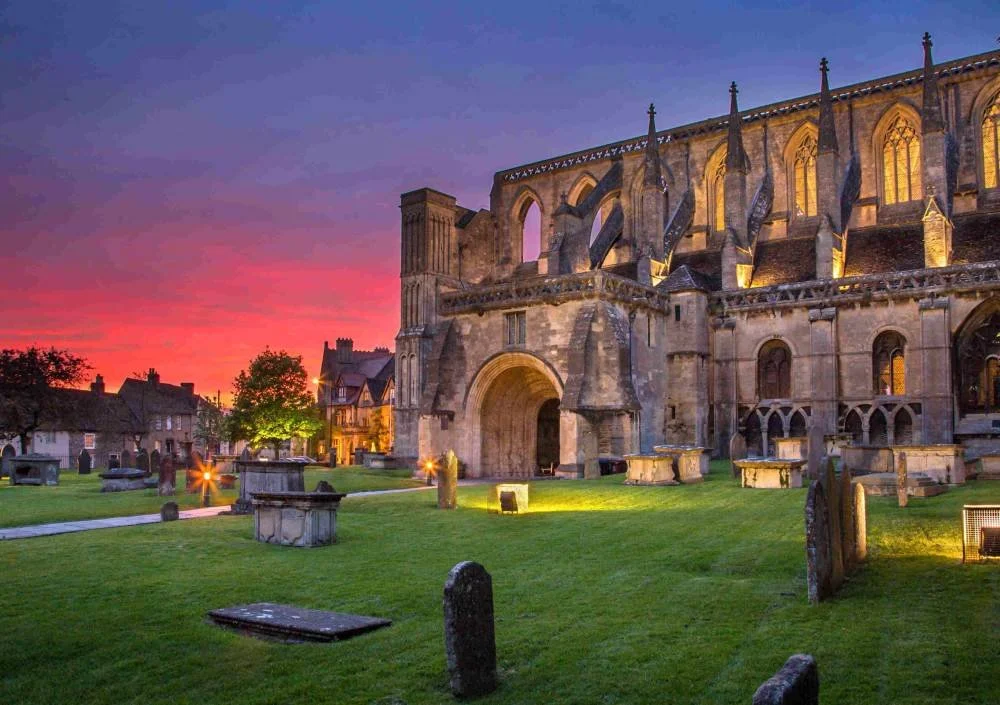
Malmesbury is a historic and pretty chocolate-box town dubbed the “Queen of Hilltop Towns”. It was a centre of learning in the Middle Ages stemming from the Malmesbury Abbey. Image copyright Malmesbury Abbey.
The stunning 12th-century Abbey is the jewel in the crown here - see the tomb of King Athelstan, a 15th-century illuminated Bible, the crest of Henry VII, a breathtaking Norman porch, and scars of Civil War battles on the walls. Malmesbury is thought to be the first capital of England and was home to the first king of England – King Athelstan the Glorious. He is believed to have had one of his palaces close by at Brokenborough and a villa at nearby Norton. Learn more at the King Athelstan Museum. The museum has displays for agriculture and industry, art, coins, transport, and more. Take a stroll around Abbey House and enjoy a break at The Old Bell, a Grade I listed building dating back to 1220, which lays claim to being the oldest existing hotel in England.
Malmesbury Tourist Information Centre, which is located in the foyer of Malmesbury Town Hall. Discover Malmesbury's town guide and map, which can be found here.
Learn about the role Cowbridge House played in WWII where Ecko set up a secret factory for radar. Sir Bernard Lovell, the astronomer, was one of the pioneers.
-
There is a Malmesbury Circular River Walk which is an easy 2-mile riverside stroll around the hilltop town and takes you past Almshouses, Silk Mill, the Old Courthouse and railway.
-
Spot the grave of Hannah Twynnoy, the first person to be killed by a tiger in the UK at Malmesbury Abbey. It escaped from its cage in 1703 at a travelling show and mauled her to death.
-
Cross Hayes (SN16 9BZ) with 100 spaces is free with no height restrictions.
-
King Athelstan the Glorious (c. 894–939)
King Athelstan, often referred to as "the Glorious," was one of the most influential rulers in English history. Reigning from 924 to 939, he was the grandson of Alfred the Great and the eldest son of King Edward the Elder. Athelstan is widely regarded as the first true King of England, as he successfully united the various Anglo-Saxon and Celtic kingdoms into one cohesive realm.
-
Unification of England:
Athelstan's reign marked the consolidation of Anglo-Saxon kingdoms into a unified English state. After his decisive victory at the Battle of Brunanburh in 937, he defeated a coalition of Norse, Scots, and Strathclyde Britons, solidifying his authority over the entire territory of England.
Administrative Reforms:
He is credited with introducing legal and administrative reforms. His law codes focused on justice, peacekeeping, and the protection of the weak, reflecting his efforts to maintain a stable and unified kingdom.
Religious Patronage:
A deeply pious king, Athelstan was a generous patron of the Church. He founded monasteries, promoted religious reform, and commissioned many manuscripts. His reign saw England become a center of learning and culture in Europe.
Diplomatic Influence:
Athelstan's court was an international hub, hosting emissaries from across Europe. He forged alliances through strategic marriages, such as the marriage of his half-sisters to European rulers.
Battle of Brunanburh (937):
This decisive battle is one of Athelstan’s most famous military victories. Celebrated in the Anglo-Saxon Chronicle, the battle confirmed his dominance over England and deterred foreign invasions for decades.
-
Athelstan died on October 27, 939, at the age of around 45, without leaving an heir. He was buried in Malmesbury Abbey, a site he had long patronized. His tomb became a place of pilgrimage, and his legacy as one of England's greatest kings endures in history.
Athelstan’s vision and leadership paved the way for the development of England as a unified and stable nation, earning him a place among the most significant monarchs in English history.
Uncover More Map
The Uncover More map highlights key points of interest, scenic viewpoints, hidden gems, and much more along the recommended route. To make the most of it, use the map in conjunction with the destination information, and explore additional options in the area you’re visiting to discover even more experiences.
If your iPhone doesn’t load via the Google Map App via the button, check out the Help page for how to update your phone or copy and paste the link into your browser: https://bit.ly/cotswold-uncover
Classic Cotswolds Last updated: 20 March 2026
Some links may earn Uncover Britain a small commission at no extra cost to you. This helps support the ongoing creation, review and presentation of our road trip guides.
Route information and listings are provided for general guidance only. Always use your preferred navigation system and check official websites to confirm suitability, opening times and the latest details before travelling.
Our guides are reviewed regularly and supported by a mix of editorial research and digital tools to help keep content clear and up to date. If you spot anything that needs updating, we’re always glad to hear from you.