

The Kingdom of Fife – Coast, History & Countryside
Coastal Villages, Royal Heritage & Scenic Inland Landscapes
Fife is best explored as a series of connected journeys, linking coastal villages, historic towns and inland landscapes into one flexible route.
Covering around 108 miles (174 km) with a total drive time of approximately 4–5 hours, this is a journey designed to be experienced slowly.
How the Journey Works
East Neuk of Fife – Coastal villages, harbours and creative communities shaped by the sea.
Historic Fife & the Forth – Royal history, industry and Scotland’s great crossings.
Heart of Fife & Lomond – Inland landscapes of lochs, hills and historic towns.
Alongside the main route, Scenic Routes & Day Trips allow you to explore specific areas in shorter, focused journeys.
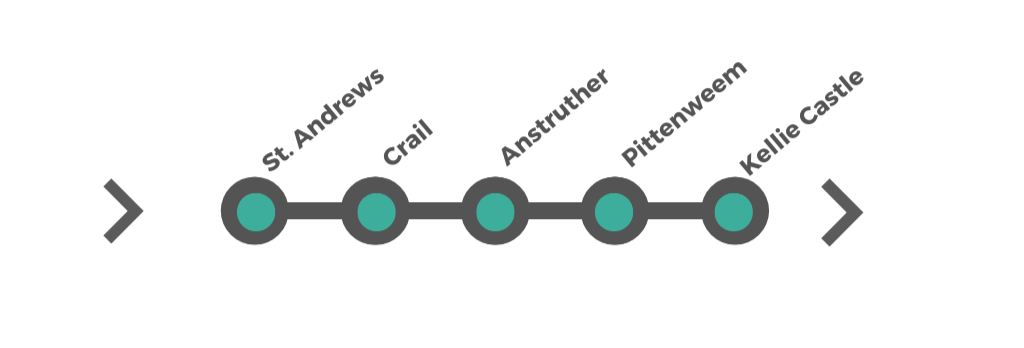

2. Historic Fife & the Forth
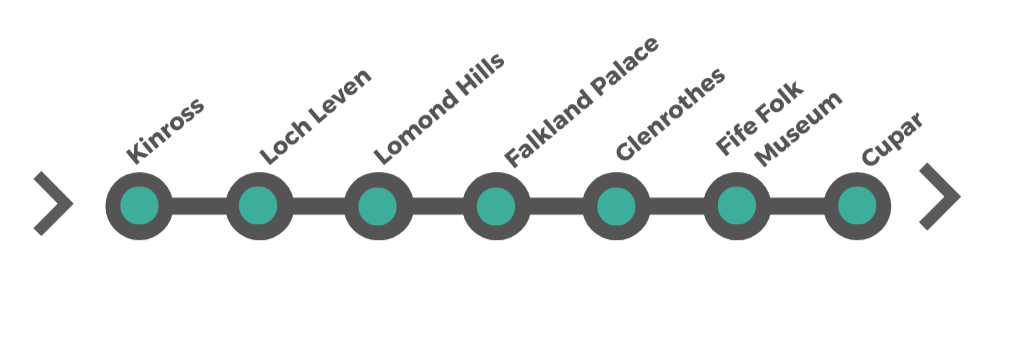
3. Heart of Fife & Lomond

4. Scenic Routes & Day Trips
How to Get to Fife
Most journeys into Fife naturally begin in St Andrews, the region’s best-known destination and a convenient starting point for exploring the wider route.
Best Starting Bases
St Andrews
The natural starting point for the East Neuk and a strong base for exploring the wider region. Ideal if you want to begin on the coast.
Edinburgh
The most accessible entry point for most travellers. Well connected by air, rail and road, and just over an hour from Fife.
Stirling
A quieter and more central base for exploring inland Fife and the Lomond Hills, particularly useful if combining with other Scottish routes.
These three bases allow you to approach Fife in different ways — as a coastal journey, a historic extension from Edinburgh, or a wider central Scotland road trip.
By Road – Driving to St Andrews
Edinburgh (~1 hr 15 mins)
M90 → A91
Glasgow (~1 hr 45 – 2 hrs)
M8/M80 → M90 → A91
Newcastle (~2.5 – 3 hrs)
A1 → M90 → A91
Manchester (~4.5 – 5 hrs)
M6 → M74 → M90 → A91
London (~8 – 9 hrs)
M1/M6 → M74 → M90 → A91
By Train
Short onward transfer to St Andrews by bus or taxi.
By Bus
Edinburgh (~1.5–2 hrs)
Glasgow (~2–2.5 hrs)
Local connections from Dundee & Leuchars
By Air
Edinburgh Airport (50 miles)
Glasgow Airport (80 miles)
Dundee Airport (13 miles)
Parking in St Andrews
Petheram Bridge – near Old Course
Argyle Street – central location
Bruce Embankment – coastal views
On-street parking available
Uncover Fife
Known as the “Kingdom of Fife,” this compact region brings together royal heritage, coastal villages and centuries of storytelling. From medieval towns and ancient abbeys to folklore, film locations and historic landscapes, each layer adds to a place shaped as much by legend as by history.
The Kingdom of Fife
The name “Kingdom of Fife” reflects status rather than sovereignty. While never an independent kingdom, Fife held extraordinary importance in medieval Scotland through the powerful MacDuff Earls, whose influence shaped the region’s identity.
Its connection to St Andrews — home to Scotland’s patron saint — further reinforced its reputation as a place of religious and royal significance that still defines it today.
A Brief History
Fife’s story stretches from prehistoric settlements and Pictish rule through to royal burghs and industrial growth. Dunfermline emerged as a key royal centre, while St Andrews became one of Scotland’s most important religious and academic hubs.
From the Wars of Independence to the Reformation and beyond, each period has left visible traces across the towns, coastlines and landscapes you explore today.
Myths, Legends & Folklore
Fife is steeped in storytelling. Legends of Macduff, ghostly figures in Culross and ancient carvings in the Wemyss Caves bring history and myth together.
Landscapes like the Lomond Hills and sites such as Balgonie Castle carry tales of magic, mystery and folklore — reminders that Fife’s past is as much imagined as it is recorded.
Fife on Screen
Fife’s distinctive settings have long attracted filmmakers. Culross appears in Outlander, while West Sands in St Andrews features in the opening scenes of Chariots of Fire.
From historic streets to sweeping coastal landscapes, the region continues to provide a natural backdrop for stories set both in the past and present.
Royal & Historic Burials
Dunfermline Abbey stands as one of Scotland’s most important royal burial sites, where figures such as Malcolm III, Queen Margaret and Robert the Bruce are laid to rest.
Across Fife, historic kirkyards and abbeys connect visitors with centuries of local life, offering a quieter but powerful link to Scotland’s past beyond the major landmarks.
End of the Road Trip — What Fife Leaves You With
By the time you reach Cupar, you’ve seen Fife from almost every angle.
You’ve followed harbours along the East Neuk, walked clifftops on the Coastal Path, stepped inside Cold War secrets, traced royal stories through abbeys and palaces, crossed under one of the world’s greatest engineering landmarks, and finished among farmland, hills and market towns that feel grounded and lived-in.
What makes this journey work so well is the contrast. Coast to countryside. Fishing villages to royal residences. Industrial shores to quiet inland roads. Each section explains a different part of how this small kingdom functioned — as a place of movement, power, work and daily life.
Fife doesn’t overwhelm you with single headline sights. It reveals itself gradually, through connected places, short walks, views, stories and atmospheres that build into something much bigger than the map suggests.
And that is exactly why it stays with you.
Continuing Your Journey Around Scotland
After exploring Fife’s coastline, crossings and inland heartlands, you’re perfectly placed to continue your journey in almost any direction.
Head south over the bridges into Edinburgh & the Borders Road Trip for castles, abbeys and layered history. Turn west and the landscape quickly opens into lochs and mountains on the West Coast of Scotland Road Trip, with the option to continue on to the Isle of Skye Road Trip. Follow the Highland line north from Inverness and you naturally reach the North Coast of Scotland.
Together, these routes let you explore Scotland not as a checklist, but as a series of journeys — each with its own character, rhythm and sense of place.
On Your Way To or From Scotland
If you’re building a longer journey from England, several routes connect beautifully into this Scottish adventure:
Northumberland Castles & Coast Road Trip — castles, wide beaches and big skies along a dramatic frontier coastline
North Yorkshire Moors & Coast Road Trip — moorland landscapes, steam railways and classic seaside towns
Yorkshire Dales & West Yorkshire Road Trip — limestone valleys, Pennine hills and literary towns
Peak District Road Trip — dales, ridges, caves and historic villages
Cumbria Coast Road Trip — a quieter, wilder edge of England with sea views and heritage
Lake District Road Trip — Britain’s most famous mountain landscape of lakes, passes and valleys
Together, these routes let you explore Britain not as a checklist, but as a series of connected journeys — each with its own character, rhythm and sense of place.
Kingdom of Fife Last updated: 25 March 2026
Some links may earn Uncover Britain a small commission at no extra cost to you. This helps support the ongoing creation, review and presentation of our road trip guides.
Route information and listings are provided for general guidance only. Always use your preferred navigation system and check official websites to confirm suitability, opening times and the latest details before travelling.
Our guides are reviewed regularly and supported by a mix of editorial research and digital tools to help keep content clear and up to date. If you spot anything that needs updating, we’re always glad to hear from you.