

Cornwall Coast Road Trip – Atlantic Way, Penwith & the Fal River
Wild Coastlines, Iconic Landmarks & One of Britain’s Most Varied Journeys
Cornwall is a place where the landscape shifts constantly — from wide Atlantic beaches and rugged cliffs to sheltered estuaries, harbour towns and granite moorland. This route brings those contrasts together into one coherent journey.
Rather than following a single road, it uses Cornwall’s natural touring spine — the Atlantic Way, the far west and the Fal River corridor — linking the places travellers actually come for into a flowing, flexible route.
How the Journey Works
This route is best understood as three distinct but connected sections, each offering a different side of Cornwall:
The Atlantic Way – Following the north coast from Bude to St Ives, this section combines dramatic cliffs, wide beaches, harbour villages and some of Cornwall’s most iconic stops.
Penwith & the West Cornwall Loop – The landscape becomes more raw and elemental as you round Land’s End, exploring granite headlands, coastal theatres and the long pull south toward the Lizard.
The Fal River & Central Cornwall – The pace softens through estuaries, cathedral cities and inland landscapes, offering a calmer, more reflective final chapter.
Practical Starting Point
Most travellers begin on the north coast — often around Bude, Tintagel or Padstow — but the route works equally well from any section depending on where you base yourself.

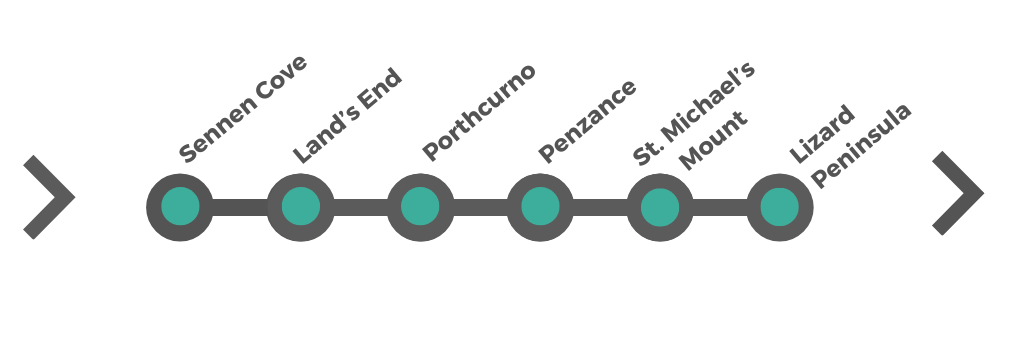
2. Penwith & West Cornwall

How to Get There
This Cornwall coast road trip begins in Bude, on the Atlantic edge of north Cornwall. Whether you’re travelling by car, train, bus or plane, getting here is straightforward — with the final approach forming part of the journey itself.
By Road – Driving to Bude
London (~5–6 hrs)
M4 → M5 to Exeter → A30 west → A39 to Bude
Bristol (~3.5–4 hrs)
M5 to Exeter → A30 → A39
Birmingham (~4.5–5 hrs)
M6 → M5 south → A30 → A39
Tip: The A30 can become busy in peak season — an early start or overnight stop near Exeter can make the journey smoother.
By Train
Nearest stations
Okehampton (~30 miles) •
Bodmin Parkway (~32 miles)
Main connections
Exeter St Davids connects directly with London, Bristol and Birmingham
Continue by local bus or taxi to Bude, or hire a car for the most flexibility along the coast.
By Bus
National Express
National Express services reach nearby towns such as Bideford and Camelford
Local connections
Bus links continue onward to Bude and surrounding coastal areas
Bus travel is slower but can be a cost-effective option.
By Air
Newquay Airport (~40 miles)
Cornwall Airport Newquay
Direct flights from
Gatwick,
Manchester and
Newcastle
Bristol Airport (~118 miles)
Bristol Airport
From Newquay, it’s around a 40-mile drive to Bude. From Bristol, expect around 2 hours 40 minutes by car or 5–6 hours by public transport.
From Outside the UK
Fly to London
Heathrow or
Gatwick offer the best international connections
Continue west
Train to Exeter or Bristol, then onward by car, bus or taxi
Alternative option
Fly directly to
Newquay Airport for the shortest onward journey
Many travellers combine rail travel into the southwest with car hire for the road trip itself, giving flexibility once you reach Cornwall.
Cornwall Coastal Road Trip – How to put it all together
This route is designed to be modular. You can travel each section independently, but when combined, they form a natural north–west–south arc through Cornwall, shifting in pace as the landscape changes.
At a glance (full route)
Total driving time (without stops): around 9–10 hours
Recommended time: 7–10 days
-
7 days: classic Cornwall highlights
This suits travellers who want to experience all three sections without lingering too long in any one place.
Days 1–3 – The Atlantic Way (Bude → St Ives)
Day 1: Bude, Boscastle and Tintagel
Day 2: Camelford, Padstow and the Camel Estuary
Day 3: Newquay and onward to St Ives
Focus is on north-coast scenery, short detours and limited longer walks.
Days 4–5 – Penwith & West Cornwall Loop
Land’s End, Porthcurno and Mount’s Bay
St Michael’s Mount and south towards the Lizard
Expect dramatic coastline with short drives and frequent stops.
Days 6–7 – Fal River & Central Cornwall Corridor
Falmouth and the Fal River
Truro and inland to Bodmin
A calmer finish focused on towns, estuaries and inland landscapes.
9 days: balanced and unhurried
This is the ideal pace for most travellers and mirrors how the route was designed to be experienced.
Days 1–4 – The Atlantic Way
Extra time for coastal walks near Boscastle or Tintagel
A relaxed day around Padstow and the Camel Valley
Time to slow down before reaching St Ives
Days 5–7 – Penwith & West Cornwall Loop
One full day around Land’s End and Porthcurno
One day around Mount’s Bay and St Michael’s Mount
One full day exploring the Lizard Peninsula
Days 8–9 – Fal River & Central Cornwall Corridor
Unhurried time in Falmouth
Truro, then inland towards Bodmin
This version allows flexibility around weather, tides and crowds.
10 days or more: slow travel
With additional time, the route becomes less about moving on and more about settling into each landscape.
Use extra days to:
Walk longer sections of the South West Coast Path
Base yourself in St Ives, Penzance or Falmouth
Reduce driving days and explore more on foot or by ferry
At this pace, the three sections feel distinct but connected — Atlantic coast, far west headlands, and inland river country.
Planning notes
The route naturally builds in contrast: wild north coast → elemental west → calmer south and inland
Driving distances are deliberately manageable, especially in the Penwith and Fal sections
The journey works equally well north to south, or with sections rearranged to suit accommodation or arrival points
In short
7 days – highlights-focused
9 days – balanced and immersive
10+ days – slow, walk-heavy, and deeply rewarding
Discovering the South West Coast Path
The South West Coast Path (SWCP) is England's longest waymarked long-distance footpath and a part of the National Trails network. Extending over 630 miles (1,014 km), the path follows the spectacular coastline of South West England, offering breathtaking views, diverse landscapes, and a rich cultural experience.
-
South West Coast Path covers a substantial portion of Cornwall's stunning coastline. Approximately 296 miles (or around 476 kilometres) of the total run along the coastline of Cornwall. This means nearly half of the entire path is situated within Cornwall. Cornwall's section of the path is renowned for its rugged cliffs, sandy beaches, charming fishing villages, and historic landmarks, making it a popular destination for hikers and nature enthusiasts.
Walkers will experience dramatic cliffs, hidden coves, sandy beaches, and picturesque harbours and the path offers panoramic vistas of the Atlantic Ocean and the English Channel. There is diverse flora and fauna, including seabirds, wildflowers, and marine life along the way. Keep an eye out for dolphins, seals, and migratory birds.
Historical landmarks along the way include Tintagel Castle, St Michael’s Mount, the Minnack Theatre, St Mawes Castle and Lands' End, the westernmost point of mainland England, marked by rugged cliffs and the iconic signpost.
Cornish towns and villages found on the way are below. Note that these are not all featured in our guide below, but you can cross-reference the areas that you are interested in:
Bude, Boscastle, Tintagel, Padstow and Newquay
Penzance, Marazion, Newlyn, Mousehole and Falmouth
St Austell Bay, Charlestown, Fowey, Polruan, and Looe
-
Explore Cornwall’s challenging and adventurous northern coastline on the South West Coast Path with this section: Marsland to Newquay 66 miles. With over 2,500m of ascent, this section offers rugged terrain and captivating ups and downs, often buffeted by westerly winds from the Atlantic Ocean. Begin in Bude, Cornwall’s northern surf hub, where you can brave the sea pool, catch Atlantic waves, and enjoy stunning coastal views. Journey onward through remote stretches, passing through Crackington Haven and reaching the resilient village of Boscastle, which survived the 2004 floods. Discover the legendary tales of King Arthur in Tintagel, crossing the historic bridge to the island. The route also features iconic spots like The Rumps, West Pentire's wildflowers, foodie haven Padstow, and picturesque beaches at Polzeath, Harlyn Bay, Watergate Bay, and Newquay. This section promises both a challenging hike and an enchanting coastal experience.
-
West Cornwall - Newquay to Falmouth 144 miles
This scenic journey along Cornwall's coastline starts from Newquay's cliffs and leads to picturesque sandy beaches like Holywell Bay and Perranporth. Explore artsy St Ives, an ancient fishing port, before venturing to two unique peninsulas: Penwith, the westernmost part of England, and the Lizard, the southernmost. Discover Cornwall's mining heritage at the UNESCO World Heritage Site, including iconic locations like Botallack mine and Levant mine. Poldark fans can explore filming sites, and nature enthusiasts can enjoy the Minack Theatre's alfresco performances and stunning views. Don't miss the fairy-tale-like setting of St Michael's Mount in Mount's Bay, along with charming coastal towns like Penzance, Marazion, Newlyn, and Mousehole. The section ends at the peaceful estuaries of Helford River and River Fal.
-
South Cornwall - Falmouth to Plymouth 76 miles
Explore South Cornwall, starting at the Fal estuary, one of the world's largest natural harbours, this section takes you through the Roseland Peninsula, a designated Area of Outstanding Natural Beauty. Encounter the well-preserved St Mawes Castle and the charm of St Austell Bay, featuring Mevagissey, Charlestown, and the scenic Par Sands beach. Visit the iconic Eden Project, a former china clay pit turned environmental marvel. Discover the picturesque towns of Fowey, Polruan, and Looe, then marvel at Whitsand Bay's grandeur. Finally, explore Cornwall's 'forgotten corner,' the Rame Peninsula, with its tidal creeks, sandy beaches, and country parks. Cross into Devon, catching a ferry to Plymouth for the next leg of your coastal adventure.
-
Visit the overview map on Google here https://www.google.com/maps/d/u/1/viewer?mid=1pBjtm6LfikTltw2G9bepIe1WeawS2cM&ll=50.51159716635567%2C-5.212797798046878&z=9
Explore Cornwall: History, Mystery, and Beauty
From Poldark’s dramatic landscapes to smuggling hotspots and ghostly tales, Cornwall brims with history and intrigue. Discover local folklore, legendary myths, stunning English Heritage properties, scenic trails, and breathtaking beaches in this captivating guide to the region.
-
Cornwall has a rich history of smuggling, and there are several well-known locations associated with this illicit activity. Here are some of the most notable smugglers' places in Cornwall:
Jamaica Inn: Located on Bodmin Moor, Jamaica Inn is perhaps one of the most famous smuggling locations in Cornwall. This historic coaching inn was frequented by smugglers in the 18th and 19th centuries, and it is said to be haunted by the ghosts of smugglers and their victims. See above.
Polperro: This picturesque fishing village on the south coast of Cornwall was once a notorious smuggling hotspot. Its narrow streets and secluded coves provided the perfect hiding places for contraband goods, and many of the old fisherman's cottages were used to store smuggled items.
Prussia Cove: Situated near Penzance, Prussia Cove was once the base of a notorious smuggling gang led by John Carter, also known as the "King of Prussia." The cove's rugged coastline and hidden caves made it an ideal location for smuggling operations.
Lizard Peninsula: The rugged coastline of the Lizard Peninsula provided numerous hiding places for smugglers to land their contraband goods. The area's secluded coves and caves were often used to store smuggled items before they were distributed inland.
Cadgwith Cove: Another picturesque fishing village on the Lizard Peninsula, Cadgwith Cove was once a hub of smuggling activity. Its sheltered harbour and rocky coastline made it an ideal location for smugglers to unload their illicit cargo under the cover of darkness.
Tintagel: Famous for its connections to the legend of King Arthur, Tintagel was also known to have been frequented by smugglers. The rugged cliffs and hidden caves around Tintagel provided ample opportunities for smuggling operations.
St. Ives: This charming seaside town on the north coast of Cornwall was once a centre for smuggling activity. Its busy harbour and narrow streets provided plenty of hiding places for contraband goods, and smugglers were known to operate here during the 18th and 19th centuries.
These are just a few examples of the many places in Cornwall with a history of smuggling. Today, visitors can explore these historic locations and learn more about Cornwall's fascinating smuggling past.
-
Cornwall, with its rugged coastline and historic mining heritage, served as the backdrop for the popular TV series "Poldark," based on the novels by Winston Graham. Fans of the show can explore various locations in Cornwall associated with the Poldark series:
Historic Port: Charlestown, near St. Austell, stood in for the fictional town of Truro in the series. Its well-preserved harbour and 18th-century ships create an authentic atmosphere.
Iconic Mining Site: Botallack Mine, a UNESCO World Heritage Site, was used to represent Ross Poldark's Wheal Leisure. The dramatic cliffside location adds to its allure.
Historical Setting: Levant Mine, another UNESCO World Heritage Site, portrayed the fictional Tressiders Rolling Mill. Its picturesque location on the cliffs overlooking the Atlantic Ocean is a must-visit.
Beautiful Beach: Porthcurno, near Land's End, served as Nampara Cove in the series. The stunning beach and turquoise waters create an idyllic setting.
Bodmin Moor: Bodmin Moor is featured as various locations in the series, showcasing its wild and mystical appeal. It's where Ross Poldark's family home, Nampara, was set.
Clifftop Views: St. Agnes Head provided the backdrop for some of the series' cliff scenes. Its rugged cliffs and sweeping views of the sea capture the essence of Cornwall's coastal beauty.
Poldark Mine & The Cornish National Heritage Collection is currently closed due to a legal battle. If you wish to visit, check the website before making a journey. It is located near Helston, and offers visitors a chance to step back in time and experience the mining world depicted in the series. It provides a hands-on glimpse into Cornwall's mining heritage.
-
Cornwall is steeped in folklore, legend, and myths, adding to its mystique and charm. Here are some prominent ones:
King Arthur and Tintagel: Cornwall is closely associated with the legendary King Arthur, with Tintagel Castle believed to be his birthplace. According to the myth, Tintagel was where King Arthur's father, Uther Pendragon, seduced Igraine, the wife of Duke Gorlois, resulting in Arthur's birth.
The Beast of Bodmin Moor: Bodmin Moor is infamous for sightings of a mysterious big cat, known as the Beast of Bodmin Moor. While officially unconfirmed, numerous reports and alleged sightings have fueled local folklore and speculation about the creature's existence.
Mermaids and Sea Creatures: Cornwall's coastal location has inspired tales of mermaids, selkies, and other sea creatures. The Mermaid of Zennor is a well-known Cornish legend about a beautiful mermaid who fell in love with a local man and lured him to the depths of the ocean.
The Legend of Tristan and Iseult: This tragic love story originated in Cornwall and has been immortalised in literature and folklore. Tristan, a knight of King Mark of Cornwall, falls in love with Iseult, the beautiful wife of King Mark. Their forbidden love and ensuing tragedy are central themes in Cornish folklore.
Piskies and Knockers: Cornwall is said to be inhabited by mischievous supernatural beings called piskies or pixies. These tiny creatures are believed to dwell in the countryside, playing pranks on unsuspecting travellers. Knockers are similar beings associated with mining folklore, said to knock on the walls of mines to warn miners of impending danger.
Lost Land of Lyonesse: Sennen's rich folklore includes tales of giants, faeries, and the legendary Lost Land of Lyonesse, which is said to be submerged beneath the waters near the Isles of Scilly. Lyonesse, home to Tristan from the romantic tale of Tristan and Iseult, adds to the region's mystique, blending Celtic legend with Arthurian lore and captivating the imagination of those who delve into Sennen's enchanting stories.
Sennen Whopper: Legend tells of the Sennen Whopper, a spirit known for predicting storms to protect fishermen. Despite its warnings, two fishermen ventured out one misty night against the tide and vanished, along with the Whopper. This maritime mystery lingers in local lore, adding to the area's intrigue.
-
Cornwall, with its ancient castles, historic houses, and rugged landscapes, is steeped in ghostly tales and haunting legends. Here are some of the most notorious ghosts and haunted locations in Cornwall:
Jamaica Inn: This 18th-century coaching inn on Bodmin Moor is notorious for its ghostly inhabitants. Guests and staff have reported encounters with the ghost of a murdered sailor, as well as the apparitions of former landlords and smugglers who once frequented the inn.
Pengersick Castle: This medieval manor house near Praa Sands is said to be haunted by the ghost of Dorothy, the daughter of a former owner, who was imprisoned and starved to death in the castle's dungeon. Visitors have reported hearing her cries and witnessing her ghostly apparition roaming the halls.
Pendennis Castle: This Tudor fortress in Falmouth is rumoured to be haunted by the ghost of a headless drummer boy. According to legend, the drummer boy was beheaded during a siege, and his ghostly drumming can still be heard echoing through the castle's walls.
Bodmin Jail: This former prison, now a museum, is one of Cornwall's most haunted locations. Visitors and staff have reported encounters with the spirits of former inmates, including children imprisoned for petty crimes, as well as the ghost of Selina Wadge, a young woman hanged for infanticide.
Berry Pomeroy Castle: This ruined castle near Totnes, just across the border from Cornwall, is said to be haunted by the White Lady and the Blue Lady. The White Lady is believed to be the ghost of Margaret Pomeroy, imprisoned and starved to death by her sister, while the Blue Lady is said to be the spirit of another tragic woman who met her end at the castle.
Minack Theatre: This open-air theatre carved into the cliffs near Porthcurno is said to be haunted by the ghost of Rowena Cade, who built the theatre in the 1930s. Visitors have reported seeing her ghostly figure sitting in the audience during performances.
St. Michael's Mount: This iconic island castle is said to be haunted by the ghost of a giant named Cormoran, who was slain by a local hero named Jack the Giant Killer. Legend has it that Cormoran's ghost still roams the island, seeking revenge.
-
There are over 20 English Heritage properties nearby including TINTAGEL CASTLE, ST CATHERINE'S CASTLE, RESTORMEL CASTLE, LAUNCESTON CASTLE, PENDENNIS CASTLE, ST MAWES CASTLE and HAILES ABBEY.
It makes sense for this road trip alone, plus enjoy unlimited access to hundreds of historic places and free child places with an annual membership, starting from £53 a year.
-
To open the map in Google Maps - use this link https://www.google.com/maps/d/u/1/viewer?mid=158StNljcII6nsK1UTJAggiB6lwNMCKs&ll=50.61574577593846%2C-4.9476970320312486&z=8
Classic Cornwall Coast Last updated: 27 March 2026
Some links may earn Uncover Britain a small commission at no extra cost to you. This helps support the ongoing creation, review and presentation of our road trip guides.
Route information and listings are provided for general guidance only. Always use your preferred navigation system and check official websites to confirm suitability, opening times and the latest details before travelling.
Our guides are reviewed regularly and supported by a mix of editorial research and digital tools to help keep content clear and up to date. If you spot anything that needs updating, we’re always glad to hear from you.