


From Pewsey 30 miles (48 km) with drive time approx. 1 hour
Part 3 - Stonehenge, Salisbury & Ancient Wessex
Leaving the chalk downs, canal valleys and village landscapes of the Vale of Pewsey, the route turns south towards one of the most iconic prehistoric sites in the world. This final chapter brings together two of Wiltshire’s best-known landmarks: Stonehenge, rising from the open sweep of Salisbury Plain, and Salisbury, whose cathedral spire, medieval streets and riverside setting offer a very different but equally memorable sense of place.
Together, they create a fitting conclusion to the journey. After the wider ceremonial landscapes of Avebury, the ridge-top tracks of the downs and the quieter villages of the Kennet Valley, the route now narrows its focus to a final pair of destinations that feel both monumental and human in scale — one an enduring mystery of prehistoric Britain, the other one of England’s finest historic cathedral cities.
How to Spend Your Time Here
This section of the road trip takes you through Wiltshire’s most iconic landmarks, from the mystical Stonehenge to the medieval splendour of Salisbury. Whether you have one, two, or three days, these itineraries offer a perfect mix of prehistoric wonders, historic sites, and scenic countryside. Walk among Neolithic stone circles, uncover the secrets of Old Sarum, and admire Salisbury Cathedral’s soaring spire and Magna Carta. With options for in-depth exploration or a relaxed getaway, these itineraries provide the ideal way to experience the ancient and medieval heart of Wiltshire.
-
Perfect for a day trip, covering the most iconic landmarks.
Morning – Stonehenge & Surroundings
Arrive at Stonehenge Visitor Centre early to avoid crowds.
Take the shuttle bus or walk to the Stone Circle, spending time exploring the site and its Neolithic significance.
Visit the exhibitions at the Visitor Centre to learn about Stonehenge’s history.
Explore Woodhenge and Durrington Walls, located nearby, to gain insight into the wider Neolithic landscape.
Afternoon – Salisbury Cathedral & Medieval City
Drive (~20 minutes) or take a bus to Salisbury.
Visit Salisbury Cathedral, home to Britain’s tallest spire and one of the best-preserved copies of the Magna Carta.
Explore The Close, including Mompesson House, The Rifles Museum, and Arundells, former home of Prime Minister Edward Heath.
Stroll through Salisbury’s historic centre, with timber-framed buildings, charming streets, and the historic market square.
Enjoy dinner in a traditional pub such as The Haunch of Venison before heading home.
-
A more relaxed itinerary that includes additional historic sites and countryside walks.
Day 1 – Stonehenge & The Neolithic Landscape
Start at Stonehenge for an early visit before crowds arrive.
Visit Woodhenge and Durrington Walls, the ancient settlement linked to Stonehenge.
Stop at Amesbury to explore Amesbury Abbey, one of England’s oldest continuously inhabited sites.
Walk a section of the Stonehenge Landscape, managed by the National Trust, to discover burial mounds and Neolithic structures.
End the day in Salisbury, enjoying an evening stroll and dinner.
Day 2 – Salisbury’s Medieval & Tudor History
Visit Salisbury Cathedral and see the Magna Carta.
Explore The Close, stopping at Mompesson House and The Rifles Museum.
Walk to Old Sarum, the original site of Salisbury, with hilltop views over the city and the ruins of a Norman castle and cathedral.
Take a riverside walk along the Avon and enjoy a relaxed meal in a historic pub.
-
A comprehensive trip covering Neolithic sites, medieval history, and the stunning Wiltshire countryside.
Day 1 – Stonehenge & Prehistoric Wiltshire
Visit Stonehenge in the early morning.
Walk the Stonehenge Landscape, stopping at Cursus Barrows, King Barrow Ridge, and Normanton Down.
Explore Woodhenge and Durrington Walls, then visit Amesbury Abbey.
End the day in Salisbury, taking a relaxed evening walk by the river.
Day 2 – Salisbury’s Medieval Treasures
Spend the morning at Salisbury Cathedral, exploring its interior and the Chapter House with the Magna Carta.
Explore The Close, including Mompesson House and Arundells.
Walk to Old Sarum and take in its views over the Wiltshire countryside.
Visit Wilton House, a stately home just outside Salisbury, known for its art collection and gardens.
Day 3 – Countryside Walks & Hidden Gems
Take a scenic walk along the Avon Valley Path, enjoying the Wiltshire countryside.
Visit Fovant Badges, World War I military hill carvings near Salisbury.
Stop at Wilton, the historic town that gave Wiltshire its name, and explore Wilton Shopping Village.
Spend a relaxed afternoon in Salisbury, revisiting favourite spots before heading home.
Optional Detour – Woodhenge
Before reaching Stonehenge, you may want to make a short detour to Woodhenge, a quieter prehistoric site near Amesbury and around 2 miles north-east of Stonehenge. Built around 2500 BC, Woodhenge once consisted of six concentric oval rings of timber posts, enclosed by a bank and ditch. Today, the original posts are gone, but their positions are marked out by concrete markers, helping visitors picture the scale and layout of the monument.
Woodhenge works best as a brief stop or optional addition rather than a main destination. It adds depth to the Stonehenge visit by showing that this was not a single isolated monument, but part of a much wider ceremonial landscape. It is also an easier, quieter site to pause at, with open views and a simpler, more understated atmosphere. Woodhenge is signposted off the A345 just south of Durrington, with postcode SP4 7AR.
What to See and Do
• See the timber-circle layout – concrete markers trace the original rings of posts.
• Take in the wider prehistoric setting – Woodhenge helps reveal the scale of the Stonehenge landscape beyond the stone circle itself.
• Use it as a quieter prelude to Stonehenge – a short stop here gives useful context before the main monument.
Stonehenge – Britain’s Most Iconic Prehistoric Monument

Stonehenge is one of the most famous prehistoric monuments in the world, rising from the open landscape of Salisbury Plain with a presence that still feels powerful and mysterious. Built in several stages between roughly 3000 BC and 2000 BC, the site remains one of the great achievements of prehistoric Britain. Its massive standing stones, carefully arranged in a circular setting, continue to inspire debate about how the monument was built, what it was used for and why this place became so important.
Part of the significance of Stonehenge lies in its setting. Unlike Avebury, where the stones are woven into village life, Stonehenge stands alone within a wider ceremonial landscape of burial mounds, ancient routes and earthworks. That openness adds to its drama. Whether seen for the first time from the visitor route or from a distance across the plain, Stonehenge feels both monumental and remote, shaped by ritual, landscape and time.
Today, Stonehenge forms part of the Stonehenge and Avebury World Heritage Site and remains one of Wiltshire’s defining landmarks. Although it is internationally known, it still feels deeply connected to the wider story of this route, bringing together the prehistoric themes that have run through the chapter in their most iconic form.
• One of the world’s most famous prehistoric monuments
• A powerful setting within the open landscape of Salisbury Plain
• Part of a wider ancient landscape of barrows, earthworks and ritual sites
For something really special, book a VIP experience to go inside the stones for a once-in-a-lifetime visit. The Visitor Centre includes a café, shop and a museum displaying priceless loans from both Salisbury Museum and Wiltshire Museum.
What to See and Do
• See the Stone Circle – the great standing stones remain one of Britain’s most extraordinary sights and are the centrepiece of any visit.
• Walk the visitor route – the approach across the landscape helps reveal the monument’s scale and setting.
• Explore the visitor centre exhibition – displays help explain the monument’s construction, archaeology and wider ceremonial landscape.
• View the reconstructed prehistoric houses – these give a useful sense of daily life in Neolithic Britain.
• Look out across Salisbury Plain – the surrounding openness is part of what makes Stonehenge so striking.
• Spot the burial mounds and earthworks nearby – the wider landscape around Stonehenge is rich in prehistoric features.
• Learn about the solstice connection – Stonehenge is famously aligned with the midsummer sunrise and midwinter sunset.
-
How long to visit
Allow around 2 hours, or longer if you want time for the exhibition and a slower walk through the landscape.Getting there / finding it
Stonehenge lies just off the A303, west of Amesbury and north of Salisbury, making it an easy stop when travelling south from Pewsey towards Salisbury.Parking
Parking is provided at the Stonehenge visitor centre, with access onwards to the monument area by shuttle or on foot.Useful to know
Stonehenge is best experienced as both a monument and a landscape. The stones themselves are the focus, but the surrounding plain, burial mounds and wide skies are part of what make the visit memorable.
Stonehenge & Salisbury: England’s Most Iconic Heritage Sites
This part of the journey brings together some of England’s most significant historic sites — from the world-famous stone circle at Stonehenge to the medieval skyline of Salisbury and the commanding hilltop ruins of Old Sarum.
Stonehenge alone typically costs around £25 per person, making it one of the most expensive single heritage attractions in the UK.
Adding nearby sites like Woodhenge and Old Sarum — along with access to hundreds of English Heritage locations — can quickly make membership far better value.
You can also combine this with the wider prehistoric landscape around Avebury, just a short drive away, to make the most of your visit.
Annual membership starts from £53 — with 15% off using code AFFEH1526 until 31.12.2026.
Membership often pays for itself in just 1–2 visits when Stonehenge is included.
Get 15% Off MembershipLeaving Stonehenge, the route continues east across the edge of Salisbury Plain towards Old Sarum, around 8.5 miles (14 km) away and usually about a 15-minute drive. The journey is short, but it marks a clear shift in the story: from one of Britain’s most famous prehistoric monuments to the site of Salisbury’s original settlement, where Iron Age earthworks, Norman power and the remains of the first cathedral all overlap in one windswept hilltop setting.
This transition works especially well because Old Sarum feels like a bridge between the ancient and medieval worlds. After the ritual landscape of Stonehenge and the open sweep of the plain, the route narrows towards a defensible hilltop above the River Avon, where the story becomes one of fortress, lost city and early cathedral foundation. It is the natural next step before reaching modern Salisbury itself.
Old Sarum – Lost City, Iron Age Hillfort & Norman Stronghold
Old Sarum is one of the most historically layered sites in Wiltshire, bringing together an Iron Age hillfort, a Norman royal castle and the remains of the original Salisbury Cathedral within one dramatic hilltop setting. For around 150 years it was a major centre of both secular and ecclesiastical power, before the city and cathedral moved to the present-day site of Salisbury in the valley below.
What makes Old Sarum so striking is the way its different eras remain visible in the landscape. The great outer earthworks began as an Iron Age fortification around 400 BC, later reused and reshaped through Roman, Saxon and Norman periods. At the centre, William the Conqueror’s Norman stronghold rose within the older defences, while the cathedral precinct occupied part of the enclosure beside it. Today, the site is both an important archaeological monument and a superb viewpoint over the surrounding countryside towards Salisbury.
Old Sarum works particularly well in this chapter because it bridges the journey from prehistoric and open downland landscapes into the medieval story of Salisbury. After Stonehenge, it adds another powerful historic layer before the route reaches the cathedral city itself.
• Iron Age hillfort, Norman castle and lost cathedral site in one place
• One of Wiltshire’s most important historic landscapes
• Wide views across the plain towards Salisbury
What to See and Do
• Walk the Iron Age ramparts – the mighty earthworks are among the site’s most impressive features and give a strong sense of its scale.
• Explore the Norman castle remains – climb up to the central motte and trace the outline of the royal stronghold.
• See the outline of the original cathedral – the grassy plan of the first Salisbury Cathedral remains visible within the earthworks.
• Look out over Salisbury and the surrounding countryside – Old Sarum is one of the best viewpoints in the area.
• Picnic or pause on the hilltop – the wide open space and dramatic setting make this a rewarding stop even for a shorter visit.
-
How long to visit
Allow around 1 to 1.5 hours for a relaxed visit, longer if you want to walk the full circuit of the ramparts and spend time reading the interpretation. This fits the way English Heritage presents the site as something to walk around and explore rather than just glance at.Getting there / finding it
Old Sarum lies about 2 miles north of Salisbury, making it a very easy stop between Stonehenge and the city. It sits on a prominent hill above the Avon valley and is reached by road from the Salisbury side.Parking
There is on-site visitor parking at Old Sarum for those arriving by car.Useful to know
The site is exposed and elevated, so it can feel windy even on a fine day. It is best appreciated as an open landscape monument, so sturdy shoes are useful if walking the earthworks.
Leaving Old Sarum, the route drops down from the exposed hilltop into the Avon Valley, where the lost city gives way to the living one. Salisbury lies just 2 miles (3 km) to the south and the drive usually takes 10 minutes or less, but it marks one of the clearest transitions in the whole journey.
After the earthworks, castle remains and cathedral foundations of Old Sarum, Salisbury feels more intimate and complete: a medieval city of lanes, market squares, river meadows and the soaring cathedral spire that now dominates the skyline. It is a natural final stop, bringing together many of the themes of the route — ancient history, sacred landscapes and enduring architecture — in a place that is still vibrant and easy to explore on foot.
Salisbury: Medieval Streets, Magna Carta and a City Steeped in History

Salisbury is one of England’s most characterful historic cities, where medieval streets, cathedral spires and centuries of heritage sit within easy reach of the countryside. Its story stretches back to Iron Age settlements and Roman occupation at Old Sarum, before evolving into a thriving Saxon market town.
Today, it’s best known for its extraordinary cathedral, elegant Close and walkable historic centre. Whether you’re drawn by history, architecture or a relaxed city atmosphere, Salisbury offers a rich and rewarding stop on any Wiltshire road trip.
A world-famous cathedral city with Britain’s tallest spire and historic treasures
A compact, walkable centre filled with medieval streets, markets and heritage buildings
Easy access to Stonehenge, Old Sarum and the Wiltshire countryside
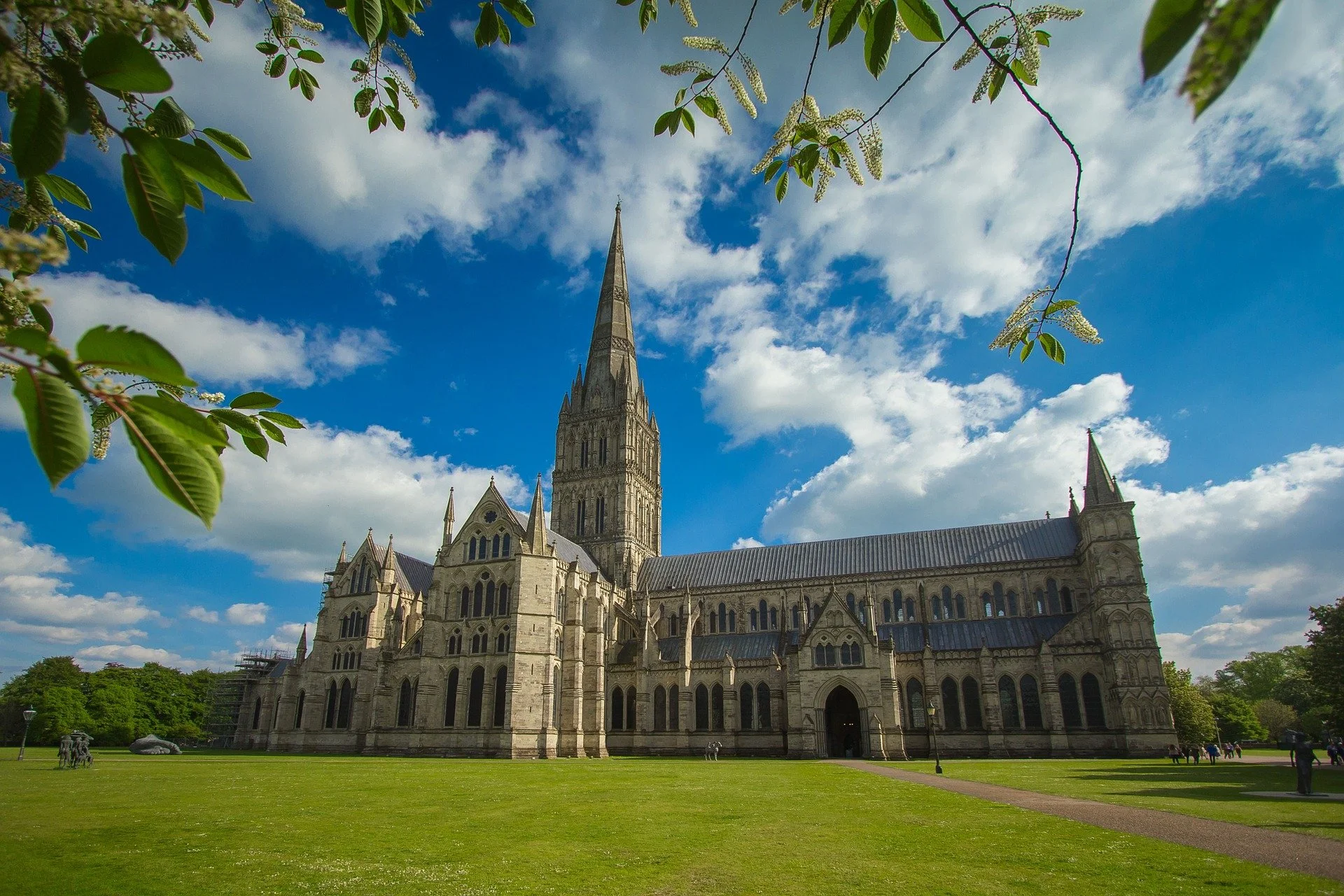
What to See & Do (Cathedral & Close)
Salisbury Cathedral – Book for the cathedral in advance. One of Britain’s finest Gothic cathedrals, home to the tallest spire (403ft), the best-preserved 1215 Magna Carta and the world’s oldest working mechanical clock (c.1386). You can also climb the tower for panoramic views. Book a tour to climb the 332 steps.
Cathedral Close – A peaceful 80-acre space surrounding the cathedral, filled with historic houses and walking routes; the largest cathedral close in Britain. Follow this trail from the National Trust around Cathedral Close and the Cathedral to see some of the splendid buildings and learn of the part they play in the history of Salisbury.
Mompesson House – A beautiful 18th-century townhouse (National Trust) with period interiors, gardens and a tea room, located within the Close.
Salisbury Museum – Located in the Close, showcasing significant archaeological finds from Stonehenge and the surrounding area.
What to See & Do (City & Nearby)
Market Square & Medieval Streets – Explore independent shops, historic buildings and one of the country’s largest markets, still active today.
Old Sarum – The original settlement site just outside the city, with Iron Age earthworks, Norman castle remains and sweeping views. See above for more informaton.
Rifles Berkshire and Wiltshire Museum – A military museum detailing the history of the local regiment.
Boscombe Down Aviation Collection – A nearby aviation museum featuring historic military aircraft.
Food & Drink
Established in 1320, the Haunch of Venison is a historic pub renowned for its mummified hand in the wall. The Gallery Café, at Fisherton Mill is found in an arts complex, serving light bites and main meals.
Hidden Gem
Nearby, Wilton House is worth the detour for its 17th-century interiors and world-famous art collection by renowned artists: van Dyck, Pieter Brueghel, Rembrandt van Rijn and Richard Wilson. Plus 22 acres of gardens and parkland to explore.
-
How long to spend
Half day (2–4 hours): Explore the city centre, market square and riverside, plus a quick visit to the cathedral.
Full day: Add time for Salisbury Cathedral (including the Magna Carta), shopping streets, museums, and a relaxed lunch.
1–2 days: Include Old Sarum and nearby sites such as Stonehenge.
Getting there
By train: Direct services from London Waterloo (approx. 1 hr 30 mins). The station is a 10–15 minute walk into the city centre.
By car: Easily reached via the A303, A36 and A338, though central streets can be busy and narrow.
Parking in Salisbury
Central car parks (short stay & easy access):
Central Car Park (Brown Street) – closest for the cathedral and shopping streets
Old George Mall Car Park – good for shops and market square
Salt Lane Car Park – quieter option, short walk into centre
Long stay options:
Britford Park & Ride site (also allows all-day parking)
Wilton Road Car Park – useful if approaching from the west
Tip: The historic centre has limited on-street parking, so car parks or park & ride are usually easier.
Park & Ride (recommended)
Salisbury has an excellent park & ride system – ideal if you want to avoid city centre traffic.Sites:
Britford (south)
Beehive (north)
London Road (east)
Wilton (west)
How it works:
Frequent buses run into the city centre (5–15 mins depending on site)
Parking is free; you pay a small fee for the bus
Stops are close to the main shopping area and cathedral
Best option during busy weekends, events, or summer months.
Getting around
Salisbury is compact and walkable – most key sights are within 10–15 minutes.
Flat terrain makes it easy for all ages.
Riverside paths offer a scenic alternative to the main streets.
Best time to visit
Morning (before 11am): Quieter streets and easier parking
Market days (Tue & Sat): Lively atmosphere in the main square
Spring–summer: Best for combining with nearby countryside and Stonehenge
Facilities & tips
Public toilets available near main car parks and the market square
Plenty of cafés, pubs and bakeries in the centre
Combine with nearby highlights:
Old Sarum (5–10 min drive)
Stonehenge (20–25 min drive)
End of Chapter – Ancient Wessex
This final chapter draws together some of the most iconic places in Wiltshire: the open prehistoric drama of Stonehenge, the layered hilltop history of Old Sarum, and the cathedral city of Salisbury, where the story settles into streets, squares and sacred architecture. Together, they bring the themes of ancient landscape, power, belief and settlement into one last sequence.
Where the previous chapter explored chalk downs, white horses, canal heritage and prehistoric landscapes on a broad scale, this one narrows the focus to three places that feel monumental in different ways: one ancient and mysterious, one ruined and windswept, and one still very much alive.
End of Stonehenge & Ancient Wessex Road Trip
This Wiltshire route has travelled through market towns, canal landscapes, chalk downs, prehistoric monuments and cathedral streets, revealing a county far richer and more varied than many visitors expect. From the textile and canal heritage of Bradford-on-Avon, Trowbridge and Devizes, through the great ceremonial landscapes of Avebury, Silbury Hill and the North Wessex Downs, to the final landmarks of Stonehenge and Salisbury, the journey shows Wiltshire as a place where history is deeply woven into the land.
It is a road trip shaped not by one single headline attraction, but by layers — Saxon towns, medieval villages, white horses, canal engineering, Iron Age earthworks, Georgian houses and some of the most important prehistoric sites in Europe. Whether taken as a full journey or explored in sections, it offers a route through ancient Wessex that feels both iconic and quietly distinctive.
Uncover More Map
The Uncover More map highlights key points of interest, scenic viewpoints, hidden gems, and much more along the recommended route. To make the most of it, use the map in conjunction with the destination information, and explore additional options in the area you’re visiting to discover even more experiences.
If your iPhone doesn’t load via the Google Map App via the button, check out the Help page for how to update your phone or copy and paste the link into your browser: bit.ly/Wilts-map-uncover
Stonehenge and the Wonders of Wiltshire Last updated: 12 January 2026
Some links may earn Uncover Britain a small commission at no extra cost to you. This helps support the ongoing creation, review and presentation of our road trip guides.
Route information and listings are provided for general guidance only. Always use your preferred navigation system and check official websites to confirm suitability, opening times and the latest details before travelling.
Our guides are reviewed regularly and supported by a mix of editorial research and digital tools to help keep content clear and up to date. If you spot anything that needs updating, we’re always glad to hear from you.