

Discover the Isle of Skye: A Journey Through Scotland’s Wildest Landscapes
Dramatic Cliffs, Mountains & Quiet Coastal Corners
The Isle of Skye is one of Scotland’s most extraordinary places — a landscape of jagged mountains, sweeping sea cliffs, ancient landslips and quiet glens shaped by constantly changing light and weather.
This road trip brings together Skye’s most famous landscapes with its quieter, more atmospheric corners — from the dramatic Trotternish Peninsula and the dark peaks of the Cuillin to the softer, greener shores of Sleat.
How This Road Trip Works
This road trip is designed as a complete exploration of Skye — not just a highlights route. It works just as well as a focused 5–7 day adventure as it does as a slower 10–14 day journey.
Skye is the largest of the Inner Hebrides. The Cuillin mountains dominate the south and centre, while the north is shaped by the vast landslip scenery of Trotternish. Between them lie sea lochs, cliffs and moorland.
Part 1 – Trotternish & the Cuillin
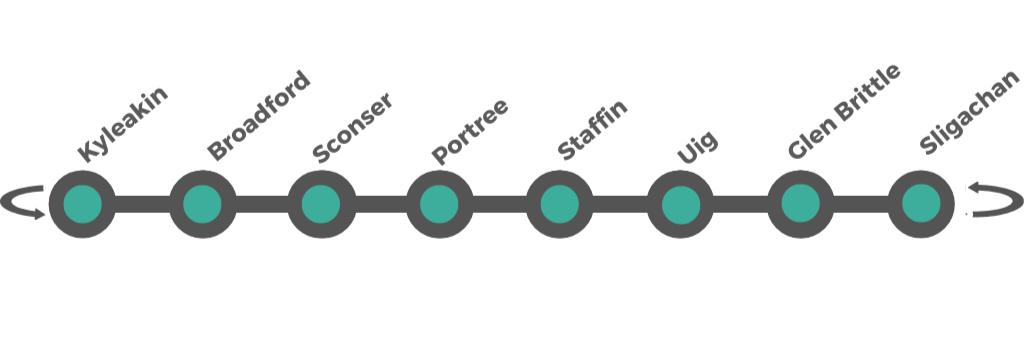
Arrival on Skye – Kyleakin → Broadford → Sconser → Portree
Trotternish Ridge – Old Man of Storr → Kilt Rock → Lealt Falls
West Trotternish & Uig – Staffin → Quiraing → Uig → Fairy Glen
West Coast of Skye – Dunvegan → Neist Point → Talisker
The Cuillin & Glen Brittle – Fairy Pools → Sligachan
Part 2 – Sleat Peninsula – Skye’s quieter south coast with villages, history and coastal views.

The Trotternish Loop – Skye’s Most Iconic Landscape
The Trotternish Peninsula forms the northern edge of Skye and delivers some of the island’s most recognisable scenery — a landscape shaped by ancient landslips, dramatic cliffs, and wide coastal views. This route is fully integrated into the Skye Coast section, meaning you continue west rather than looping back to Portree.
Old Man of Storr – A steep but rewarding climb to one of Skye’s most famous viewpoints
Lealt Falls & Gorge – Waterfalls cutting through deep coastal ravines
Kilt Rock & Mealt Falls – Cliffs and waterfall dropping straight into the sea
Quiraing – Surreal rock formations, ridgelines and hidden plateaus
Staffin & Kilmuir – Crofting heritage, fossils and quieter coastal stops
Uig – Harbour village and gateway to the Outer Hebrides
Allow a full day to explore properly — longer if walking. The route’s strength is not just individual stops, but the way the landscape evolves as you move through it, before continuing towards Dunvegan and the west coast.
Eilean Donan Castle – Gateway to Skye
Set on a small tidal island where three sea lochs meet, Eilean Donan is one of Scotland’s most iconic landmarks and a natural stopping point on the approach to Skye.
Historic setting – Origins in the 13th century, rebuilt into its present form
Location – Just before the Skye Bridge at Kyle of Lochalsh
Views – Mountain backdrops and loch-side viewpoints
It works equally well as a quick stop or a longer visit before continuing onto the island or heading into Glen Shiel.
Visiting Tips
Access – Footbridge from mainland, parking nearby
Best time – Early morning or late afternoon for light and fewer crowds
Allow time – Interior rooms, shoreline walks and viewpoints
Route position – Ideal stop en route to Skye, Applecross or Glen Shiel
One of the easiest and most rewarding stops on the west coast approach — and a strong visual starting point for the journey ahead.
How to Get to the Isle of Skye
Reaching Skye is part of the experience. Whether you arrive by road, rail, or ferry, the journey takes you through some of the most dramatic landscapes in Scotland — from lochs and glens to coastal crossings that set the tone for the island ahead.
By Road – Driving to Skye
From Inverness (~2.5 hrs)
A82 along Loch Ness → A87 through Glen Shiel → Eilean Donan Castle → Kyle of Lochalsh
From Glasgow (~5–6 hrs)
A82 via Loch Lomond and Glencoe → Fort William → A87 to Skye
From Edinburgh (~5.5–6.5 hrs)
M90 / A9 north → join A82 or A87 west towards Skye
Final stretch: Cross via the Skye Bridge (free) from Kyle of Lochalsh into Kyleakin.
By Train – One of Scotland’s Best Routes
Inverness → Kyle of Lochalsh (2.5–3 hrs)
Scenic Highland line via Dingwall, Achnasheen and Plockton
From London / Edinburgh / Glasgow
Connect via Inverness or travel to Fort William for ferry access
Kyle of Lochalsh station sits beside the Skye Bridge — an easy transition onto the island.
By Bus – Direct to the Island
Glasgow → Skye (5–6 hrs)
Citylink routes via Fort William and the west Highlands
Inverness → Skye (3–4 hrs)
Via Loch Ness and the A87 corridor
Arrival: Most services terminate in Portree
Slower than driving, but a scenic and cost-effective option.
By Air – Nearest Airports
Inverness (INV)
~2.5 hrs drive to Skye
Glasgow (GLA) / Edinburgh (EDI)
~5–6 hrs drive or combine with train/bus
Car Hire
Available at all major airports
Flying into Scotland’s central belt gives the most flexibility.
By Ferry – The Most Scenic Arrival
Mallaig → Armadale (30 mins)
A classic sea crossing across the Sound of Sleat with views to Skye’s southern coastline
Glenelg → Kylerhea (seasonal)
A small, traditional turntable ferry offering a quieter and more atmospheric alternative
Why take the ferry? It turns your arrival into part of the experience — approaching Skye by water gives a real sense of scale, isolation and landscape that the bridge simply can’t match.
Good to know: The Mallaig route connects easily with the West Highland railway and road routes via Fort William, making it a natural choice for a circular journey.
The Layers of Skye – Coast, Sky and Story
There’s more to Skye than the road itself. Beyond the headline landscapes are quieter moments — beaches shaped by tides and weather, skies untouched by light, and stories that have been carried through generations.
These are the details that give the island its character, adding depth and texture to the journey as you explore — not separate from the route, but woven into it as you move across the island.
Isle of Skye’s Best Beaches
Coral Beach (Claigan)
White coral sands and turquoise water with views to the Outer Hebrides
Talisker Beach
Black sand and sea stacks beneath the Cuillin
An Corran (Staffin)
Dinosaur footprints with views to the Trotternish Ridge
Glenbrittle Beach
Wild coastal setting at the foot of the Cuillin
Tarskavaig Bay
Quiet, remote beach with wide coastal views
These beaches appear naturally along the journey, rather than as standalone stops.
Myths, Legends & Folklore
Fairy Folklore
Hills, pools and glens linked to Skye’s mythical fairy folk
Old Man of Storr
Said to be the thumb of a buried giant
The Cuillin
Stories of battles, gods and creatures
Kelpies
Shape-shifting spirits of lochs and rivers
MacLeod’s Tables
Flat-topped hills tied to giant legends
Selkies
Seal-human shapeshifters of coastal folklore
Best Stargazing Spots on Skye
Trotternish Peninsula
Remote northern skies and wide horizons
Quiraing
Dramatic terrain beneath open night skies
Neist Point
Western edge views out over the Atlantic
Fairy Pools
Quiet and atmospheric after dark
Glenbrittle Beach
Excellent dark skies near the Cuillin
Tarskavaig
One of the island’s most secluded spots
On clear nights, the skies feel as expansive as the landscape itself.
Isle of Skye Last updated: 24 March 2026
Some links may earn Uncover Britain a small commission at no extra cost to you. This helps support the ongoing creation, review and presentation of our road trip guides.
Route information and listings are provided for general guidance only. Always use your preferred navigation system and check official websites to confirm suitability, opening times and the latest details before travelling.
Our guides are reviewed regularly and supported by a mix of editorial research and digital tools to help keep content clear and up to date. If you spot anything that needs updating, we’re always glad to hear from you.