

Northumberland — Coast, Castles, National Park & Hidden Valleys
A Complete Journey from Remote Interior to Iconic Coastline
Northumberland is a county best understood by driving it. Big skies, quiet roads and long views link a wild, dune-backed coastline with river valleys, heather moorland, deep forests and the stone line of the Roman frontier.
This guide brings those landscapes together into two beautifully contrasting sections that can be driven separately or combined into one richly varied road trip.
How the Journey Works
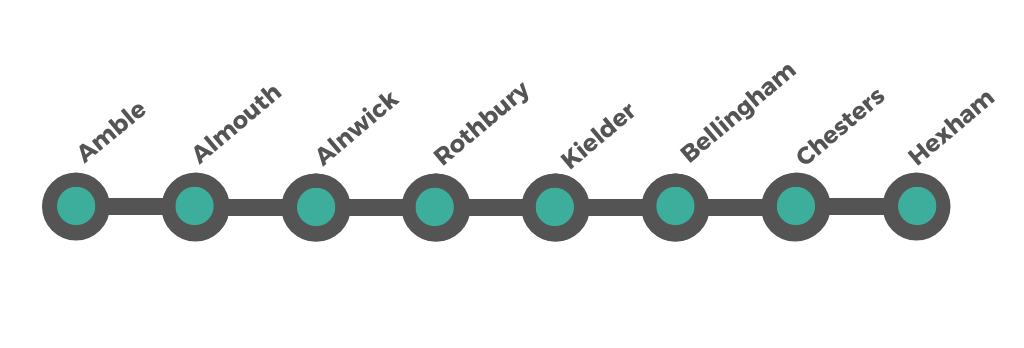
Inland 250 Loop – National Park, valleys, forest, Roman frontier
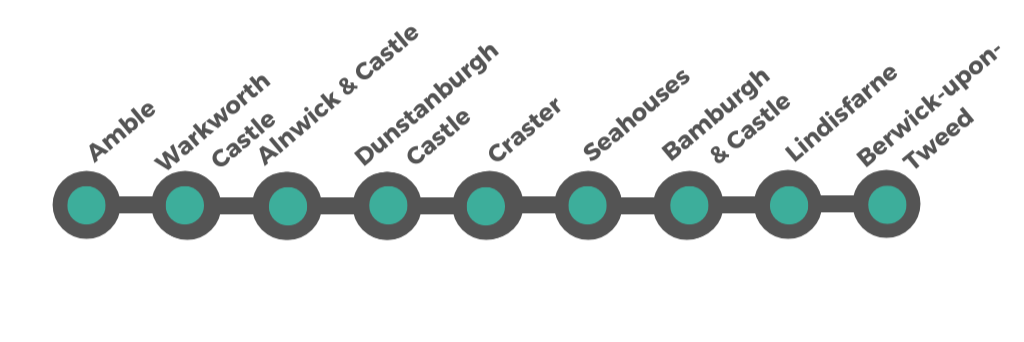
Castles & Coast – Castles, beaches, villages, tidal crossings
2. Castles & Coast
Optional Scenic Routes & Detours
How to Get There
The Northumberland route naturally begins around Amble, a small harbour town on the county’s coast. Well connected by road, rail and nearby airports, it’s an easy starting point whether you’re travelling from within the UK or further afield.
By Road – Driving to Amble
Newcastle (~45 mins)
A1 north, then A1068 coastal route to Amble
Edinburgh (~2 hrs)
A1 south directly into Northumberland
Leeds (~2.5 hrs)
A1(M) north, continuing on A1 into Northumberland
Manchester (~3 hrs)
M62 → A1(M) north → A1
London (~5–6 hrs)
A1(M) north (most direct route)
Scenic routes:
Many visitors continue north beyond Amble towards Bamburgh, Lindisfarne and Berwick-upon-Tweed.
Tip: The A1 makes Northumberland one of the easiest “far north” destinations to reach by car.
By Train
Nearest station: Alnmouth (East Coast Main Line)
London King’s Cross (~3h 45m)
Direct services to Northumberland via the East Coast Main Line
Edinburgh (~1 hr)
Frequent direct trains south into Northumberland
Newcastle (~20 mins)
Quick local rail connections
Search UK train tickets and fares: Search train tickets
Travelling longer distances around Britain? Compare: UK rail passes
Save up to 1/3 on UK rail travel with a Railcard .
From Alnmouth, it’s around a 10–15 minute taxi or bus journey to Amble.
By Bus & Coach
From Newcastle
Arriva X18 / X20 coastal routes
connecting Newcastle, Alnwick, Alnmouth and Amble
Local connections
Regular buses between Alnwick, Alnmouth, Warkworth and Amble
Long-distance coaches
National Express
,
Megabus
and
FlixBus
services connect Newcastle with cities across the UK
Save on longer journeys with National Express Coachcards .
Bus travel is straightforward along the coast, though having a vehicle gives greater flexibility for inland castles, beaches and Northumberland National Park.
From Europe
Southern UK Arrivals
Le Shuttle
Vehicle crossings through the Channel Tunnel between Calais and Folkestone.
Vehicle crossings via Channel Tunnel
Eurostar
High-speed passenger rail connecting London with Paris, Brussels and Amsterdam.
Find lowest fares
DFDS Ferries
Dover–Calais, Dover–Dunkirk and Newhaven–Dieppe crossings.
Explore DFDS crossings
P&O Ferries
Dover to Calais crossings for southern UK arrivals.
P&O ferry routes
Brittany Ferries
Ferry routes from France and Spain into southern England.
Explore ferry routes
Northern England & Scotland Arrivals
DFDS Ferries – Amsterdam to Newcastle
One of the most useful routes for reaching Northumberland directly from mainland Europe.
Explore DFDS crossings
P&O Ferries – Rotterdam to Hull
Useful for combining Yorkshire and Northumberland road trips.
P&O ferry routes
•
Vehicle travel information
Campervan travellers:
Newcastle arrivals are especially popular for reducing overall UK driving time before reaching Northumberland.
By Air – Best Airports
Newcastle Airport is the closest and most convenient airport for Northumberland, with strong UK and European connections.
Newcastle Airport
Closest airport for the Northumberland coast and easiest overall access point.
Around 45 minutes by road to Amble and the coast.
Edinburgh Airport
Wider international route network and useful for combining Scotland and Northumberland.
Around 2 hours by road into Northumberland.
Vehicle Hire Options
Having your own vehicle gives the most flexibility for exploring Northumberland’s castles, beaches, countryside and remote inland landscapes.




The Sandstone Way — Castles, Crags & Coast
The Sandstone Way is a well-known coast-to-coast cycling route that traces Northumberland’s distinctive sandstone landscapes from Berwick-upon-Tweed to Hexham. Rather than following the quickest line, it links castle headlands, rocky crags, river valleys and historic towns shaped by this warm, honey-coloured stone.
While you’re not following the route directly, this road trip passes through many of the same landscapes. You can explore more here: The Sandstone Way
How to experience it by car
You’re not following the Sandstone Way itself, but you are travelling through the same terrain. Look for castle-lined headlands along the coast, sandstone-built towns, and the craggy ridges that shape the inland route.
As you move from Alnwick into Rothbury and Coquetdale, and then toward Simonside and Hexham, the landscape shifts in exactly the way the route was designed to showcase.
It’s a useful lens for understanding why Northumberland looks and feels the way it does — a journey shaped as much by geology as by history.
Uncover More — Stories, Skies & Legends
Northumberland is a land of deep history, legendary tales, and awe-inspiring natural beauty. From Viking invasions to folklore woven into its landscapes, the region offers far more than its castles and coastline.
It is also home to some of the UK’s darkest skies — where vast nightscapes, ancient ruins and remote landscapes combine to create something truly special.
Northumberland’s Dark Skies — One of Europe’s Best Stargazing Regions
Northumberland International Dark Sky Park is one of the largest in Europe, covering vast areas of National Park and Kielder Water & Forest Park. With almost no light pollution, it offers exceptional conditions for stargazing and astrophotography.
From coastal horizons to the remote interior, this is one of the few places in England where you can clearly see the Milky Way — and occasionally the Northern Lights.
Vikings & Border History
Northumberland was once part of the Anglo-Saxon Kingdom of Northumbria, frequently targeted by Viking raids along its exposed coastline.
Norse settlers later established communities across the region, leaving a lasting imprint in place names, culture and identity — shaping Northumberland as a true borderland.
From Viking incursions to major battles like Brunanburh, this history is embedded in the landscapes you’re driving through.
Folklore, Myths & Legends
Laidly Worm — A cursed princess transformed into a dragon, eventually freed by her brother.
Thomas the Rhymer — A poet taken to the realm of the fairies who returned with prophetic powers.
Cauld Lad of Hylton — A ghostly stable boy said to haunt a castle, both mischievous and helpful.
Border Reivers — Infamous raiding clans whose violent feuds shaped life along the Anglo-Scottish border.
These stories add a layer of mystery and atmosphere, bringing Northumberland’s landscapes to life beyond what you can see.
Continue Your Journey
From Northumberland, you’re perfectly placed to continue north into Scotland or explore more of northern England along the way.
Whether you follow the coast, cross into the Highlands or loop inland, each route builds naturally on your journey.
North Yorkshire Moors
Moorland landscapes and seaside towns.
Yorkshire Dales
Limestone valleys and open landscapes.
Peak District
Dales, ridgelines and classic countryside landscapes.
Edinburgh & Borders
Castles, abbeys and rolling countryside just across the border.
Kingdom of Fife
Fishing villages, beaches and St Andrews.
North Coast of Scotland
The NC500, remote landscapes and dramatic coastal scenery.
West Coast of Scotland
Sea lochs, Mull and Scotland’s wild Atlantic coastline.
Isle of Skye
Cuillin mountains, cliffs and iconic Highland landscapes.
Northumberland Castles & Coast Last updated: 25 March 2026
Some links may earn Uncover Britain a small commission at no extra cost to you. This helps support the ongoing creation, review and presentation of our road trip guides.
Route information and listings are provided for general guidance only. Always use your preferred navigation system and check official websites to confirm suitability, opening times and the latest details before travelling.
Our guides are reviewed regularly and supported by a mix of editorial research and digital tools to help keep content clear and up to date. If you spot anything that needs updating, we’re always glad to hear from you.