

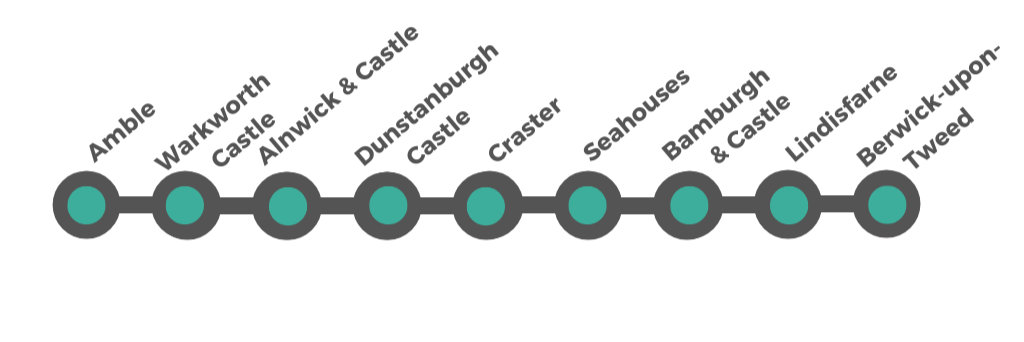
62 miles (99 km) with approx. drive time of 2 hours and 30 minutes
Customisable and Live Navigation via Google Maps –
click here:
Or use the link to jump to the destinations in the guide below
Amble →
Warkworth Castle →
Alnwick →
Dunstanburgh Castle →
Craster →
Seahouses →
Bamburgh →
Lindisfarne →
Berwick-upon-Tweed
Northumberland Coast Path — Walking the Castle Coast
The Northumberland Coast Path is a long-distance walking route that threads together beaches, dunes, cliffs, castles and fishing villages along one of the most beautiful shorelines in England. It broadly follows the coast between Cresswell in the south and Berwick-upon-Tweed in the north, passing directly through many of the places on this road trip.
You don’t need to walk it all. The real joy is dipping into the best sections where the scenery is at its most dramatic.
Best sections to join alongside this route
Craster → Dunstanburgh Castle (≈ 1.3 miles each way)
Start in Craster harbour and follow the path across open fields to Dunstanburgh Castle. This is the classic stretch: sheep pastures, seabirds, big skies and the castle slowly appearing on its headland.
Seahouses → Bamburgh (≈ 3 miles one way)
A beautiful sandy walk with constant sea views between Seahouses and Bamburgh. You can walk one way and return by road, or simply enjoy a shorter out-and-back along the beach.
Bamburgh → Budle Bay (flexible distance)
Quieter and wilder, this section leaves the village behind and opens into dunes, salt marsh and wide views toward Holy Island.
Holy Island causeway approach
Near Lindisfarne, the path explores the mudflats, shoreline and dunes that give context to the tidal crossing. Even a short wander here helps you understand the scale and isolation of the island.
How to use it with your road trip
Because your route stops at Craster, Seahouses, Bamburgh and Lindisfarne, you’re perfectly placed to enjoy the very best parts of the Coast Path without committing to a full day’s hike. Park in the villages, walk a memorable section, then continue the drive.
It’s an ideal way to slow the pace, stretch your legs and experience the coastline at ground level rather than just through the windscreen.
Amble — Harbour Life, Islands and Wide Sands
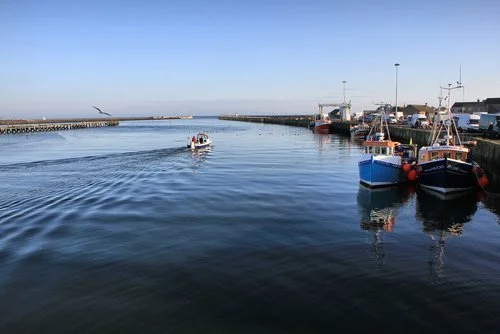
Amble is a friendly working harbour at the mouth of the River Coquet where fishing boats, seabirds and big coastal skies set the tone for this road trip. It’s an easy place to arrive, park, wander and breathe in the sea air before heading inland. With a small marina, a sweep of sandy beach at Little Shore, and views across the water to Warkworth Castle, Amble feels both open and compact — a perfect starting point.
What to see and do
Browse the harbourside seafood pods for fresh, local lunches
Walk the pier for views toward Coquet Island and its lighthouse
Stroll along Little Shore beach and the dunes south of the harbour
Follow the River Coquet path for views back to Warkworth Castle (included on the coast route)
Visit the marina and watch fishing boats unload the day’s catch
Enjoy cafés, ice cream and easy harbourfront wandering before setting off inland
Warkworth Castle — A Fortress in a River Bend
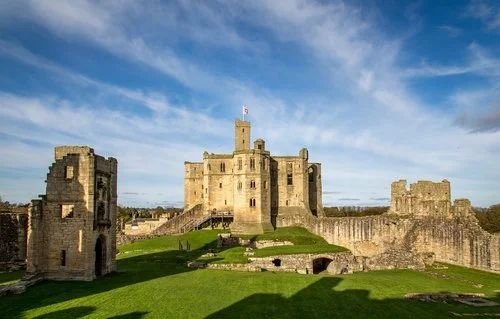
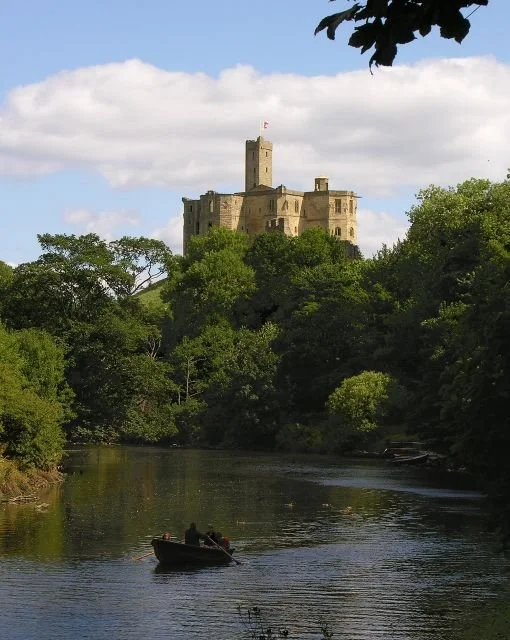
Warkworth Castle sits inside a sweeping loop of the River Coquet, creating one of the most picturesque medieval settings in Northumberland. From the village, an easy riverside walk reveals changing views of the great keep rising above meadows and slow water, while a near-complete circuit of towered walls still encloses the site. It’s a peaceful, photogenic stop that contrasts beautifully with the dramatic headland castles further up the coast.
What to see and do
Walk the circular riverside path for classic views of the keep above the Coquet
Explore the impressive keep, great hall and curtain walls
Climb the towers for views across river, village and countryside
Combine with time in Warkworth village cafés and the medieval bridge
-
12th century origins
Founded as a motte-and-bailey stronghold, the castle occupied a strategic river position controlling movement through the Coquet valley.The Percy stronghold
From the 14th century, the powerful Percy family transformed Warkworth into a principal residence, enlarging it into a formidable symbol of northern power and prestige.Wars of the Roses
In 1462 the castle was besieged and taken by Yorkist forces before later returning to Percy control, reflecting the shifting loyalties of the period.Civil War and decline
Garrisoned for the Royalists, Warkworth fell to Parliament in 1648 and was deliberately slighted, after which it slipped into ruin.Preservation
In the 19th century the Dukes of Northumberland stabilised the remains. Today the castle is cared for by English Heritage and open for visitors to explore its remarkably intact medieval fabric.
Explore Coastal Heritage with English Heritage
Along Northumberland’s coastline, dramatic castles and historic sites sit right on the edge of the North Sea — combining some of England’s most iconic views with centuries of history.
These coastal landmarks are among the most recognisable in the UK — from the sweeping ruins of Dunstanburgh to the tidal setting of Lindisfarne — and are perfectly placed along the route.
Annual membership starts from £53 — with 15% off using code AFFEH1526 until 31.12.2026.
Membership often pays for itself in just 2–3 visits, making it easy to explore multiple castles along the coast.
Get 15% Off MembershipAlnwick — Cobbled Streets, Books and Gardens
Alnwick is a handsome market town of stone buildings, cobbled lanes and independent shops, sitting neatly between coast and countryside. It’s an easy place to slow down for an hour or two — browse, wander and enjoy the atmosphere — before the road begins to climb inland toward the hills. With cafés, bookshops and gardens, Alnwick offers a relaxed pause that feels distinctly Northumbrian without needing to rush.
What to see and do
Visit Alnwick Castle (see below)
See Bondgate Tower (Hotspur Gate), a 15th-century stone gatehouse built after Henry V granted the town a licence to crenellate its walls in 1434
Explore the stories of the border conflicts atBailiff Gate Museum, home to artefacts, documents and audio-visual displays
Catch a performance or film at Alnwick Playhouse, a lively arts venue with an eclectic programme
Browse Barter Booksin the old railway station, complete with model railway, poetry lines and the popular Station Buffet café
Wander through Alnwick Garden with its themed planting, water features and contemporary design
Walk in Hulne Park, a vast walled estate of parkland, woodland, priory ruins and Brizlee Tower viewpoints
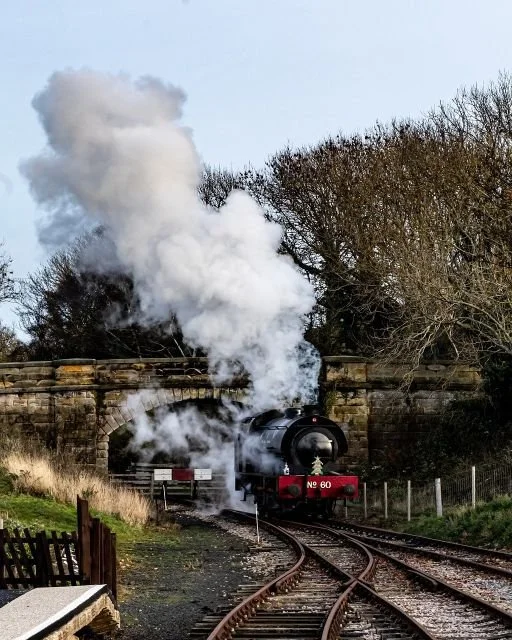
Ride a heritage diesel service with the Aln Valley Railway, restoring part of the old Alnwick–Alnmouth line
Alnwick Castle - Medieval Power, Film Fame and Living History

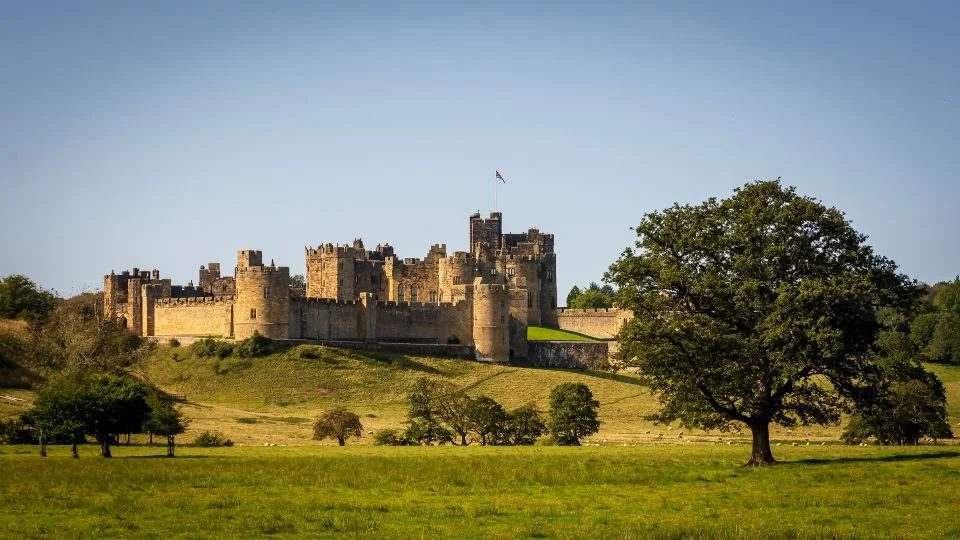
Alnwick Castle, located in the market town of Alnwick in Northumberland, is one of the most iconic and historically significant castles in the country. Alnwick Castle has a rich history dating back to the Norman period, with the earliest parts of the castle constructed in the 11th century. It was built to defend the northern border of England against Scottish invaders and served as a formidable stronghold during the medieval period.
Since 1309, Alnwick Castle has been the ancestral seat of the Percy family, who are the Earls and Dukes of Northumberland. The castle has been continuously inhabited by the Percy family for over 700 years, making it one of the oldest inhabited castles in England.
In addition to its historic significance, Alnwick Castle is surrounded by beautifully landscaped gardens and grounds. The Alnwick Garden, adjacent to the castle, features stunning formal gardens, water features, and contemporary art installations, offering visitors a tranquil oasis to explore and enjoy.
The Castle has a starring role as Hogwarts School of Witchcraft and Wizardry casts a hint of magic over the grounds. Have a guided tour led by Ron Weasley and take a broomstick lesson on the very spot where Harry, Ron, and Hermione learned to fly. Harry Potter aside, get lost in the history of medieval architecture and opulent Italianate State Rooms of the Duchess of Northumberland’s family home.
Today, Alnwick Castle is open to the public as a major tourist attraction, offering guided tours, historical reenactments, and family-friendly activities. Visitors can explore the castle's grand interiors, including the State Rooms, Percy Tenantry Museum, and medieval dungeons, and learn about its fascinating history through interactive exhibits and displays.
Dunstanburgh Castle — The Headland Fortress Above the Sea
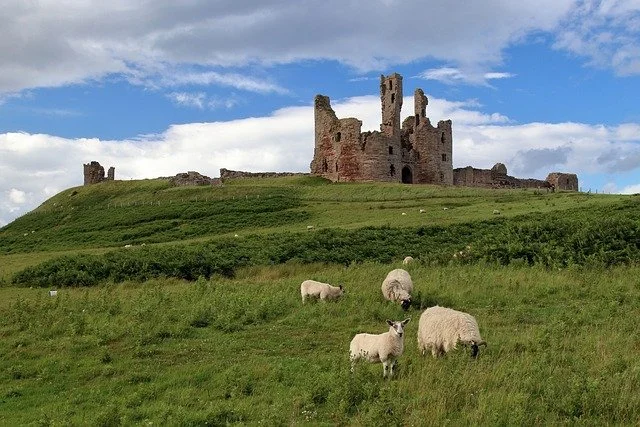
Dunstanburgh Castle from a remote headland between Craster and the open North Sea, one of the most dramatic castle settings in Britain. Reached on foot along a beautiful coastal path, the approach is part of the experience: working farmland, seabirds, big skies and then the vast curtain walls appearing ahead. It’s a peaceful, windswept place that feels closer to landscape than architecture — and unforgettable in changing light.
What to see and do
Walk the 1.3-mile coastal path from Craster for the classic approach
Explore the great gatehouse, curtain walls and towers
Picnic on the grassy headland with sea views
Photograph the castle against waves, cliffs and wide skies
-
A rebel’s fortress (1313)
Built by Thomas, Earl of Lancaster, cousin to Edward II, Dunstanburgh was conceived on a grand scale as a statement of power on a remote coastal spur.Lancaster’s fall
Before he could enjoy it, Lancaster’s rebellion failed and he was executed in 1322. The castle later passed to John of Gaunt, who strengthened the gatehouse against Scottish threats.Wars of the Roses
Dunstanburgh was briefly besieged and captured in the 15th century, though it saw little sustained military action.Civil War and decline
By the 17th century the castle’s military role had faded. It slipped into ruin, its dramatic setting preserving it more as a landmark than a fortress.Art, literature and preservation
The ruins inspired artists and writers, including Sir Walter Scott. Today the site is cared for by English Heritage, with access along the coastal walk that makes this one of Northumberland’s most atmospheric visits.
Craster — Kippers, Harbour Life and the Walk to Dunstanburgh
Craster is a small, working fishing village where the harbour, the sea and the smell of woodsmoke set the tone. Lobster pots line the quayside, small boats bob in the inlet and the pace feels unhurried. This is the traditional starting point for the coastal walk to Dunstanburgh Castle, and the place most closely associated with Northumberland’s famous kippers.
What to see and do
Wander around the harbour and watch daily fishing life unfold
Visit L. Robson & Sons for the legendary Craster kippers
Enjoy seafood lunches, crab sandwiches and sea views in village cafés
Walk the coastal path to Dunstanburgh Castle (around 1.3 miles each way) or other coastal walks
Browse small galleries and artisan shops for local crafts
Craster is as much about atmosphere as attractions — big skies, crashing waves, rugged cliffs and the simple pleasure of sea air before or after the castle walk.
Seahouses — Harbour Life, Beaches and Boat Trips
Seahouses is a lively harbour village where fishing heritage meets seaside atmosphere. Lobster pots stack along the quayside, boat skippers call out for island trips and the smell of fish and chips drifts across the promenade. With wide beaches, open views towards Bamburgh Castle and easy access to coastal paths, it’s both a practical stop and a classic Northumberland seaside pause.
What to see and do
Wander the working harbour and watch boats heading to the islands
Enjoy fish and chips on the front with sea views
Walk the Northumberland Coastal Path toward Bamburgh or Beadnell
Browse small shops, cafés and the Seahouses Tourist Centre
Relax on Low Hauxley Beach which is located about 1 mile south of the village.
Farne Islands — Puffins, Seals and Sea Cliffs
Just offshore from Seahouses lie the Farne Islands, one of Britain’s most important wildlife sites. These rocky islands are home to thousands of seabirds in spring and summer — including puffins, terns and guillemots — while grey seals bask on the rocks year-round. The islands also carry a spiritual link to St Cuthbert, who once lived here as a hermit.
How to visit
Boat trips depart regularly from Seahouses harbour (seasonal and weather dependent). Billy Shiel’s Boat Trips provides guided tours.
Options include landing trips on Inner Farne or wildlife cruises circling the islands
Best time for puffins: late April to July
Bring layers — sea conditions can feel much cooler offshore
A Farne Islands trip adds a memorable wildlife dimension to the Castles & Coast section of the route.


Bamburgh Castle — The Great Fortress Above the Beach
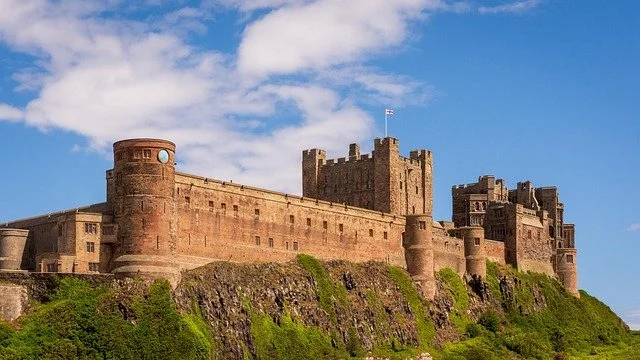
Bamburgh Castle dominates the shoreline from its dark volcanic outcrop of the Great Whin Sill, rising straight above miles of sand and sea. Few castles in Britain feel so perfectly placed. Whether viewed from the beach, the dunes or the village, it is a constant presence on the coast — vast, dramatic and unmistakable.
What to see and do
Walk the beach for the classic castle-and-dunes perspective
Explore the state rooms, armoury and exhibitions inside the castle
Climb the battlements for sweeping views of coastline and Farne Islands
Combine with time in Bamburgh village cafés and shops
-
An ancient royal site
The rock on which Bamburgh stands has been fortified for over 1,400 years. It was once the royal seat of the Anglo-Saxon Kings of Northumbria, long before the Norman castle rose here.Norman fortress
After the Norman Conquest, a formidable castle was built on the site, taking full advantage of the natural defensive position above the sea.Wars of the Roses
In 1464, Bamburgh became the first castle in England to fall to gunpowder artillery, marking a turning point in medieval warfare.Victorian restoration
By the 18th and 19th centuries the castle had fallen into ruin. In 1894, industrialist and philanthropist William George Armstrong purchased the site and began an ambitious restoration, shaping
Bamburgh — Wide Sands, Quiet Streets and Castle Views
Bamburgh is a small coastal village that lives comfortably in the shadow of its great castle. Stone cottages, tearooms and small shops line quiet streets, while just beyond the dunes a vast sweep of sand opens out beneath the fortress. It’s a place to slow down — part seaside, part history, part scenery. Bamburgh combines beach, village life and historic atmosphere in one of the most memorable settings on the Northumberland coast.
What to see and do
Wander the village streets for cafés, galleries and local shops
Walk the beach for panoramic views of Bamburgh Castle rising above the dunes
Visit St. Aidan's Church for Norman architecture and one of the best castle viewpoints
Follow the coast path toward the Bamburgh Lighthouse for wide views to the Farne Islands
Learn about Grace Darling’s famous sea rescue at the Grace Darling Museum
St Cuthbert’s Way — The Pilgrim Approach to Holy Island
St Cuthbert’s Way is a celebrated long-distance walking route that traces the historic journey from the Scottish Borders to Lindisfarne. For centuries, this was a pilgrim approach to Holy Island, and today it shapes how many visitors experience the landscape leading to the tidal causeway.
The path passes through quiet farmland, big Cheviot views and gentle coastal scenery before reaching the sands opposite Lindisfarne. It gives context to why the island feels so remote and special — it was meant to be approached slowly.
Where this connects with this route
Lindisfarne (Holy Island) — the spiritual and physical end point of the route, matching your tidal crossing.
Bamburgh and the surrounding coast — the same open shoreline and dune landscapes walkers see on their final approach.
You’re not following the walking route itself, but you are travelling through the same pilgrimage landscape. Referencing St Cuthbert’s Way helps explain why this stretch of coast feels purposeful, historic and quietly dramatic, especially as you time your crossing to Holy Island.
Lindisfarne (Holy Island) — The Tidal Crossing to England’s Spiritual Shore
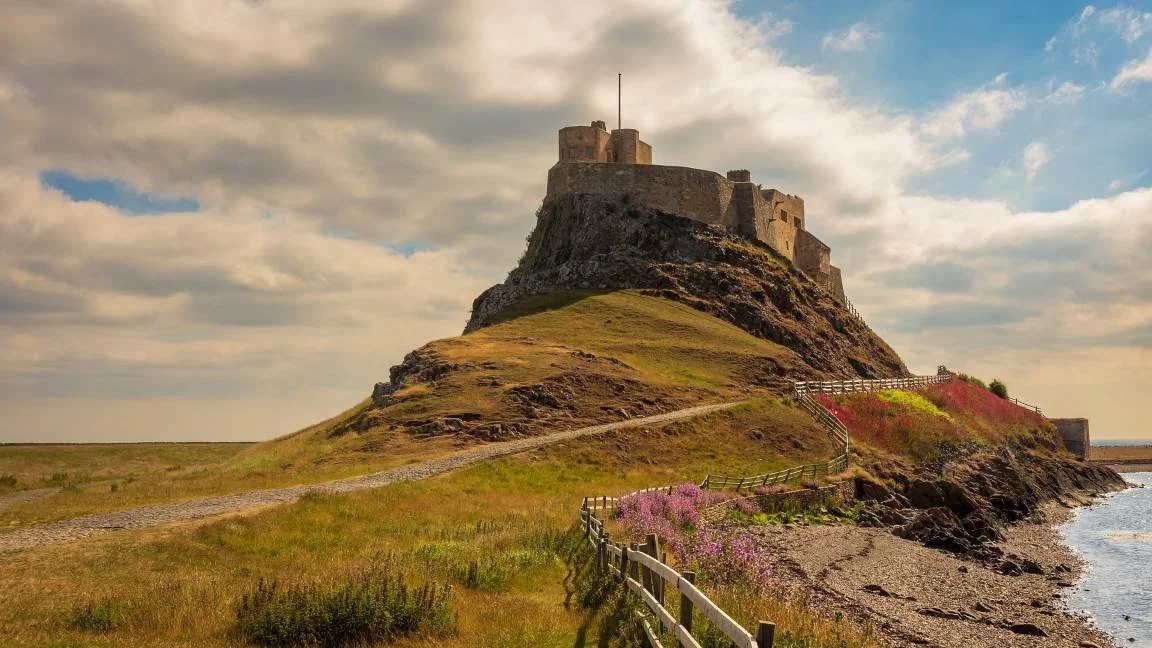
Few places in England arrive with such theatre. Twice a day, the sea covers the road. Then, just as quietly, it reveals it again. Timing your drive across the causeway to Holy Island is part of the experience — a sense that you are entering somewhere set apart from the everyday world.
Once across, the island feels calm, elemental and deeply historic. Ruins of a great priory sit in open grass above the shore. A small castle perches on rock above the harbour. Wide skies, mudflats, dunes and seabirds surround a village of cottages, cafés and quiet lanes. This is not just a scenic stop — it’s one of the most atmospheric places on the entire coast.
What to see and do
Explore Lindisfarne Priory and its museum, home to the story of the Lindisfarne Gospels and Viking raids
Visit Lindisfarne Castle for panoramic coastal views
Walk the beaches and dunes for seals, birds and vast skies
Visit the Lindisfarne Heritage Centre that tells the story of the island's history and culture.
Browse small galleries, cafés and island shops
Pause simply to absorb the stillness that defines this place
-
Early Christianity (7th century)
Lindisfarne became one of the most important centres of early Christianity in Britain. Monks founded a priory here in AD 635, and the island became the home of St Cuthbert.The Lindisfarne Gospels
Around AD 700, monks produced the beautifully illuminated Lindisfarne Gospels, one of the greatest medieval manuscripts in the world.Viking raids (793 AD)
The Viking attack on Lindisfarne Priory shocked the Christian world and is often marked as the beginning of the Viking Age in Britain.Later centuries
The priory fell into ruin after the Dissolution of the Monasteries. In the 16th century, a small fort (now the castle) was built to guard the harbour. -
Check safe causeway crossing times before you go — the road is fully covered at high tide
Allow several hours; this is a place to explore slowly on foot
Parking is outside the village; the island is best explored walking
Boat trips sometimes run around the island in summer months
Combine with Bamburgh or Seahouses on the same day, depending on tide times
Arriving and leaving with the tide is what makes Holy Island unforgettable.
Berwick-upon-Tweed — Walls, Ramparts and a Border Story
Set at the mouth of the River Tweed, Berwick-upon-Tweed feels different from anywhere else in England. As the northernmost town in the country, it changed hands between England and Scotland many times, and that turbulent history is written into its streets, walls and skyline. Wide Elizabethan ramparts encircle the town, offering one of the finest town walks in Britain with views across river, sea and rooftops.
What to see and do
Walk the complete circuit of the Elizabethan walls for panoramic views
Explore the remains of Berwick Castle and its ramparts
Visit the Berwick Town Hall & Cell Block Museum for courtroom, jail cells and local stories
Browse independent shops and cafés along Marygate and the Market Cross
Take a river or sea trip with Berwick Boat Trips
Visit the Berwick Museum and Art Gallery
Berwick’s markets (Wednesdays and Saturdays) add to the atmosphere, while museums and galleries reveal a long border history and fine art collections. It’s a fitting northern finale to the Castles & Coast section — a town shaped as much by defence and geography as by everyday life.

Duddo Stone Circle – Northumberland’s Ancient Mystery
Duddo Stone Circle, also known as Duddo Five Stones, is a prehistoric stone circle located approximately 7 miles west of Berwick-upon-Tweed and 4 miles south of the Scottish border. Thought to date back over 4,000 years to the Early Bronze Age, it stands as a testament to ancient ritual landscapes. Duddo Stone Circle is a scheduled ancient monument, recognised for its archaeological and historical importance. While its original purpose remains uncertain, theories suggest it may have been used for rituals, gatherings, or celestial observations.
Originally seven stones, now five upright stones remain, standing between 1.5 to 2.3 meters tall. The circle offers panoramic views of the Cheviot Hills to the south and the Lammermuir Hills to the north, making it one of the most atmospheric ancient sites in Northumberland.
From Berwick-upon-Tweed
~10 miles / 20 minutes west
Easy rural drive into the border countryside
From Holy Island / Bamburgh area
~25–30 miles / about 45 minutes inland
From Wooler (St Cuthbert’s Way / Cheviot foothills)
~8 miles / 15 minutes
Location: Near the village of Duddo, Northumberland. Access: A permissive path from the B6354 road leads to the site across farmland. The short walk to the stones can be muddy, so sturdy footwear is recommended.
A Fitting End to the Coast — And the Whole Journey
As you reach Berwick-upon-Tweed, the story of the Northumberland coast gently comes to a close. The great beaches, castle headlands and fishing villages give way to town walls, river views and a skyline shaped by centuries of border history. It feels like a natural full stop — not dramatic, but satisfying.
This is where the Castles & Coast section resolves itself into something quieter and more reflective. You’ve travelled from open sands and tidal islands to a place where England and Scotland once contested every street and stone.
It’s also a fitting end to the entire Northumberland road trip. From inland valleys and Roman frontiers, through moorland, forest and rivers, and out along one of Britain’s most beautiful coastlines, the journey has shown how varied this county truly is.
You finish not at a viewpoint or a landmark, but in a place that gathers all those landscapes — history, coast, countryside and story — into one final, memorable stop.
Uncover More Map
The Uncover More map highlights key points of interest, scenic viewpoints, hidden gems, and much more along the recommended route. To make the most of it, use the map in conjunction with the destination information, and explore additional options in the area you’re visiting to discover even more experiences.
If your iPhone doesn’t load via the Google Map App via the button, check out the Help page for how to update your phone or copy and paste the link into your browser: https://bit.ly/northumberland-uncover
There are over 40 English Heritage properties in Northumberland, including WARKWORTH CASTLE, DUNSTANBURGH CASTLE, LINDISFARNE PRIORY, SEVERAL HADRIAN'S WALL SITES, INCLUDING CHESTERS ROMAN FORT AND MUSEUM AND HOUSESTEADS ROMAN FORT, EDLINGHAM CASTLE.
It makes sense for this road trip alone, plus enjoy unlimited access to hundreds of historic places and free child places with an annual membership, starting from £53 a year.
Continuing Your Journey Around Northern England — or into Scotland
If this Northumberland road trip has sparked an appetite to explore further, you’re perfectly placed to continue in several natural directions — first across Northern England, then onward into Scotland. Each of these journeys builds on the same sense of space, history and quiet roads you’ve already experienced here.
Exploring more of Northern England
Heading south and west from Northumberland, a series of classic landscapes unfold in easy succession:
North Yorkshire — heather moorland, coastal cliffs and historic fishing villages
Yorkshire Dales — limestone valleys, dry stone walls and peaceful green dales
Peak District — gritstone edges, rolling hills and market towns
Lake District — mountain passes, lakeside roads and dramatic scenery
Each offers the same blend of scenic driving, walking opportunities and historic towns that define Northumberland, but with their own distinctive character.
Crossing the border into Scotland
If you continue north instead, Scotland opens up quickly:
Scottish Borders — abbeys, rolling hills and quiet historic towns
Fife Road trip — fishing villages, beaches and the medieval streets of St Andrews
West Coast of Scotland — sea lochs, mountain roads and long coastal viewpoints
Isle of Skye — ridges, peninsulas and iconic scenic loops
North Coast of Scotland road trip — wild cliffs, empty beaches and remote Highland driving
Taken together, these routes allow you to explore Britain not as isolated highlights, but as a chain of connected journeys — each one flowing naturally into the next, just as Northumberland does from coast to castle, forest to frontier.
Northumberland Castles & Coast Last updated: 25 March 2026
Some links may earn Uncover Britain a small commission at no extra cost to you. This helps support the ongoing creation, review and presentation of our road trip guides.
Route information and listings are provided for general guidance only. Always use your preferred navigation system and check official websites to confirm suitability, opening times and the latest details before travelling.
Our guides are reviewed regularly and supported by a mix of editorial research and digital tools to help keep content clear and up to date. If you spot anything that needs updating, we’re always glad to hear from you.