Viewing as a member

Stargazing in Wales: Valleys & Brecon


41 miles (66 km) with drive time approx. 2 hours
Rhondda Cynon Taf > Merthyr Tydfill > Brecon Beacons National Park > Brecon
Customisable via Google Maps (If it doesn’t launch on your iPhone copy and paste it into a browser: https://bit.ly/Stars-SWales) – click here
Part 1: The Valleys — From Industry to Darkness
This journey begins in the Welsh Valleys — a landscape shaped more dramatically by human history than almost anywhere else in Britain.
In the 18th and 19th centuries, these steep-sided valleys became one of the industrial engines of the world. Coal mines, ironworks, railways, and terraces transformed quiet rural landscapes into dense, hard-working communities whose labour powered the Industrial Revolution.
That history still defines the character of the region, but today the Valleys are also something else: a landscape of recovery, where nature, space, and silence have gradually returned. Wooded slopes, high ridgelines, rivers, and waterfalls now sit alongside the great industrial monuments, creating a place that works beautifully for both exploration and reflection.
For this Dark Skies journey, the Valleys play an important role. They are where the route transitions from the populated south into the increasingly empty heart of Wales — and where you first begin to notice the night sky changing.
Industrial Heritage & Mining History
One of the best ways to understand the Valleys is to explore the surviving industrial sites and museums that tell the story of how this landscape was built.
Big Pit National Coal Museum (Blaenavon) is one of the most powerful industrial heritage sites in Britain and a UNESCO World Heritage Site. Here, you descend into a real coal mine with former miners as guides and experience first-hand the conditions and routines that defined generations of working life in South Wales.
Rhondda Heritage Park at the former Lewis Merthyr Colliery offers another immersive insight into the world of coal, with underground tours and interactive displays explaining how mining shaped both the landscape and the communities of the Valleys.
Together, these sites provide essential context for everything you see around you — from the shape of the valleys themselves to the towns and transport routes that follow them.
Landscapes, Waterfalls & Outdoor Scenery
The Welsh Valleys are not only about industry. They are also home to some of the most beautiful and unexpectedly wild scenery in southern Wales.
One of the highlights is the The Vale Of Neath Waterfalls, a dramatic area of wooded gorges, rivers, and cascades on the fringes of the Brecon Beacons. The Pontneddfechan and Ystradfellte area is an excellent base for walking, with several famous falls close together, including:
Sgwd Gwladys (Lady Falls)
Aberdulais (National Trust)
These walks offer a perfect contrast to the industrial heritage sites: deep, green, and full of movement and sound — a reminder of how quickly nature reasserts itself when given space.
Rhondda by Day: Ridges, Heritage & Hidden Landscapes
Before thinking about the night sky, it’s well worth spending time exploring the Rhondda landscape by daylight.
This is a place of long ridgelines, steep-sided valleys, forest tracks, and open upland plateaus. Former industrial routes now form walking and cycling paths, and country parks and high viewpoints offer wide views across the South Wales landscape.
Good daytime ideas include:
Short ridge or viewpoint walks above the valleys
Exploring former colliery sites and heritage centres
Visiting country parks such as Dare Valley and Barry Sidings
Woodland and river walks on the edges of the Brecon Beacons
This is also a practical area to settle into accommodation, stock up on supplies, and watch the weather before choosing where to head later in the evening.
As daylight fades, many of these same hills and open spaces become something quite different.
By Night: Stargazing in Rhondda Cynon Taf: Where the Stars Return
Rhondda Cynon Taf has become one of the most proactive areas in Wales for protecting and promoting dark skies. Despite its proximity to towns and cities, the surrounding uplands and ridgelines offer surprisingly dark, open horizons.
With eight designated Dark Sky sites — ranging from mountain lay-bys and country parks to hilltop pubs — this area is an ideal introduction to stargazing in Wales. It’s perfect for:
First-time stargazing sessions
Short evening outings after a day’s exploring
Or a gentle beginning to what becomes a much wilder, darker journey further north
-
These are:
Easier to reach
Less exposed
Good if you’re tired, testing the weather, or just want a short session
Dare Valley Country Park - Orion Class: Near Cwmdare and Aberdare. Large open area, plenty of parking, easy access.
Barry Sidings Countryside Park - Orion Class: Between Hopkinstown and Trehafod. Good southerly views, easy access, good “starter” site.
-
These are:
Higher
More exposed
Better sky quality
More “proper” stargazing locations
Daerwynno Outdoor Centre - Milkyway Class: Between the Rhondda and Cynon Valleys. Natural bowl shape gives wide panoramic views.
Garn Eiddel Car Park - Milkyway Class: High-level car park with excellent panorama, slight southerly light pollution.
Bwlch Mountain - Milkyway Class: On top of Bwlch Mountain with views to south, east and west.
Hendre Mynydd Car Park - Milkyway Class: One of the best all-round viewpoints: uninterrupted views to south, east and west.
-
These are:
As much about experience as sky quality
Great for mixed groups or more relaxed evenings
Red Lion Pub - Milky Way Class: Historic 12th-century drover’s inn on a hilltop in the Brecon Beacons with excellent skies.
Rose and Crown Pub - Orion Class (Eglwysilan area): Although currently closed, the nearby viewpoint offers wide panoramas over the Valleys to the Severn Estuary.
Merthyr Tydfil: From Iron, Steam, and Stone to Stars
Few places in Wales tell the story of human industry as powerfully as Merthyr Tydfil.
In the 19th century, this was one of the most important industrial towns in the world — a place of ironworks, furnaces, railways, and global ambition. The landscape around you was shaped by fire and effort, and for a time, Merthyr was quite literally one of the engines of the modern world.
Today, the town sits in a very different kind of position: on the threshold between the populated Valleys and the open, dark uplands of the Brecon Beacons.
By day, Merthyr is a place of heritage, museums, parks, and dramatic industrial scenery. You can explore Cyfarthfa Castle, follow the Taff Trail, or ride the Brecon Mountain Railway into the hills.
By night, something remarkable happens. Within half an hour’s drive, the glow of towns and streetlights falls away, and the landscape opens into one of the UK’s great dark sky reserves. The same hills that once echoed with industry become silent, and the sky above them fills with stars.
Merthyr is not a stargazing destination in itself — but it is a perfect gateway. A place to eat, rest, and explore by day, and then to set out from after dark into a completely different Wales.
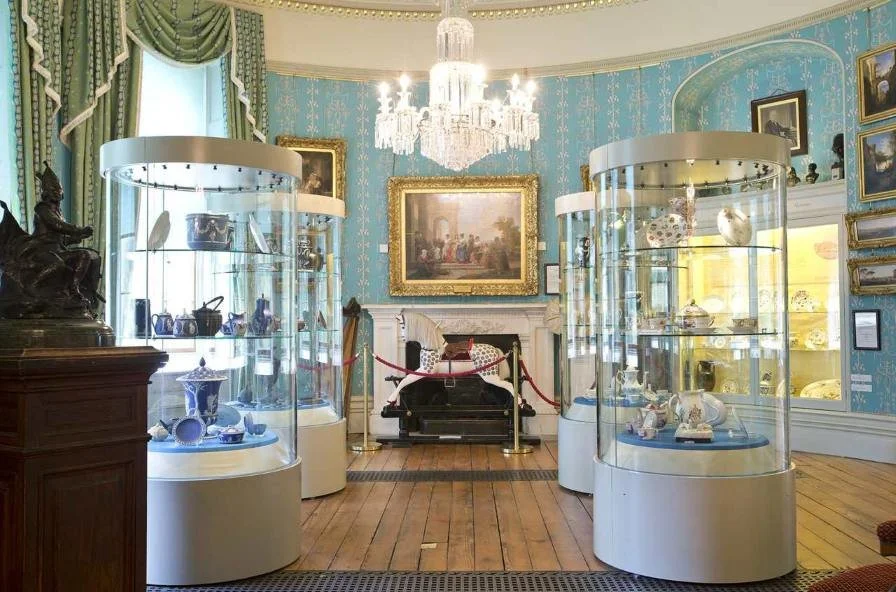
Copyright: Cyfarthfa Museum & Art Gallery
Merthyr Tydfil, located in the historic county of Glamorgan, is one of the most important towns in the story of the Industrial Revolution in Wales. During the 18th and 19th centuries it became a global centre for iron production and coal mining, earning the nickname “the Iron Capital of the World.”
Its rapid rise was driven by abundant natural resources — especially iron ore and coal — and its strategic position along the River Taff. Ironworks such as Cyfarthfa Ironworks and Dowlais Ironworks became among the largest and most productive in the world, driving major technological advances in iron and steel production.
This explosive growth brought huge social change. Workers arrived from across Wales and beyond, leading to overcrowding, harsh living conditions, and growing labour unrest. One of the most dramatic moments was the Merthyr Rising of 1831, when ironworkers rebelled against low wages and oppressive conditions — a key moment in the wider struggle for workers’ rights in Britain.
In the 20th century, heavy industry declined, but today Merthyr Tydfil has reinvented itself as a centre for heritage, culture, and outdoor adventure, combining powerful industrial history with easy access to some of the best landscapes in south Wales.
What to See & Do in Merthyr Tydfil
Culture, Heritage & History
Cyfarthfa Park & Castle – Set in 65 hectares of parkland, this grand former home of the Crawshay family reflects the enormous wealth generated by the iron industry.
Cyfarthfa Museum & Art Gallery – Built between 1824 and 1825, this is one of the town’s most important attractions. It hosts walks, talks, workshops, and exhibitions. Highlights include:
A replica of the world’s first steam locomotive
Displays on Laura Ashley and Julien MacDonald, both of whom have strong connections to Merthyr Tydfil
Joseph Parry’s Cottage – The birthplace of one of Wales’s most famous composers. This well-preserved 19th-century ironworker’s cottage offers a fascinating glimpse into everyday life during the industrial era and celebrates Parry’s musical legacy.
Redhouse – An arts and creative centre in the Old Town Hall, a magnificent Grade II listed building. Hosts exhibitions, performances, workshops, and community events.
Ynysfach Engine House – Built in 1836. Currently closed, but worth keeping an eye on. You can read more about the four-storey blast engine house here and check the website for reopening updates.
Nature, Parks & Scenic Places
Pontsticill Reservoir (Taf Fechan Reservoir) – A beautiful reservoir in the Taf Fechan Valley, famous for its dramatic bell-mouth overflow that looks like a giant plughole. A peaceful place for walks and enjoying mountain scenery.
The surrounding valleys and hills offer easy access to walking, cycling, and outdoor exploration.
Adventure & Outdoor Activities
BikePark Wales – The UK’s largest purpose-built mountain biking centre, with downhill trails, uplift service, bike hire, coaching, and an on-site café.
Rock UK Summit Centre. – Home to the largest indoor climbing wall in Wales and a major adventure activity centre. Activities include canoeing on the Taff Bargoed lakes, man-made caving systems, aerial adventure courses, and over 20 instructor-led activities.
Spread across 65 hectares of sprawling land, Cyfarthfa Park & Castle stands as a testament to the grandeur once enjoyed by the esteemed Crawshay family.
The historic Cyfarthfa Museum & Art Gallery, constructed between 1824 and 1825, offers visitors a rich tapestry of experiences with its annual lineup of captivating walks, talks, immersive workshops, and exhibitions.
Highlights include a faithful replica of the world's pioneering steam locomotive, paying homage to Merthyr Tydfil's significant role in industrial history. Additionally, visitors can delve into the lives and legacies of renowned fashion icons Laura Ashley and Julien MacDonald, both of whom have roots tracing back to Merthyr Tydfil, through engaging displays that celebrate their contributions to the world of fashion.
Optional Detour: National Botanic Garden of Wales (Dark Sky Discovery Site)
If your itinerary allows, a detour west brings you to the National Botanic Garden of Wales in Carmarthenshire.
By day, it is one of Wales’s most impressive garden landscapes, spread across 560 acres and centred around the vast Great Glasshouse. The themed gardens, meadows, and walking routes make it a rewarding and relaxing stop in its own right.
By night, it becomes something else again. As a designated Swansea Astronomical Society, the Garden regularly hosts stargazing events, including family-friendly astronomy sessions and evenings run by the Swansea Astronomical Society.
It’s an ideal place to experience how this journey works at its best: a beautiful landscape by day, and a window into the universe after dark.
Leaving the Valleys
From here, the route begins to climb and open out. Towns become fewer, roads become quieter, and the night sky becomes steadily darker.
The next stage takes you into the Brecon Beacons (Bannau Brycheiniog) — the first true dark heart of the journey, and one of the finest stargazing landscapes in the UK.
By Day: Brecon Beacons National Park (Bannau Brycheiniog)

Railways, Viewpoints & Easy Exploring
Brecon Mountain Railway – One of the most enjoyable ways to experience the landscape. Restored steam locomotives run from Pant (near Merthyr Tydfil), past Pontsticill Reservoir, and climb to Torpantau high in the Brecon Beacons. The return journey is around 9 miles / 14 km and offers wonderful views.
National Park Visitor Centre – Offers panoramic views, walking ideas, maps, and local information, plus tea rooms.
Walking Highlight
The Beacons Circuit – An 11-mile circular mountain walk taking in:
Corn Du (873m)
Pen y Fan (886m) (highest mountain in south Wales)
Cribyn (795m)
This is a classic ridge walk offering huge views, big skies, and a real sense of achievement.
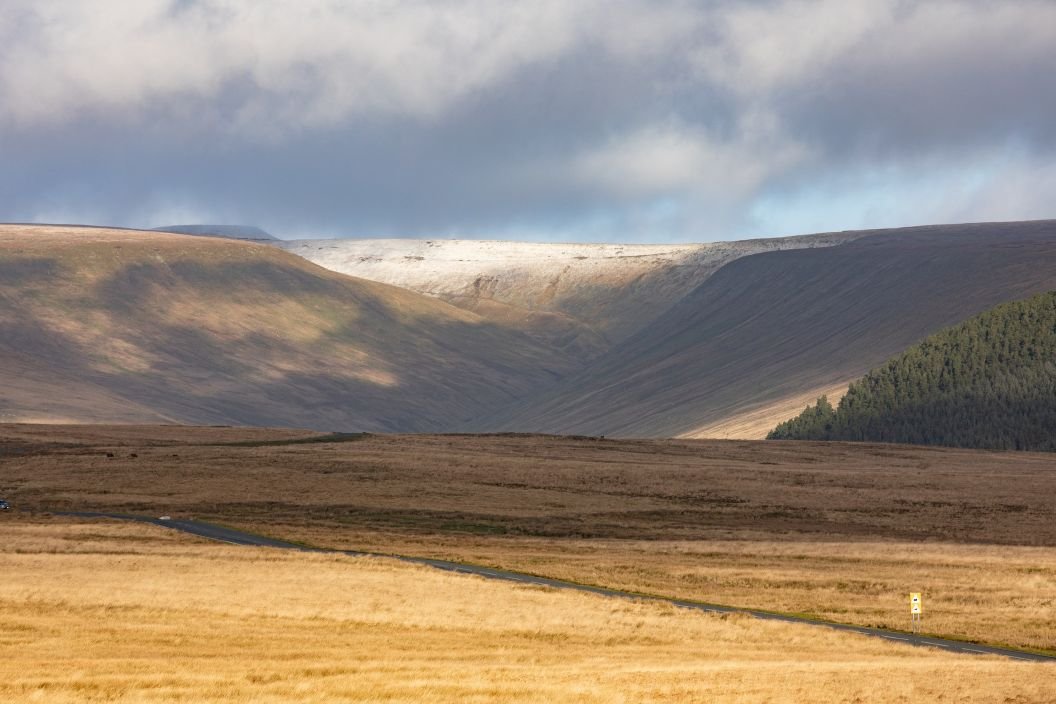
Overview
The Brecon Beacons National Park (Welsh: Bannau Brycheiniog) is one of the most beautiful and varied protected landscapes in the UK. It is a place of high mountains, open moorland, waterfalls, reservoirs, forests, and dark skies, offering some of the finest outdoor experiences in Wales.
The park is famous for its wide open spaces, dramatic scenery, and huge range of activities — from gentle walks and heritage railways to serious mountain hiking, climbing, and stargazing.
What to See & Do in the National Park
Outdoor Activities & Adventures
There are countless ways to enjoy the park, including:
Walking & hiking
Water sports such as kayaking, canoeing and sailing
Cantref Adventure Farm – Offers a variety of trekking experiences, including the half-day Brecon Beacons Explorer.
Parkwood Outdoors Dolygaer – An activity centre in the south of the park, about 15 minutes from Merthyr Tydfil, offering zip wire, caving and kayaking.
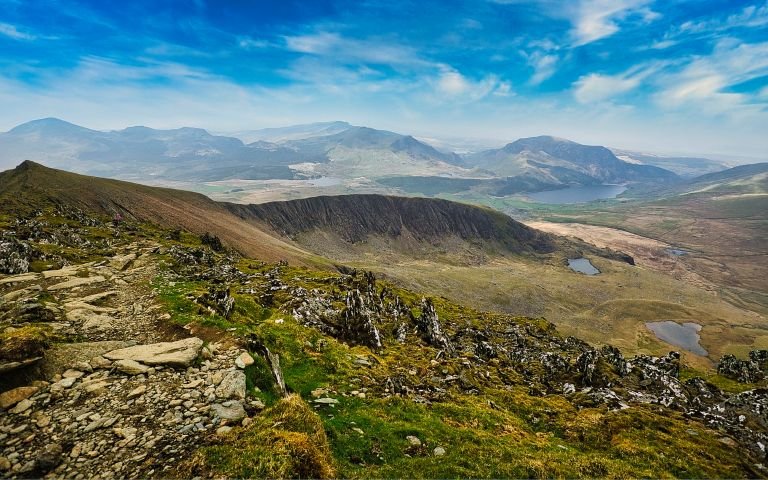
Dark Sky Reserve: Brecon Beacons National Park

The Brecon Beacons National Park (Welsh: Bannau Brycheiniog) is one of the great dark-sky landscapes of the UK. Designated an International Dark Sky Reserve in 2013, it marks a turning point in this journey — the moment when darkness stops being a bonus and becomes the main event.
This is a land of high ridges, open moorland, silent reservoirs, and long, empty horizons. By day, it’s one of Britain’s finest outdoor playgrounds. By night, it becomes something far rarer: a place where the Milky Way is often visible to the naked eye, where planets burn brightly, and where meteor showers can feel properly spectacular.
What makes the Brecon Beacons special is not just the quality of the skies, but the variety of places you can experience them: from easy-access car parks and visitor centres, to wild mountain passes and atmospheric historic ruins.
This is the first true dark heart of the route — and one of the highlights of the entire journey.
© Crown Copyright
How to Choose a Stargazing Site Here
Different nights call for different places:
Short evening / easy access / first time? Choose a reservoir or the Visitor Centre
Want big skies and real darkness? Head for the Black Mountain passes or high viewpoints
Want atmosphere and drama? Choose a castle or priory
Staying in Brecon or Merthyr? Several of these are within 25–45 minutes’ drive
The Best Stargazing Places in the Brecon Beacons
-
These are flat, accessible, and excellent for short or spontaneous nights.
Bannau Brycheiniog National Park Visitor Centre: One of the most convenient stargazing locations in the park, just off the A470. Large car park, easy access, and consistently good skies (limiting magnitude ~6.37). Ideal if you’re staying in Brecon or coming up from the Valleys.
Usk Reservoir: At the western end of the park beneath the Black Mountain range. Wide horizons, very dark skies (limiting magnitude ~6.4), and a large, flat car park perfect for telescopes. One of the best all-round sites in the Beacons.
Crai Reservoir: Quieter and a little less accessible than Usk, but still reachable by car. Dark, peaceful, and excellent for stargazing (limiting magnitude ~6.37). Lay-bys along the A4067 also offer good viewpoints.
-
These are for nights when you want space, scale, and serious skies.
Pen Rhiw Ddu (Black Mountain Pass): On the road between Llandeilo and Brynamman. High, open, and very dark (limiting magnitude ~6.31), with views out across Mid and West Wales. Excellent if approaching from the Swansea Valley side.
Hay Bluff (Gospel Pass): A spectacular hilltop viewpoint above the Wye Valley, with skies around 6.34. Feels huge and exposed in the best possible way. Pairs beautifully with a day in Hay-on-Wye before heading up into the hills at night.
-
These are places where the setting is as memorable as the sky.
Llanthony PrioryOne of the most atmospheric sites in southern Wales: a great monastic ruin in a remote valley beneath Hatterrall Hill. Very dark skies (limiting magnitude ~6.35). The priory itself is closed at night, but the car park is used for stargazing — visitors should be quiet and respectful.
Carreg Cennen Castledramatically perched on a limestone cliff near Llandeilo. Dark skies (limiting magnitude ~6.26) and a magnificent sense of place. Works brilliantly as a “castle by day, stars by night” destination.
Craig-y-nos Country Park and Craig Y Nos Castle The former home of opera singer Adelina Patti, now set in quiet, dark countryside (limiting magnitude ~6.30). A lovely combination of heritage, parkland, and night sky.
-
Llangorse Lake Easily reached from Brecon and the A40. There is some stray light from the activity centre, but skies are still good (limiting magnitude ~6.24). Works well for a relaxed, low-effort evening.
Sugar Loaf Mountain The iconic hill above Abergavenny. Slightly brighter skies (limiting magnitude ~6.10) but still offers expansive views and a good escape from town lights. Best paired with eastern Beacons / Abergavenny days.
Brecon: The Perfect Base for the Beacons
Brecon is the natural hub for exploring the central Brecon Beacons and one of the most practical places to base yourself on this journey. The town has a good range of accommodation, places to eat, and everyday facilities, making it an easy and comfortable place to pause, plan, and watch the weather before heading out into the hills after dark.
While Brecon itself is too bright for serious stargazing, several of the park’s best dark sky sites lie within an easy evening drive. From here, you can reach Usk Reservoir, Crai Reservoir, the Bannau Brycheiniog Visitor Centre (Libanus), Llangorse Lake, and Hay Bluff in around 20–40 minutes, allowing you to choose your destination based on cloud cover, wind, and how adventurous you feel.
This makes Brecon ideal for the day–night rhythm of the trip: explore waterfalls, valleys, and hills by day, enjoy dinner in town, then head out into the dark for a completely different experience.
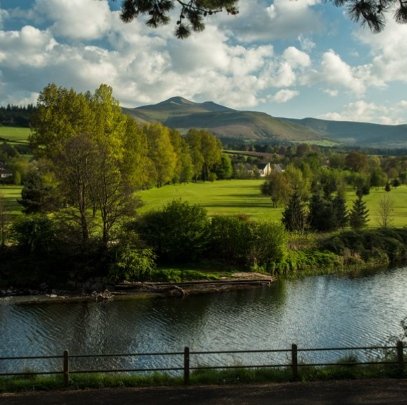
© Crown Copyright
Brecon By Day
Brecon (Welsh: Aberhonddu) is a historic market town in the heart of the national park, founded around a Roman fort (c. 75 AD) at the meeting point of the River Usk and River Honddu.
It developed into an important Norman stronghold with Brecon Castle and later grew through brewing, textiles, agriculture, and improved transport links via canal and railway.
Today, it is a lively and attractive base for exploring the Brecon Beacons.
What to See & Do in Brecon
Brecon Beacons / Bannau Brycheiniog National Park Visitor Centre – Just outside town, with walking ideas, maps and park information.
Brecon Cathedral – Founded as a priory in the 11th century, with stained glass, medieval tombs and carved woodwork. The flag carried at Rorke’s Drift can be seen here.
The Military Museum of The Royal Welsh – Covers 400 years of military history, including the Zulu conflict and both World Wars, with over 33,000 objects.
Y Gaer Museum, Art Gallery & Library– A modern cultural centre combining the former Brecknock Museum & Art Gallery with the town library.
Monmouthshire and Brecon Canal – Walk, cycle or take boat trips from the Brecon Canal Basin.
Events include:
-
Location:
Brecon sits in the heart of the Brecon Beacons / Bannau Brycheiniog National Park, at the meeting point of the River Usk and River Honddu.Getting there:
Brecon is best reached by car via the A40 and A470, which link it to Abergavenny, Builth Wells, and Merthyr Tydfil.
There is no mainline railway station in Brecon, so driving or bus travel are the most practical options.
By bus:
Regular bus services connect Brecon with surrounding towns and cities, including Abergavenny, Merthyr Tydfil, and Builth Wells.
Using Brecon as a base:
Brecon works extremely well as a base for exploring the National Park, with shops, cafés, accommodation, and easy access to both mountain and valley scenery. -
Brecon has several convenient town-centre car parks, all within easy walking distance of the main sights, shops, and the canal basin.
Good options include:
Brecon Canal Basin car park – Ideal for visiting the Monmouthshire and Brecon Canal, canal walks, and the town centre.
Town centre car parks – There are multiple public car parks around the shopping streets, cathedral area, and market area, all well signposted on arrival.
Brecon Beacons Visitor Centre – Has its own on-site parking if you are visiting the centre and starting walks from there.
Tips:
If you plan to explore the town centre, cathedral, museums, and canal, use one of the central car parks and walk between sites.
If your focus is walking in the National Park, consider parking at the Visitor Centre or at specific trailhead car parks outside the town.
-
Brecon (Welsh: Aberhonddu) began life as a Roman settlement, built around a fort established around 75 AD to control routes through this part of Wales. The Romans chose the site because it sits at the strategic meeting point of the River Usk and the River Honddu, a natural crossroads for movement through the region.
After the Norman conquest, the town became an important border stronghold. Brecon Castle was built in the late 11th century to secure control of the area, and the town developed around it as a military, administrative, and trading centre. During the medieval period, Brecon grew into a significant market town serving the surrounding upland farming communities.
In the 18th and 19th centuries, Brecon’s role shifted again. Although it was never an industrial giant like Merthyr Tydfil, it became an important market, administrative, and transport hub, helped by the arrival of the canal and later the railway, which connected it to the wider Welsh and English economy.
Today, Brecon’s streets, cathedral, and mix of historic buildings reflect these many layers of history — from Roman frontier town, to Norman stronghold, to Georgian and Victorian market centre — making it one of the most characterful towns in the Brecon Beacons.
-
This gentle walking route introduces you to Brecon’s historic heart, cathedral, rivers, and canal, and works perfectly as a relaxed half-day activity.
1) Start: Brecon Cathedral
Begin at Brecon Cathedral, one of the town’s most important historic buildings. Take time to explore the interior, including the medieval tombs, stained glass, and the famous flag carried at Rorke’s Drift.
From here, walk down towards the town centre.
2) The Historic Town Centre & Market Area
Stroll through the town centre streets, taking in the mix of Georgian and Victorian buildings, small shops, cafés, and market spaces. This is the historic commercial heart of Brecon and still feels very much like a traditional market town.
If you wish, make a short detour to:
Y Gaer Museum, Art Gallery & Library – For a quick cultural stop
Or continue towards the canal
3) Monmouthshire & Brecon Canal Basin
Head to the Brecon Canal Basin, where the Monmouthshire and Brecon Canal ends. This is a peaceful and scenic area with narrowboats, towpaths, and waterside views.
You can walk a short stretch of the canal towpath, which is flat and very easy going, before looping back towards the river.
4) Riverside Walk Along the River Usk
From the canal area, pick up riverside paths along the River Usk. This is a lovely, quiet section of the walk, with open views and a strong sense of Brecon’s natural setting within the National Park.
Follow the riverside path back towards the cathedral area.
5) Finish: Back Near the Cathedral or Town Centre
The route naturally loops back towards the cathedral and town centre, where you’ll find plenty of cafés, pubs, and places for lunch or tea.
Practical Notes
Distance: Short and flexible — easily adjusted to suit your time and energy
Difficulty: Easy, mostly flat
Surface: Pavements, riverside paths, canal towpath
Best for: First-time visitors, gentle exploration, combining history and scenery
Optional Detour: Llanthony Priory — A Night Worth the Miles
Llanthony Priory is not on the direct line of travel — and that is exactly why it is so special.
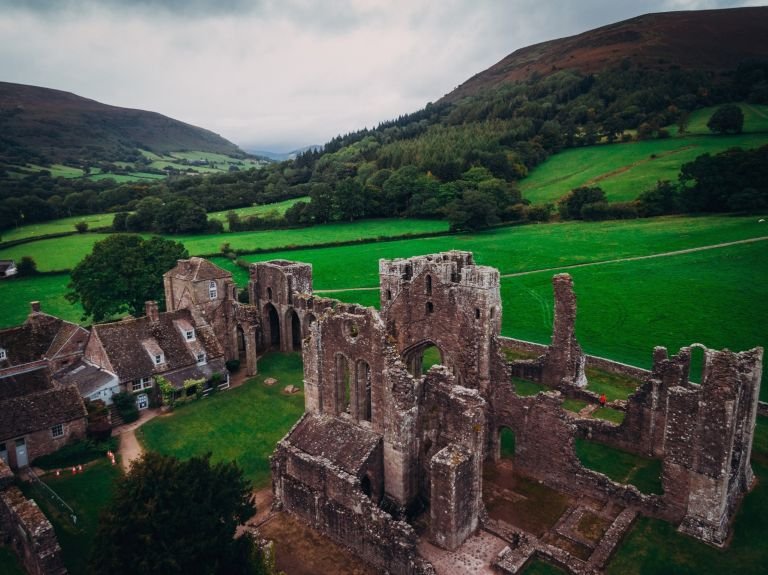
Hidden deep in the remote Vale of Ewyas in the Black Mountains, this haunting monastic ruin sits in one of the quietest and darkest corners of southern Wales. Reaching it requires a deliberate detour and a little commitment, but on a clear night, few places on this route offer a more memorable combination of history, landscape, and sky.
By day, Llanthony is one of the most atmospheric medieval ruins in Wales. By night, far from towns and major roads, it becomes a place of near-total silence, where the surrounding hills block distant light and the stars feel unusually close.
This is not a casual, last-minute outing — it’s best saved for a calm, clear evening when you want to turn stargazing into a true experience rather than just a stop.
⚠️ Important: Visiting Llanthony Priory adds significant extra mileage, especially if you return to Brecon afterwards. It’s a destination to choose deliberately, not to squeeze in.
Llanthony Priory, lies in the remote Vale of Ewyas in the Black Mountains and is one of the most atmospheric monastic ruins in Wales. Founded in the 12th century by Augustinian monks under Walter de Lacy, it grew from a small religious cell into one of the wealthiest monastic houses in Wales.
Its isolated setting among mountains and open countryside is a huge part of its appeal.
What You’ll See
Visitors can explore the evocative ruins of:
The church
Cloister
Chapter house
Domestic buildings
Stars (hopefully, subject to weather and time of day!)
The site is especially popular with walkers, photographers, and history lovers.
© Crown Copyright
-
Llanthony Priory was founded in the early 12th century by Augustinian monks, under the patronage of the Norman nobleman Walter de Lacy. Its location, deep in the remote Vale of Ewyas in the Black Mountains, was chosen for its isolation and spiritual atmosphere, but this same remoteness would also shape its turbulent history.
Originally established as a small religious community, the priory grew in wealth and importance over time and eventually became one of the more significant monastic houses in this part of Wales. However, its position close to the Welsh Marches made it vulnerable to border conflicts and raids, and the community suffered repeated attacks during periods of unrest.
Because of these difficulties, the monks at one point even abandoned the site temporarily and focused their efforts on a daughter house in Gloucester, before later returning to Llanthony.
Despite these setbacks, the priory continued to function for several centuries as a place of worship, learning, and administration, with monks engaged in prayer, study, and the management of surrounding lands.
Like many religious houses, Llanthony Priory was finally dissolved in the 16th century during the Dissolution of the Monasteries under Henry VIII. After that, the buildings fell into ruin, gradually becoming the atmospheric remains we see today.
Today, the priory is valued not only for its historical importance, but also for its extraordinary setting, which gives a powerful sense of the isolation, beauty, and hardship that shaped monastic life in medieval Wales.
-
Location:
Llanthony Priory is located in the Vale of Ewyas in the Black Mountains, on the western edge of the Brecon Beacons National Park.Important route note:
Visiting Llanthony Priory is a significant detour from the main route. If you plan to return to Brecon afterwards to continue your journey, allow for approximately an extra 55 miles of driving.Getting there:
The priory is best reached by car via narrow, scenic mountain roads.
The approach roads are steep and winding in places and form part of the experience, but take your time, especially in poor weather.
Parking:
There is parking near the priory ruins, from which it is a short walk to the site.
Access:
The site is in a remote rural setting.
Paths and ground around the ruins can be uneven and muddy, so good footwear is recommended.
Visiting time:
Allow at least 1 hour to explore the ruins, and longer if combining it with walking in the surrounding valley.
Wales Stargazing: Dark Skies Last updated: 21 January 2026
Some links may earn Uncover Britain a small commission at no extra cost to you. This helps support the ongoing creation, review and presentation of our road trip guides.
Route information and listings are provided for general guidance only. Always use your preferred navigation system and check official websites to confirm suitability, opening times and the latest details before travelling.
Our guides are reviewed regularly and supported by a mix of editorial research and digital tools to help keep content clear and up to date. If you spot anything that needs updating, we’re always glad to hear from you.