Viewing as a member

Stargazing in Wales

Introduction — Wales After Dark
A Journey Through Landscape, History and the Night Sky
Wales is a land of contrasting landscapes: deep, industrial valleys once ignited by coal and iron; vast upland plateaus where silence feels physical; and towering mountains where weather and light are constantly changing. Each of these landscapes offers extraordinary experiences by day, but when night falls they reveal another dimension entirely — skies of surprising clarity and depth, where stars, planets and the Milky Way become vibrant parts of the landscape.
This guide is not simply a list of places to look at the night sky. It is a 213 miles (343 km) journey through Wales itself, organised around how the land changes from south to north, and how darkness becomes an integral part of each place you visit. Travelling through this route you will feel the shift from the sounds of valleys and towns, to the quiet of upland roads, and finally to the expansive silence of high mountains and wide horizons.
Each of the three major sections — the Valleys & Brecon, Mid Wales, and North Wales — forms its own kind of dark-sky experience, connected by dramatic geography, heritage and a sense of scale that deepens as you travel.
Section 1 — Valleys & Brecon: From Industry to the First Dark Heart
41 miles (66 km) with drive time approx. 2 hours
Rhondda Cynon Taf > Merthyr Tydfill > Brecon Beacons National Park > Brecon
Your journey begins in the Valleys of South Wales, landscapes shaped by centuries of industrial activity and community life. The skies here were once obscured by both smoke and settlement, but as you move away from the towns you begin to sense how darkness is returning to the uplands. In Rhondda Cynon Taf, accessible hilltops and parkland clearings provide your first taste of dark skies and quiet horizons.
From there the route leads to Merthyr Tydfil, once one of the world’s most important industrial towns and now a gateway to the Brecon Beacons National Park. As the terrain rises, the sky opens. The Brecon Beacons hold one of the UK’s first Dark Sky Reserves, and from high ridges and reservoir shores you can watch the stars wheel over mountain silhouettes. Brecon itself makes a practical base here, with easy access to a network of night-sky spots and a rich day-time programme of landscapes, heritage and outdoor adventure.
Section 2 — Mid Wales: Into the Wild Heart
(From Brecon) 49 miles (79 km) with drive time approx. 2 hours
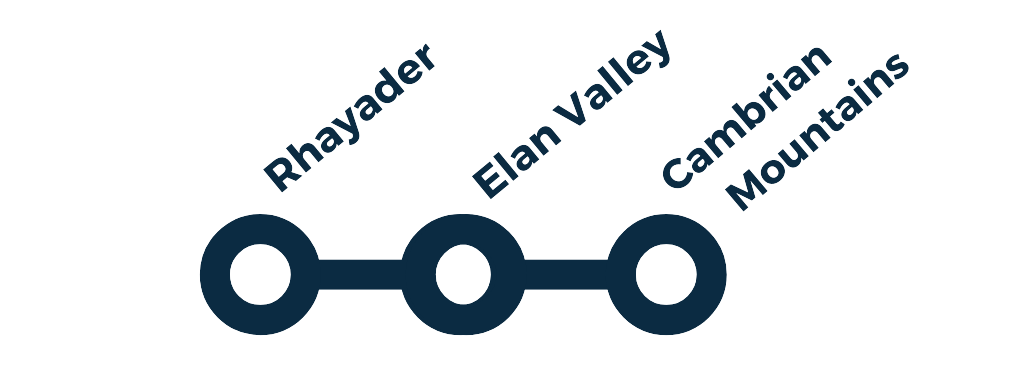
Rhayader > Elan Valley > Cambrian Mountains
Leaving the Brecon Beacons behind, the journey slips into Mid Wales — a region defined by wide horizons, remote uplands and long, quiet roads. Rhayader sits at the southern edge of this wild country, a welcoming town nestled beside rivers and forests and perfectly placed for exploring deep into the hills. The famous Elan Valley Estate unfolds from here: a sweeping, engineered landscape of dams and reservoirs where Victorian ambition meets remoteness — and where the first true darkness of the route begins to take hold.
The Cambrian Mountains rise beyond, one of Britain’s least populated and most atmospheric upland areas. Here the night sky is seldom interrupted by artificial light, and nine designated Discovery Sites form the Cambrian Mountains Astro Trail. From open plateaus to moorland ridges and quiet woodland edges, this is a place to slow down, stretch your journey over multiple nights, and let the night sky become the primary landscape.
Section 3 — North Wales: Mountains, Forests and Final Horizons
(From Cambrians) 126 miles (202 km) with drive time approx. 4 hours
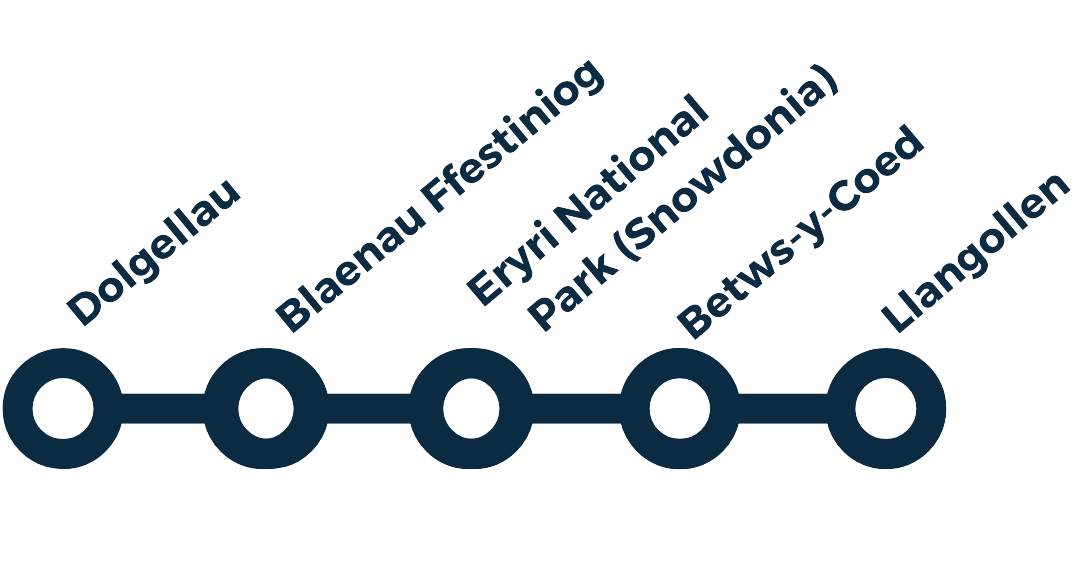
Dolgellau > Blaenau Ffestiniog > Snowdon > Betws-y-Coed > Llangollen
The final stage of the guide rises into the high, dramatic landscapes of North Wales. In Dolgellau you are greeted by the broad valley and the great bulk of Cadair Idris, where powerful day-time walks give way to dark skies filling with stars. Blaenau Ffestiniog brings a contrasting industrial mountain landscape, carved by slate and now a remarkable setting for both heritage and night-sky watching.
At the heart of this region is Yr Wyddfa (Snowdon), the highest peak in Wales. By night the mountain becomes a profound silhouette against the heavens, and nearby high passes and lakes offer some of the most dramatic star-filled vistas in the country. Betws-y-Coed introduces water, woodland and rivers to the mix, where reflective lakes and quiet forest clearings become prime places for calm, intimate night-sky experiences.
Finally the route broadens again around Llangollen and the Dee Valley. Here you can blend cultural history, canalside walks, and engineering marvels with the open skies of the Clwydian Range and Dee Valley AONB, bringing the journey to a thoughtful close under some of the last wide horizons in Wales.
How to Use This Guide
Each section has been structured with both day-time landscapes and night-time dark-sky experiences in mind. Use it to:
Explore the land by day — its history, geology, trails, towns and valleys
Discover how the night changes the same landscapes into an entirely different world
Choose night-sky spots based on weather, terrain and time available
Combine broader road travel with focused stargazing sessions
Across Wales the night sky is a companion to the journey — at times subtle, at times spectacular, but always reminding you that the land you see by day continues in silence above and around you after dark.
Or copy and paste https://bit.ly/Stars-Route
Valleys & Brecon: Rhondda Cynon Taf > Merthy Tydfil > Brecon Beacons National Park > Brecon
Mid Wales: Rhayader > Elan Valley > Cambrian Mountains
North Wales: Dolgellau > Blaenau Fffestiniog > Snowdon > Betws-y-Coed > Llangollen
-
![1. Valleys and Brecon]()
Valleys & Brecon
41 miles (66 km) with drive time approx. 2 hours
-
![Mid Wales]()
Mid Wales
(From Brecon) 49 miles (79 km) with drive time approx. 2 hours
-
![North Wales]()
North Wales
(From Cambrians) 126 miles (202 km) with drive time approx. 4 hours

Useful information
-
How Long Do You Need?
This is a flexible journey designed to work at different speeds.
Long weekend (3–4 days): Focus on one region or chapter of the route
One week: A balanced journey covering several contrasting landscapes
10–14 days: A slow, immersive experience with time for walking, weather, and multiple stargazing nights
Because stargazing depends on conditions, this is a trip that rewards allowing spare evenings and alternative plans rather than rushing from place to place.
-
This road trip begins in South Wales and travels northwards.
By Car
If you’re travelling by car, South Wales is easy to reach from:
London & the South East: via the M4
Midlands: via the M50 / A40 or M4 / M5
South West England: via the M4 or Severn crossings
Most travellers will find it easiest to begin somewhere in the South Wales Valleys or the southern edge of the Brecon Beacons, depending on where they are coming from.
By Train
If you’re arriving by train, good gateway stations include:
Cardiff Central – the main rail hub for South Wales, with fast services from London, Bristol, Birmingham and beyond
Newport – another major interchange on the South Wales main line
From here, you can either:
Pick up a hire car, or
Use local rail and bus connections to reach the first part of the journey (though a car is strongly recommended for the full route).
By Air
The most convenient airports for this trip are:
Cardiff Airport – for South Wales and the start of the journey
Bristol Airport – often more international flights, about 1–1.5 hours from South Wales
Birmingham Airport – a good option if approaching from the Midlands or overseas
From any of these, hiring a car is the most practical option.
-
For most travellers: yes.
While some individual places on this journey are accessible by public transport, many of the best dark-sky locations are not. They lie in:
Upland areas
Mountain parks
Reservoir landscapes
Remote valleys and forest roads
To reach them safely, flexibly, and at night, a car is strongly recommended.
-
The best stargazing season in Wales is:
September to March – longer nights, darker skies
October, November, February and March are often ideal compromises between darkness and weather
Summer is still beautiful, but:
Nights are short
True darkness is limited, especially in June and July
-
Much of this route passes through:
Mountain roads
Upland passes
Narrow rural lanes
You should expect:
Very dark roads
Occasional wildlife (sheep, deer)
Little or no mobile signal in places
Driving carefully and unhurriedly is part of the experience.
-
This is a trip that works best if you:
Stay 1–3 nights in each region, rather than moving every day
Choose accommodation slightly outside towns or villages where skies are darker
Mix day exploration with night-sky evenings
The full guide includes suggestions on how to base yourself for the best balance of comfort and darkness.
-
At minimum:
Warm clothing (even in summer)
Torch or headlamp (red light is ideal)
Thermos or hot drink for longer nights
A basic stargazing app (optional, but useful)
No telescope is required — many of the best experiences are naked-eye.
How Long to Spend - Itinerary Suggestions
-
Option A: Brecon Beacons Dark Skies (3–4 days)
Base: Brecon
Day 1 – Brecon & Talybont Reservoir
Arrive in Brecon. Visit Brecon Cathedral and take a short walk along the canal or around Talybont Reservoir.
By night: Stargazing at Talybont Reservoir or Usk Reservoir.Day 2 – Waterfalls & Central Beacons
Day trip to waterfalls or a gentle ridge walk.
By night: Stargazing at Bannau Brycheiniog Visitor Centre or Llangorse Lake.Day 3 – Western Beacons / Black Mountain
Scenic drive towards Craig y Nos or Pen Rhiw Ddu.
By night: Stargazing at Pen Rhiw Ddu or Carreg Cennen.Optional Day 4: Detour to Llanthony Priory (day) and stargazing from its valley.
Option B: Elan Valley & Cambrian Mountains (3–4 days)
Base: Rhayader
Day 1 – Rhayader & Elan Valley
Red Kite Feeding Station and scenic drive around the dams.
By night: Stargazing at Claerwen Dam or Craig Goch Dam.Day 2 – Elan Valley & Mountain Roads
Drive the Claerwen Mountain Road loop. Walks around the reservoirs.
By night: Stargazing at Cwmdauddwr Common or Pont ar Elan.Day 3 – Cambrian Mountains
Visit Cwmystwyth or Strata Florida.
By night: Stargazing at Y Star Inn (Dylife) or Y Bwa (Cwmystwyth). -
Day 1 – Brecon
Brecon town, canal, Cathedral.
Night: Talybont ReservoirDay 2 – Central Beacons
Waterfalls / Llangorse Lake / Black Mountain.
Night: Usk Reservoir or Pen Rhiw DduDay 3 – Drive to Rhayader via Elan Valley
Full Elan Valley dam circuit.
Night: Claerwen Dam or Craig GochDay 4 – Cambrian Mountains
Cwmystwyth mines or Strata Florida.
Night: Y Star Inn (Dylife) or Pont ar ElanOptional Day 5: Extra night in Mid Wales for weather flexibility.
-
Days 1–2 – Brecon Beacons (Base: Brecon)
Day: Brecon, Waterfalls, Black Mountain, Llangorse
Nights: Talybont, Usk Reservoir, or Pen Rhiw Ddu
Days 3–4 – Elan Valley & Cambrian Mountains (Base: Rhayader)
Day: Elan dams, Claerwen Road, Strata Florida, Cwmystwyth
Nights: Claerwen Dam, Craig Goch, Y Star Inn
Days 5–6 – Snowdonia South & Central (Base: Dolgellau / Trawsfynydd)
Day: Dolgellau, Coed y Brenin, Cadair Idris
Nights: Bwlch y Groes, Trawsfynydd Lake, Coed y Brenin
Day 7 – Llangollen & Clwydian Range
Day: Pontcysyllte Aqueduct, Llangollen
Night: Moel Famau or nearby Clwydian hills
-
Days 1–3 – Brecon Beacons (Brecon base)
Nights at: Talybont, Usk Reservoir, Pen Rhiw Ddu / Llanthony
Days 4–6 – Elan Valley & Cambrian Mountains (Rhayader base)
Nights at: Claerwen Dam, Craig Goch, Y Star Inn / Cwmystwyth
Days 7–9 – Snowdonia / Eryri (Dolgellau or Betws-y-Coed base)
Day: Cadair Idris, Coed y Brenin, Blaenau Ffestiniog, Llanberis
Nights at: Bwlch y Groes, Trawsfynydd Lake, Pen-y-Pass / Llyn y Dywarchen
Day 10 – Llangollen & Clwydian Range
Day: Pontcysyllte, Dee Valley
Night: Moel Famau or Clwydian hills
About Stargazing
-
An International Dark Sky Reserve is a designated area recognised by the International Dark-Sky Association (IDA) for its exceptional quality of night sky and commitment to preserving darkness for astronomical observation and the enjoyment of natural darkness. These reserves are typically located in remote or sparsely populated areas with minimal light pollution, making them ideal for stargazing and astrophotography.
To earn the designation, a Dark Sky Reserve must meet stringent criteria set by the IDA, including implementing lighting ordinances to minimise light pollution, raising public awareness about the importance of dark skies, and promoting responsible outdoor lighting practices. These reserves often encompass large tracts of land, including national parks, nature reserves, and other protected areas.
International Dark Sky Reserves are not only valuable for scientific research and astronomy but also contribute to environmental conservation efforts by preserving natural habitats and ecosystems that rely on darkness for their ecological balance. Additionally, they provide opportunities for tourism, education, and recreation centred around the appreciation of the night sky and the beauty of the cosmos.
-
Dark Sky Parks and Dark Sky Reserves are two types of designation, awarded by the International Dark-Sky Association. The awards officially recognise certain locations and areas to be so naturally dark at night and have no light pollution to affect star viewing. This means the Parks and Reserves are officially the best places in the world to stargaze.
The difference between a dark sky park and a dark sky reserve is that a dark sky park is on public lands, that are typically uninhabited and that can be of any size. A dark sky reserve is centred around a core dark sky area, on either private or public land, and the reserves benefit from specific requirements for protecting the “core” from light pollution.
A Dark Sky Discovery Site is a location certified by the Dark Sky Discovery initiative, aimed at promoting stargazing and appreciation of the night sky. These sites are chosen for their minimal light pollution and excellent visibility of the stars, making them ideal for observing astronomical phenomena such as stars, planets, and meteor showers. They often have designated facilities or amenities to enhance the stargazing experience, such as observation platforms, information boards, or guided tours.
The Dark Sky Discovery Sites include The Cambrian Mountains, the National Botanic Garden of Wales, Stackpole Estate, Pembrokeshire, Rhondda Cynon Taf, South Wales and the Clwydian Range.
-
The UK has some of the largest areas of dark sky in Europe. It’s possible to see around 100 stars in your own back garden, subject to light conditions, however, how about immersing yourself under a dark sky with over one thousand stars? How about spotting the Milky Way – our very own galaxy – across the night sky? If you’ve never seen the full brightness of the Milky Way, take a closer look at the Dark Sky options below and choose the best spot for you. Choose from wild forests to national parks, grab your binoculars and your night vision for the 'night show' at a stargazer’s paradise!
The UK now has more certified international dark-sky places (DSP) than any other country outside the USA. The UK has three Dark-Sky Parks; Northumberland National Park, Elan Valley Estate (Wales) and Galloway Forest Park (Scotland) and a handful of Dark-Sky Reserves, including Brecon Beacons National Park, Exmoor National Park, Snowdonia National Park and the South Down National Park. Plus there are several Dark Sky Discovery Sites.Six UK National Parks – Exmoor, Brecon Beacons, Moore’s Reserve in the South Downs, Snowdonia, North York Moors and Yorkshire Dales have been awarded International Dark Sky Reserve status. Northumberland, with England’s most pristine dark skies, is an International Dark Sky Park (Gold Tier). Every year, these National Parks celebrate the amazing night sky with Dark Skies Festivals and stargazing opportunities galore. They’re fun events for all the family and one of the highlights of the calendar year.
-
- View an hour and a half after sunset – when the sky is properly dark. Sunset times vary around the country and around the year– you can check local sunset times See: Sunrise Sun Set Map.
- Moonlight can make it difficult to see the stars as the moonlight can produce too much of its own light. Use a moon calendar to see when the best time is, avoiding full moon, for example. See the Sunrise Sun Set Map.
- Wrap up warm as it’s colder when the sky is clearer, without a layer of insulating cloud!
- Grab a star chart – check out Dark Sky Discovery to show you where to start.
- You can use just your naked eyes, however if you’re ready for the next step, a pair of binoculars or a telescope would be perfect for viewing. A specialist shop can provide advice on what is most suitable for you.
- Invest in a red torch if you want to use light to see which would not affect your night-time vision as much as a standard torch could do.
- Be patient – it can take up to 10 minutes for your eyes to fully adjust to the dark. -
Websites and Apps for Stargazing
Websites for Stargazing
Sky & Telescope Offers star charts, guides to observing celestial events, and educational articles on astronomy.
Stellarium Web A free, browser-based planetarium that shows the sky in real-time based on your location.
Heavens-Above Tracks satellites, the ISS, and offers detailed star maps and astronomy resources.
Time and Date – Night Sky Provides custom night-sky maps, information about celestial events, and visibility guides.
Dark Site Finder Helps locate dark-sky areas for optimal stargazing.
Astronomy.com Features news, tips, and interactive tools for skywatching enthusiasts.
Apps for Stargazing
Star Map Apps
SkySafari (iOS/Android) Advanced star map and telescope control. Great for serious astronomers.
Star Walk 2 (iOS/Android) Interactive guide to the night sky with beautiful visuals and AR features.
Stellarium Mobile (iOS/Android) A mobile version of Stellarium Web with detailed star maps and constellation views.
Night Sky (iOS) AR-powered app that identifies celestial objects by simply pointing your device.
SkyView (iOS/Android) User-friendly with real-time tracking of stars, planets, and satellites.
Event Tracking Apps
ISS Detector (iOS/Android) Tracks the International Space Station and other satellites.
Solar Walk 2 (iOS/Android) Focuses on our solar system with a 3D model and planet tracking.
Sky Tonight (iOS/Android) Provides daily highlights of celestial events and night-sky guides.
Planning Tools
Clear Outside (iOS/Android) Predicts stargazing conditions with cloud cover, visibility, and light-pollution data.
Light Pollution Map (iOS/Android) Helps find the darkest skies for stargazing by showing light-pollution levels worldwide.
Starry Night (iOS/Android) Combines a detailed planetarium experience with observing guides.
Wales Stargazing: Dark Skies Last updated: 21 January 2026
Some links may earn Uncover Britain a small commission at no extra cost to you. This helps support the ongoing creation, review and presentation of our road trip guides.
Route information and listings are provided for general guidance only. Always use your preferred navigation system and check official websites to confirm suitability, opening times and the latest details before travelling.
Our guides are reviewed regularly and supported by a mix of editorial research and digital tools to help keep content clear and up to date. If you spot anything that needs updating, we’re always glad to hear from you.