Viewing as a member

Scottish Heritage Golf

Protected by Copyscape
FIFE WEATHER

192 miles (308 km) with drive time of approx. 6 hours

Continuing to Dalmahoy Golf Club: 224 miles (360km) with a drive time of 7 hours

Customisable route: https://bit.ly/Scottish-Golf-Route

This Scottish Heritage Golf Trail combines the history and heritage of Scottish golf and combines it with a spectacular backdrop of the East Lothian coast, the Kingdom of Fife, and Perth with Kinross.

Follow in the footsteps of James Braid and Old Tom Morris, with world-famous courses, those that have played have played a key part in the history of golf, and some hidden gems along the way.

Powered by GetYourGuide
Time in Fife:
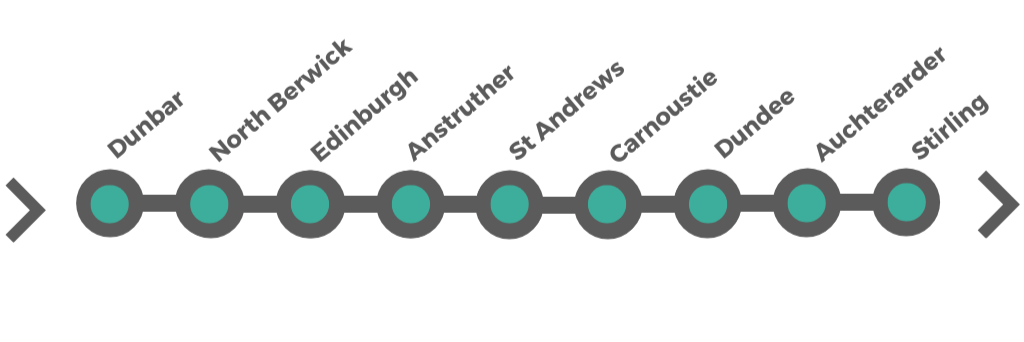
Stylised route stops showing Dunbar, North Berwick, Edinburgh, Anstruther, St Andrews, Carnoustie, Dundee, Auchterarder, Stirling.

About this route

This route begins east of Edinburgh and heads up north, following the East Lothian coast, Fife and Perth with Kinross.

The route is 226 miles (364 km) with a drivetime of around 7 hours, and 45 minutes, with the option to stop at 9 destinations to combine a golf road trip with some great visitor attractions along the way. Includes options for 10 golf clubs.

Dunbar > North Berwick > Edinburgh > Anstruther > St. Andrews > Carnoustie > Dundee > Auchterarder > Stirling

Getting to Dunbar from UK Hubs

The historic seaside town of Dunbar, in East Lothian, is the suggested starting point for this road trip. Here’s how to get there:

    • From Edinburgh (30 miles): Drive southeast on the A1, a scenic and fast route.

    • From London (370 miles): Follow the M1, A1(M), and A1 directly to Dunbar.

    • From Newcastle (70 miles): Drive north on the A1.

    • For parking options in Dunbar, visit here. For Eat Lothian Park & Ride options, visit here.

  • Dunbar railway station is on the East Coast Main Line, offering direct connections:

    • From London King’s Cross: Direct trains take approximately 4-5 hours.

    • From Edinburgh: Frequent services, around 20-30 minutes.

    • From Newcastle: Direct trains take about 1-1.5 hours.

    • From Glasgow: Travel via Edinburgh (2 hours total).

    • From Birmingham and Manchester: Take trains via Edinburgh or York, with total travel times of 4-6 hours.

  • Long-distance buses may not go directly to Dunbar but can connect via Edinburgh or other nearby towns:

    • From Edinburgh: Lothian Country or East Coast Buses provide regular services.

    • From Newcastle: Connect through Berwick-upon-Tweed or Edinburgh for local buses.

  • The nearest airport to Dunbar is Edinburgh Airport (EDI):

    • From Edinburgh Airport to Dunbar:

      • By car: 1-hour drive via the A1.

      • By public transport: Take a tram or bus to Edinburgh city centre, then a train to Dunbar.

    • Other nearby airports: Glasgow Airport (GLA) and Newcastle Airport (NCL), both about 2-2.5 hours away.

  • International visitors can fly into Edinburgh Airport (EDI), the closest major hub:

    • From Europe: Direct flights from cities like Amsterdam, Paris, Frankfurt, and Dublin.

    • From North America: Direct flights from New York, Toronto, and Chicago.

    • From Asia or Australasia: Layovers in London, Amsterdam, or Dubai.

    By Train (via London)

    International travellers arriving in London (Eurostar from Paris, Brussels, or Amsterdam) can take a train to Dunbar via the East Coast Main Line.

    By Ferry and Road

    Ferries connect ports in Northern Europe (e.g., Amsterdam, Rotterdam) to Newcastle or Hull. Drive north on the A1 to Dunbar

James Braid

James Braid, was one of Scotland’s greatest golfers, famed for winning the prestigious Open Championship five times and founder of the Professional Golfers' Association.

Retiring from competitive golf in 1912, he focused on golf course architecture. His legacy now lives on in more than 250 courses he designed and remodelled.

Baird was born in the Kingdom of Fife, learning to play golf from an early age at the nearby Elie Golf Club. The current layout at Elie Golf Club is attributed to Old Tom Morris, in 1895. Braid was born in the adjacent village of Earlsferry in 1870.

Braid was the first to suggest that the shorter the hole, the smaller the green, which is now accepted as standard practice. He designed many of the country's most famous courses. His work was characterised by its strategic design, which often featured challenging holes that required players to think their way around the course.

The Association of James Braid Courses: members of clubs within the Association of James Braid, can play at all the other member clubs for reduced green fees, subject to tee availability.

Some of the most famous James Braid golf courses in Scotland are included as highlights in this route:

It is both necessary and desirable that the holes should be laid out as suggested by the lie of the land, every natural obstacle being taken care of. There should be a complete variety of holes ... not just length, but in their character ... the way in which they are bunkered ... the kind of shot that is required ... the kind of approach and so forth. The greens should be well guarded.
— James Braid

Old Tom Morris

Old Tom Morris was a Scottish golfer, widely regarded as the "Father of Modern Golf". He was born in St Andrews, Scotland in 1821, and died there in 1908 at the age of 86.

Morris was a pioneer in the development of golf equipment and course design. He is credited with inventing the modern golf ball, and he was also one of the first golfers to design and build his own clubs.

Morris was also a prolific tournament golfer. He won the Open Championship four times, and he was runner-up on several other occasions. He also won the British Amateur Championship six times.

Morris was a popular figure in the golf world. He was known for his sense of humour and his love of the game. He was also a skilled teacher, and he helped to spread the game of golf to new generations of players.

Some of the most famous Old Tom Morris golf courses in Scotland are included as highlights in this route:

We were all born with webbed feet and a golf club in our hand.
— Old Tom Morris

The Fife Coastal Path along the East Neuk

Running for 116 miles around the Fife coastline, the Fife Coastal Path is the quiet thread that links St Andrews, Crail, Anstruther and Pittenweem together. You don’t need to “walk the path” in any formal sense to benefit from it. In this part of Fife, it simply provides a series of short, easy, memorable stretches that help you understand how the coastline and villages connect.

Throughout this section of the guide, you’ll see suggestions for dipping into the path for 20–60 minutes at a time. These aren’t hikes — they’re short coastal wanderings that add atmosphere, views and breathing space between harbour stops, cafés and historic sights.

Below is where the path is most rewarding to use as you travel this route.

St Andrews — Cliffs, dunes and big sea views

  • Best stretch: East Sands heading south along the cliffs

  • Character: Open views, dramatic coastline, dunes and skyline views back to town

  • Ideal for: A 30–45 minute out-and-back before leaving St Andrews

This is where the coastline first feels expansive and sets the tone for what follows.

Crail — Harbour to Roome Bay

  • Best stretch: Crail Harbour to Roome Bay

  • Character: Clifftops, wildflowers, seabirds and views back to the village

  • Ideal for: A gentle pre- or post-coffee harbour walk

This is one of the prettiest, most photogenic short sections of the whole route.

Anstruther → Pittenweem — Working shoreline

  • Best stretch: Anstruther → Cellardyke → Pittenweem

  • Character: Fishing cottages, boats, nets, real harbour life

  • Ideal for: A one-way shoreline walk between villages

This is where you understand the East Neuk as a connected coastal community rather than separate stops.

Pittenweem — Shoreline, rocks and harbour edges

  • Best stretch: Either direction from the harbour along the rocks

  • Character: Rocky shoreline, small caves, sea textures

  • Ideal for: A short exploratory wander rather than a set walk

This section feels rugged and close to the water.

Kellie Castle — Woodland contrast

  • Estate paths and woodland walks rather than coastal scenery

  • A deliberate shift in landscape after the shoreline villages

This change of setting rounds off the day and shows a different side of Fife.

Scottish Heritage Golf Last updated: 07 January 2026

Some links may earn Uncover Britain a small commission at no extra cost to you. This helps support the ongoing creation, review and presentation of our road trip guides.

Route information and listings are provided for general guidance only. Always use your preferred navigation system and check official websites to confirm suitability, opening times and the latest details before travelling.

Our guides are reviewed regularly and supported by a mix of editorial research and digital tools to help keep content clear and up to date. If you spot anything that needs updating, we’re always glad to hear from you.

Get in touch here.